
Essays · Photography
Adam Fuss. My Ghost.
The most fragile things leave the clearest marks.
Fraenkel Gallery · Fraenkel Gallery
Photographs without a camera
Adam Fuss is a photographer born in London who has worked for many years in New York. He is known for almost giving up the camera. Many of his best known images are photograms: objects placed directly on photographic paper, or passed in front of it in the dark, until a flash of light records their shadow.
No lens, no distance, no point of view. Only the object, the light and a sensitive surface. The image is the same size as the thing. It is not a picture of the object seen from afar. It is the mark the object leaves when it meets the light.
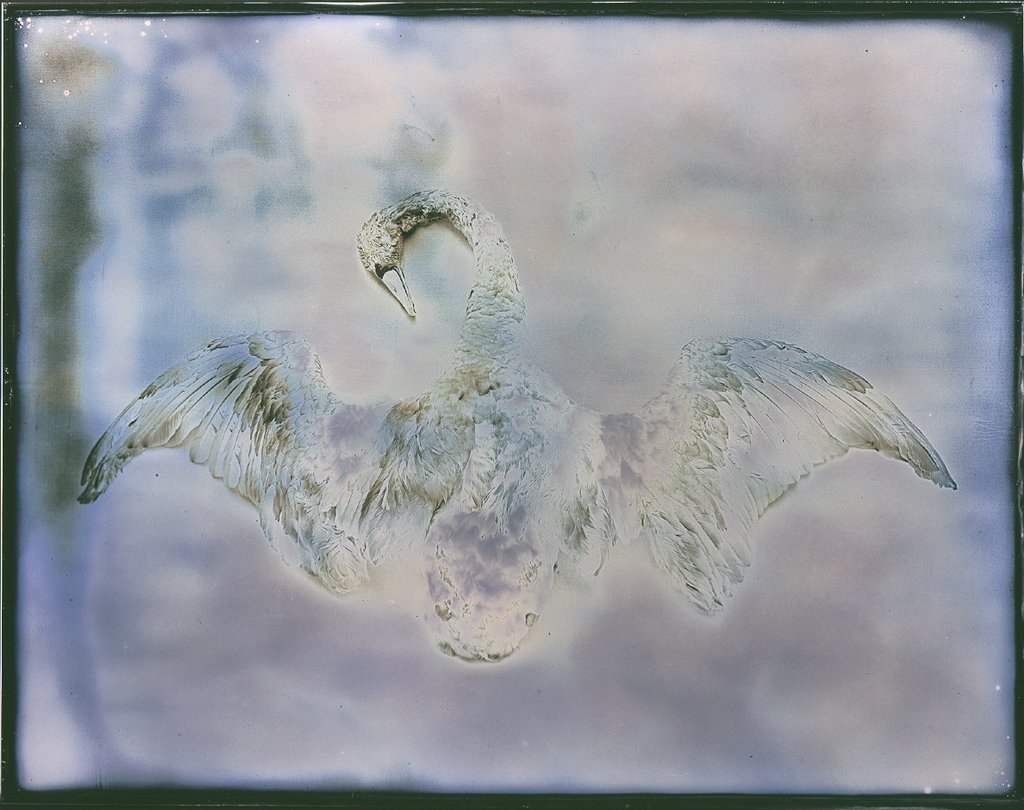
In My Ghost, Fuss also used an older technique: the daguerreotype, the first photographic process made widely public, in 1839. The image sits on a polished silvered copper plate. Each one is unique, with no negative and no possible reprint. Seen from one angle it is a picture. Tilt it slightly and it becomes a mirror holding the viewer's own face.
What is in My Ghost
The exhibition My Ghost opened at Fraenkel Gallery in San Francisco in early January 2001 and ran until early March. It brought together daguerreotypes and photograms made from smoke and light.
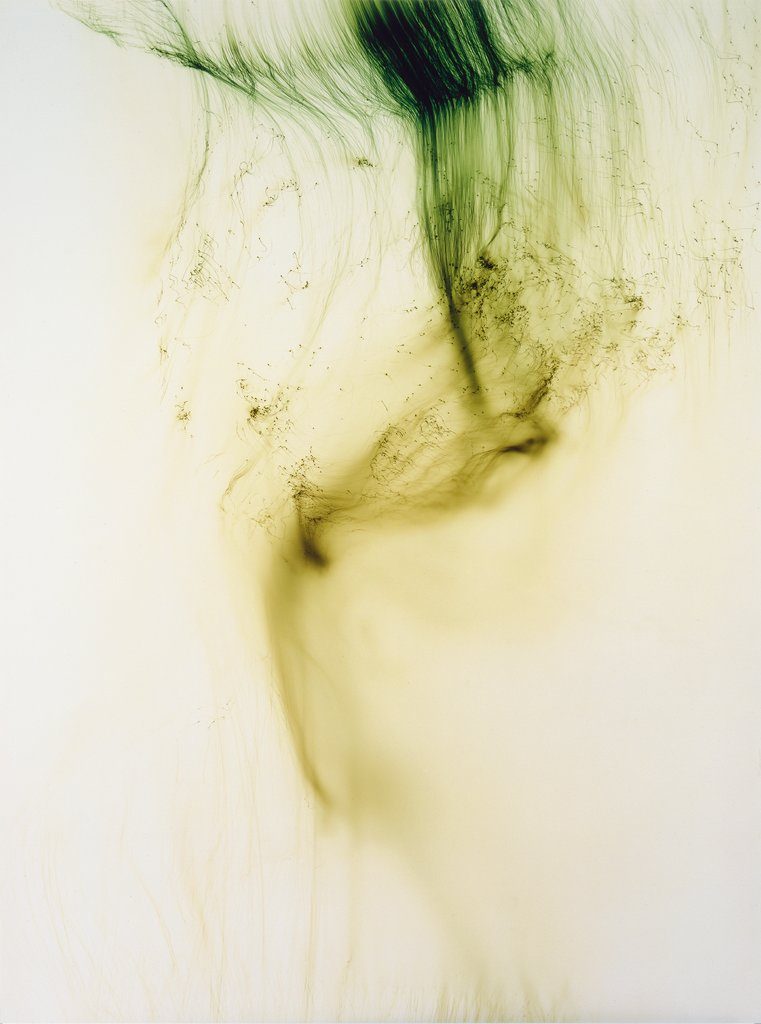
The subjects return again and again. Swans with outstretched wings. Christening gowns. Butterflies. A few self portraits. And smoke, caught by a flash as it rises.
Some images are crisp, their edges clean as if cut. Others are hazy, light, translucent like breath on glass. The difference is not entirely in Fuss's control. He leaves part of it to chance: how smoke moves, how light falls, how a wing lies on a surface.
A book of the same name, gathering the daguerreotypes of the series, accompanied the show.
Birth, loss and what lies between
Read the list of subjects and a life cycle appears. The christening gown marks a child who has just arrived. Wings and butterflies are things that fly away. Smoke is what remains after something has burned. The self portrait is the maker standing among them all.
The gallery described the show as dealing with life and death, birth, love and its loss. Yet the work tells no story. No characters, no setting. Only light, thin things, held at the moment they almost cease to be.
A child's gown on a silver plate has no child inside. It is only the shape of the gown, at full size, like a shell. The viewer fills the space. Some see a beginning. Some see an absence.
That is why the title matters. A ghost usually belongs to someone else. Here Fuss says my ghost. As if what we lose does not vanish, but moves in with us, in another form.
Why it stays
My Ghost takes photography back to its starting point: light touching a surface and leaving a mark. Before photography became a way to record the world from a distance, it was a way for things to print themselves.
Beside Lisa Oppenheim's smoke pictures, My Ghost shows why smoke is such a difficult and compelling subject. It has form, but the form never holds. It is real, but it cannot be held.
Fuss does not try to make smoke last. He only chooses a fraction of a second to keep. The rest still drifts away, as it always does.
Photography