
Essays · Photography
Susan Derges. River Taw.
The river is not photographed. It leaves its own image.
A sheet of paper under the river
The River Taw runs through Devon, in the south west of England, close to Susan Derges's studio. In the late 1990s she began carrying photographic paper to the river at night.
The sheets were large, about five and a half feet long and two feet wide. Derges slipped them into the water, just beneath the surface, where the current curled around branches and stones. In the dark, the sensitive paper was safe. When everything was in place, she fired a strobe.
The light lasted a tiny fraction of a second. In that time, everything between the lamp and the paper left its shadow: ripples, eddies, foam, drifting leaves, branches reaching from the bank. The sheet was carried home and developed, and the image of one moment on the river appeared.
No camera was there. These are photograms, pictures made by direct contact between object, light and paper.
The method asks for patience. The night, the spot and the water level must be chosen. One must stand in the dark beside cold moving water, waiting for the surface to take a shape worth keeping. The maker cannot see in advance what she will receive. Only when the sheet is developed does the river of that night appear for the first time.
What the river carries
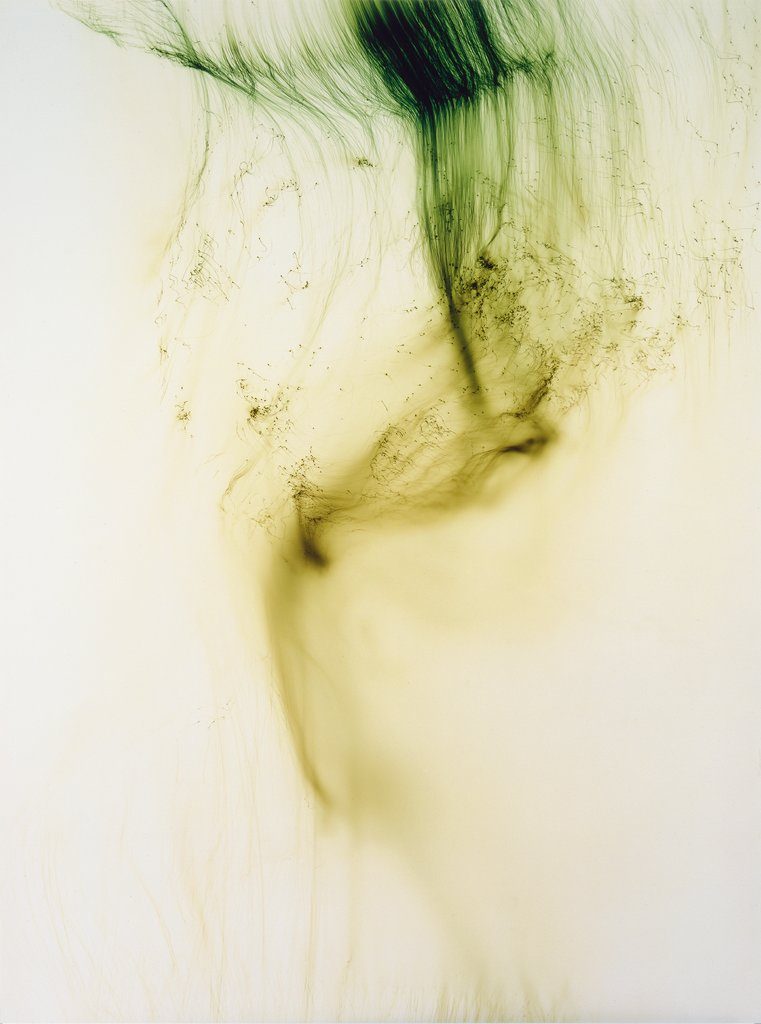
Look closely at the River Taw pictures and a whole riverbank can be named. Rowan, holly, blackthorn, ivy, hawthorn, hazel, willow. They grow along the Taw, drop their leaves, and float near the surface. Derges does not arrange them. They arrive because the water brings them.
Each picture is close to a record of one place on one night. Where the current is fast, the ripples crowd together. Where it is slow, the surface flattens and the leaves lie still. Some sheets look like woven cloth, others like maps.
The originals were made on Cibachrome, a colour paper with deep colour and a glossy surface. The colours in River Taw are not the colours of a river at night. They are the colours of light meeting chemistry on paper, colours that a person standing on the bank at night could never see.
The format is vertical, long and narrow, like a column of water. Standing before it, the viewer is almost looking down into the river from the bank.
Twenty two years later
Working outdoors, underwater, in darkness, does not always succeed. Many sheets were damaged along the way. Some were scratched, some ruined at a corner. They stayed in the studio, unseen.
In 2020, Danziger Gallery in New York presented a short exhibition, The River Taw Restored, from late July to early August. The damaged originals were scanned at high resolution, retouched digitally, and printed for the first time on Fujicolor Crystal Archive paper, in editions of two.
It is a strange and thoughtful thing. A moment when the river printed itself happened more than twenty years earlier. It waited inside a damaged sheet that no one had seen. Then new technology let it appear.
The river of that year is gone. The water has moved on, the leaves have rotted. Only the paper holds its image.
Why it stays
River Taw reverses how we usually think of landscape photography. The photographer does not stand at a distance choosing a frame. She goes into the water, places a sensitive surface inside the scene, and lets the scene do the rest.
Like Hiroshi Sugimoto's sparks writing themselves onto film, River Taw is the image of an energy the eye cannot follow. One is electricity. The other is water.
Both show that some things cannot be looked at, only touched. And sometimes the touch is clearer than any look.
Photography