
Essays · Photography
Liz Deschenes. Gallery 7.
This picture changes with whoever stands before it.
Aperture · Aperture
Pictures made from night
Liz Deschenes is a New York based artist. She works in photography but rarely uses a camera. Much of her work is photograms, pictures made by letting light touch light sensitive paper directly.
Her method differs from tradition. She does not lay objects on paper in a darkroom. She takes sheets of photographic paper outside and leaves them under the dim ambient light of night. The paper is then treated with silver toner. The surface becomes a silvery sheen, close to a mirror but never as perfect.
The result depends on things she cannot control: temperature, humidity, how much light that night held. Each sheet is a record of one particular night. No image is taken. Only the condition of the air is kept on paper.
A room opened up
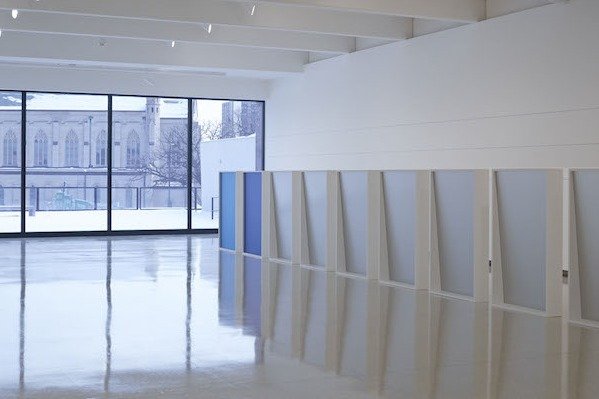
From 22 November 2014 to 22 November 2015, the Walker Art Center in Minneapolis gave Deschenes a seventh floor gallery for a full year. When the museum opened in 1971 the room was called Gallery 7. Deschenes took back that old name as the title.
Her first move was to remove the temporary walls added over the years. The east facing windows reappeared. Daylight entered the room again.
Then she placed free standing rectangular panels in the space. Some were silver photograms. Some were a new experiment: digital pigment prints on acrylic in several monochrome blues. The panels stood where they changed the way through the room. Visitors had to walk around, slow down, turn.
The proportions of the panels came from an index card. It was a nod to c. 7,500, Lucy Lippard's 1973 exhibition of conceptual art by women, which had been shown at the Walker itself, and in which index cards played a part.
The photograph as an object in a room
In Gallery 7, viewers do not look at a picture on a wall. They move among objects. The silver panels alternately absorb and reflect light. In their surfaces viewers see their own faint shape, the windows, others passing. Morning sun from the east makes the room quite different from the afternoon.
So the work never looks the same twice. It depends on light sliding across surfaces, on where people stand, on the season. A year on view is a year of constant change.
A year is long enough for the surfaces themselves to shift. A silver toned photogram is a sensitive surface, not entirely inert to light and air. A visitor in the first month and one in the last may not have seen the same work.
Deschenes raises a question many photographers ignore: are the conditions of display part of the picture? For her, yes. A photograph does not end when it is printed. It goes on living in the room where it stands.
Thomas Ruff, in Photograms, also makes photograms, but in a virtual darkroom where everything is calculated. Deschenes goes the other way. She hands the work to what cannot be calculated: night, humidity, windows, and the footsteps of those who look.

Photography