
Essays · Photography
Thomas Ruff. Photograms.
A trace that nothing ever touched.
Courtesy of the artist and David Zwirner Gallery, New York and London · Aperture
Pictures without a camera
The photogram is one of photography's oldest techniques. No camera, no lens. Objects are placed on light sensitive paper in a darkroom, a light is switched on for a moment, and the paper is developed. Where the object blocks the light, the paper stays pale. Where light reaches it, the paper darkens. The result is a shadow printed directly onto paper.
The technique goes back to the nineteenth century. In the 1920s avant garde artists such as Man Ray and László Moholy-Nagy made it into an artistic language. They laid springs, prisms, glass, cut paper on the sheet and let light decide the rest. Moholy-Nagy also experimented with colour photograms in the 1930s.
A photogram always involves chance. An object shifts slightly, a lamp moves, the paper is a little old, and the result changes. Its size is limited by the size of the paper in the darkroom.
A darkroom inside a computer
Thomas Ruff is a German photographer of the Düsseldorf generation, known for series built from existing images: astronomical pictures in Sterne of 1989, industrial machinery in maschinen of 2003, pictures from the Cassini probe in 2008. He often works with images he did not take himself.
The idea for Photograms came from his own collection. Ruff owned some photograms by Art Siegel, an American artist of the mid twentieth century. Around 2011 he began to wonder whether photograms could be made another way.
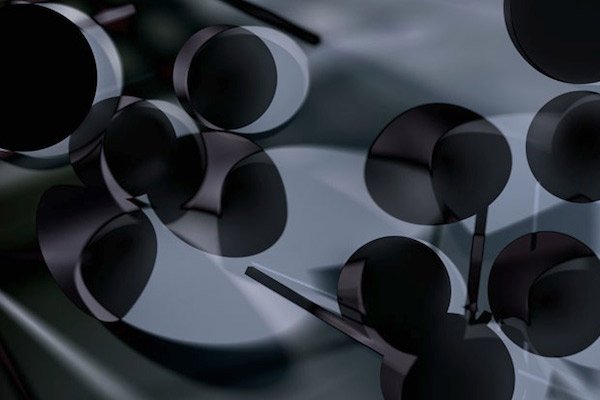
His answer was a virtual darkroom built in 3D software. It contains digital photographic paper, objects and light sources. The objects are familiar from photogram history: lenses, chopsticks, spirals, strips of paper. Ruff places them, positions the light overhead, chooses its colour. Then the computer calculates the shadow.
Because the light is virtual, he can use colour. But he uses it sparingly. Too much colour, he has said, and the image no longer looks like a photogram, only strange and abstract. He wanted it still to read as a shadow.
Shadows larger than any darkroom
Classic photograms are limited in size. Ruff's are printed very large, larger than almost anything made with the technique before. Standing before them, viewers face spirals bigger than their own bodies, translucent shadows overlapping as if enlarged from a tiny world.
The series debuted at David Zwirner in New York in photograms and ma.r.s., from late March to late April 2013. Alongside it was ma.r.s., Ruff's series made from images of the surface of Mars.
Seen together, the two series share something. Both picture places no person can stand: the surface of another planet, and the inside of a darkroom that does not exist. Ruff does not photograph the world. He asks what photography still is when no one stands behind the lens.
Adam Fuss, in My Ghost, uses photograms to hold smoke and butterfly wings, real but fragile things. Ruff goes the other way. He keeps the photogram's shape but leaves the object's place empty. One technique, two very different answers to the question: what does a trace need to be a trace?
Photography