
Essays · Modern Art
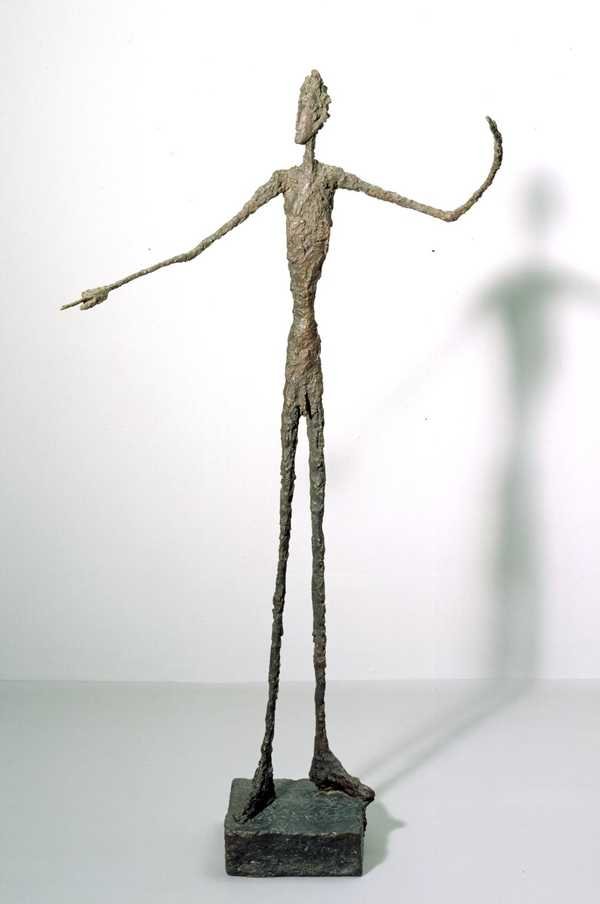
Alberto Giacometti. Man Pointing.
A finger pointing at something we cannot see.
Tate · Tate
One night, one wet plaster
Late in 1947 Alberto Giacometti was preparing his first New York exhibition, at the Pierre Matisse Gallery, due to open in January 1948. He made several works very quickly for it. Man Pointing was one.
In 1964 he told the writer James Lord that he made it in one night, from midnight to nine the next morning. He had in fact already finished it. But he destroyed it and made it all again because the men from the foundry were coming to collect it. When they arrived, the plaster was still wet.
The story says a lot about how Giacometti worked. He rarely considered a piece finished. He modelled, erased, modelled again, often until very little was left. Man Pointing was born in compressed time: the last night before he had to let go.
A body like a skeleton
The Tate bronze is about 1.78 metres tall. On the top of the base is written A. Giacometti 3/6, the third of six casts. The back of the base names the foundry, Alexis Rudier, Paris. Tate bought it directly from the artist in 1949, two years after it was made.
The figure is so thin it has almost no flesh. The bronze is rough and lumpy, keeping the marks of fingers in plaster. One arm reaches out, the finger pointing into the distance. The other curves in a loop, as if holding something that is not there. The long legs are fixed to a heavy base.
Jean Paul Sartre, who wrote about Giacometti in these years, described the work as always halfway between nothingness and being. Tate draws attention to its theatrical gesture and skeletal form.
The figure belongs to the years just after the Second World War. Like Epstein's half figure from The Rock Drill after the war before, the human body in sculpture grows thin once more.
The companion destroyed
The curved arm is not an accident. From the start Giacometti wanted a group of two. The pointing man would put an arm around a companion and with the other hand show him something in the distance.
But in 1947 he could not make the second figure. In a letter of 20 October 1953 he wrote that once the first was done, making the second was entirely impossible, and he did not even begin.
In 1951 he tried again. He modelled a second man in plaster, very upright, arms at his sides, and showed the pair at the Galerie Maeght in Paris as Groupe 2 Hommes. It was not what he wanted. Straight after the exhibition he destroyed the plaster. It was never cast and no longer exists.
Giacometti concluded that the pointing man would stand alone. So the curved arm holds empty space: the place of someone who once existed in intention, and then was gone.
At a crossroads near the studio
The scholar Reinhold Hohl links Man Pointing to a work Giacometti made in 1933. Both describe space through a figure that marks the edge of its presence with an outstretched arm.
The photographer Ernst Scheidegger once photographed Man Pointing standing at the crossing of rue Hippolyte Maindron and rue du Moulin Vert, close to Giacometti's studio in Paris. In the picture it looks like a policeman directing traffic, perhaps with the artist's consent.
That photograph reveals something. In the street, the pointing gesture becomes ordinary, almost practical. In the gallery it becomes a question. The same arm, the same finger. Only the space around it changes.
The man has been pointing for nearly eighty years. Viewers still follow his arm. Perhaps that is all the work asks: that we look where it points.
Modern Art