
Essays · Modern Art
Naum Gabo. Head No. 2.
A head made of empty space.
Tate · Tate
A head opened up
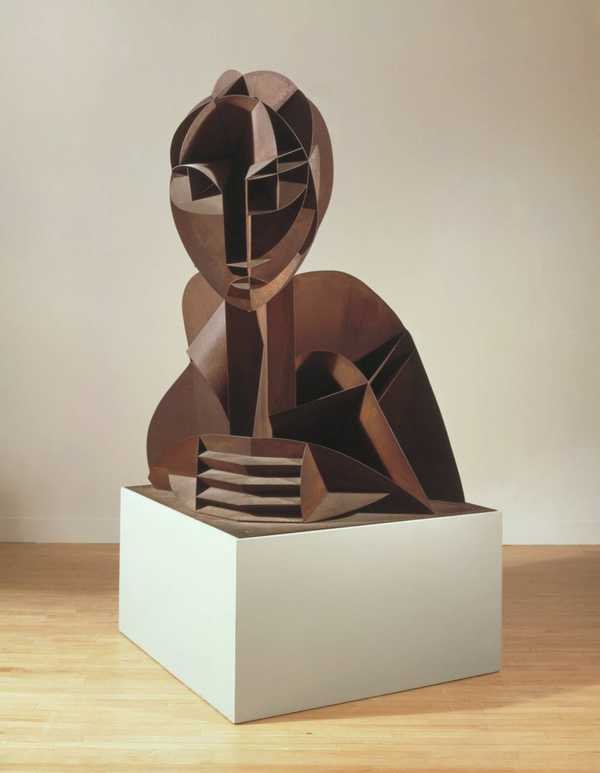
Head No. 2 is a sculpture of a human head and shoulders. But it is not carved from stone or cast in bronze like a traditional portrait bust. It is built from flat plates, cut and slotted together at right angles or on the diagonal, like the partitions inside a box.
From the front you recognise brow, nose, cheek, chin, neck. But each part is an upright plane, not a curved surface. Between the planes is empty space. Light enters the sculpture; shadows fall inside it. We see the inside of a head.
When the viewer steps to one side, the head changes completely. Planes overlap, gaps close and open again. No single viewpoint shows the whole.
Naum Gabo made the first version in 1916, at a small scale. Almost fifty years later, in 1964, he made an enlarged version in steel. That enlarged version is in the collection of Tate in London.
Norway, in the middle of a war
Gabo was born in Russia in 1890 as Naum Pevsner. Before the war he studied in Munich, in the natural sciences and engineering, and came to art by that route. He took the name Gabo to distinguish himself from his elder brother, the painter and sculptor Antoine Pevsner.
When the First World War broke out the brothers went to Norway. There, around 1915 and 1916, Gabo made his first heads built from planes. The first materials were modest: plywood, cardboard, sheet metal.
The method came from an engineer's way of thinking. A cube can be understood as a solid. It can also be understood as intersecting planes and the space they enclose. Gabo applied the second idea to a human head.
Space instead of mass
In 1920, back in Moscow after the Revolution, Gabo and Pevsner issued a short text known as the Realistic Manifesto. It argued that sculpture need not rely on solid mass. Space and time, they wrote, were the real materials of a new art.
Head No. 2 is an early proof of that idea. It does not occupy space as a rock does. It opens up and lets space pass through. The viewer does not stand before a solid thing, but before a structure one can see through.
In those years in Russia many artists were building forms from industrial materials. Tatlin was a major name in that direction, later honoured by an American artist in fluorescent light, in Dan Flavin's monuments for V. Tatlin. Gabo differed from Tatlin in not wanting art to serve production alone. He kept it in the realm of pure form and space.
The enlargement of 1964
Gabo left Russia in 1922 and lived in Berlin, Paris and London before moving to the United States. Throughout his life he returned to his earliest works, remaking them in new materials and at new sizes.
The 1964 steel Head No. 2 is one such return. At a large scale the work is no longer a model to hold in the hand. It stands at the viewer's height, and the spaces inside are wide enough for the eye to enter.
Steel also changes the meaning. Cardboard and plywood suggest a studio experiment. Steel suggests a structure. The head of 1916, once a fragile idea, now carries the weight of a small building.
Yet the core is the same. Looking at Head No. 2, we still see a face made from what lies between the planes. The form is not in the material. The form is in the space.
Modern Art