
Essays · Modern Art
Barbara Hepworth. Pelagos.
Not what the eye saw, but what the body felt.
Tate · Tate
Two arms of wood
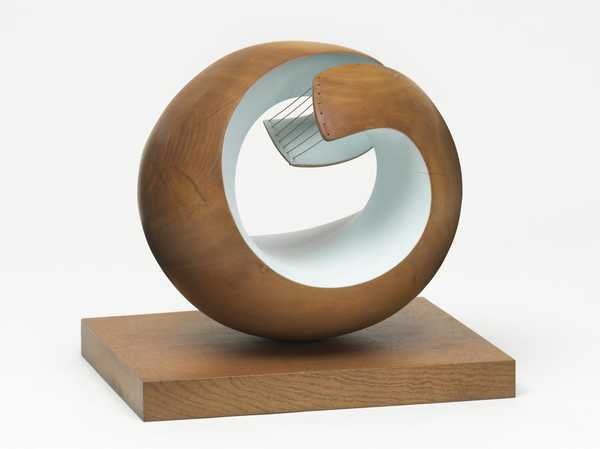
Pelagos was carved in 1946 from elm, partly painted and strung, on an oak base. It is not large: about 43 centimetres high, 46 wide, weighing a little over 15 kilograms. On a table, it is the size of something two hands could hold.
Hepworth hollowed out the centre of the block, leaving two arms that spiral into each other. From different angles it resembles a shell, a curling wave, the roll of a hill. In photographs it looks spherical; in fact it is ovoid.
The interior is painted a pale, very matt blue. The outside is bare wood, polished until the grain shows. Between the two arms, strings run from edge to edge, radiating and parallel, like the strings of an instrument.
Tate notes that the form allows the wood enough movement that it has far fewer radial splits than many of her other carvings.
A room facing the bay
In 1939 Hepworth and her husband, the painter Ben Nicholson, moved to Cornwall, at the far south west of England. There the wild coastal landscape fed some of her best known work.
Pelagos was carved at her house, Chy an Kerris, overlooking St Ives Bay. She later described her studio room: facing the sea's horizon, held by arms of land to left and right, yet always with an escape for the eye out to the Atlantic. She wrote that she had used this idea in Pelagos.
She added something more. Facing the bay, she did not sense the danger of endless water. She sensed containment and security. Pelagos, she said, was less what she saw than what she felt.
The title is a Greek word meaning the sea. According to Tate it was suggested by the critic E. H. Ramsden, as were several of Hepworth's Greek titles of the period.
String, wood and colour
Stringing was a Constructivist technique, used by Naum Gabo, Hepworth's friend and interlocutor in those years. In Pelagos the strings lose their mechanical feel. Tate quotes her: the taut strings express the tension she felt between herself and the sea, the wind or the hills.
Through the 1940s Hepworth moved away from a Constructivism she found too rigid, towards organic form and landscape. Pelagos is seen as the place where the two directions meet: the engineer's string, the carver's wood, the shape of a wave.
The colour has its own story. The pale blue inside faded over time. Years later, writing about a related work, she said she cared more about how colour was applied and the brushstrokes than the colour itself. A matt coat set against polished wood: perhaps that contrast was what she wanted to keep.
The work she bought back
In October 1946 Pelagos was shown in Hepworth's solo exhibition at the Lefevre Gallery in London. Her dealer, Duncan Macdonald, bought it soon after. That same season it appeared on the cover of Studio magazine.
In 1958 Hepworth bought it back from the estate of Macdonald's widow. Six years later, in 1964, she gave it to Tate. It later appeared on the catalogue covers of both her Tate retrospectives, in London in 1968 and in Liverpool in 1994.
An artist buying back her own work is unusual. It shows how much Pelagos mattered to her. Beside Henry Moore's pierced reclining figures, made in the same years, Pelagos shows Hepworth taking another path: not the body, but space, light and the feeling of being held.
Modern Art