
Essays · Modern Art
Constantin Brâncuși. Le roi des rois.
A sculpture made for a temple that never existed.
Solomon R. Guggenheim Museum · Solomon R. Guggenheim Museum
A column taller than a person
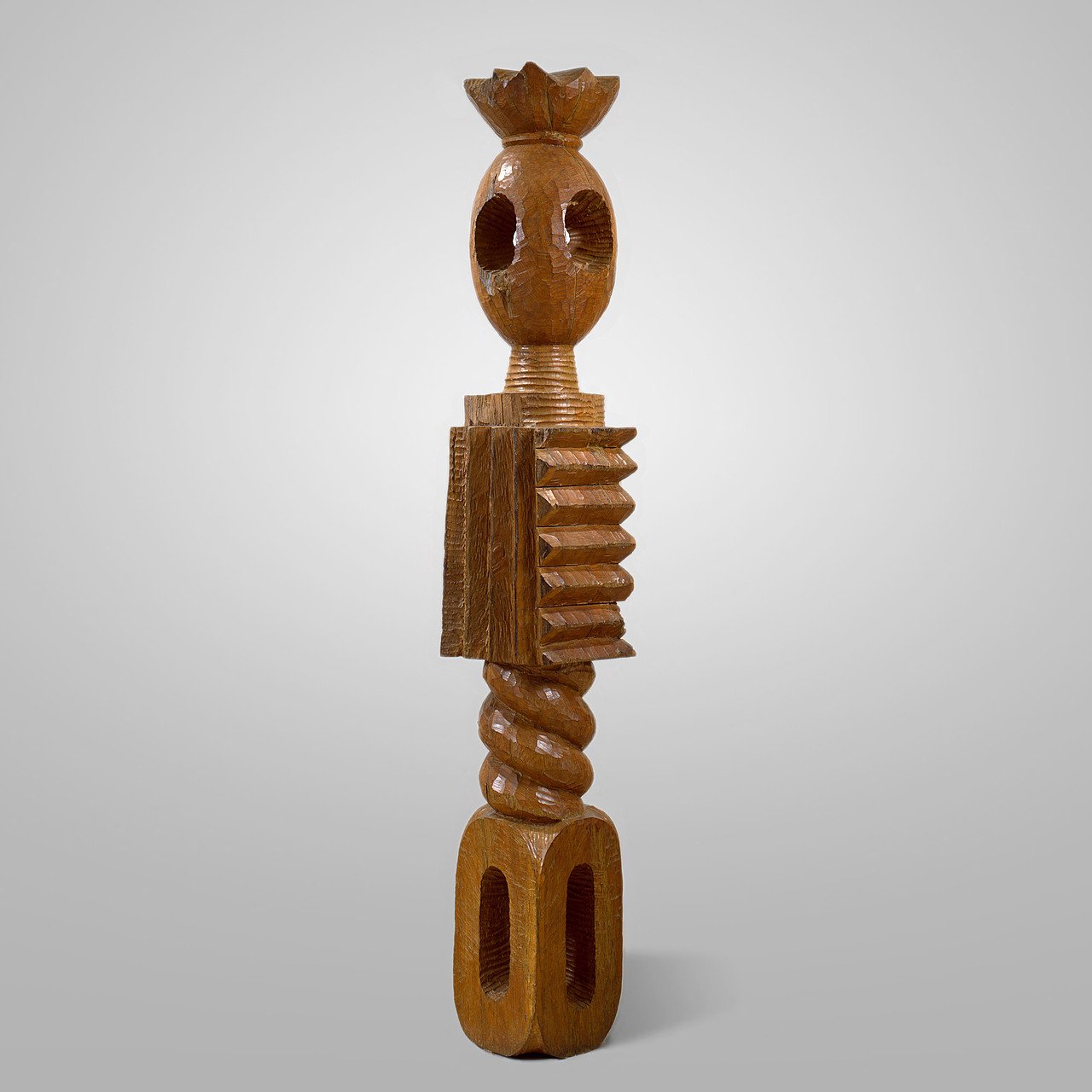
King of Kings, Le roi des rois in the original French, is an upright block of oak about three metres tall. The Solomon R. Guggenheim Museum in New York, which holds the work, dates it to around 1938.
Read from bottom to top, it is a stack of forms. One section is round like a mortar, one narrows, one is serrated. At the top sits a shape like a crowned head, or an upturned cup. There is no face, no limbs. Yet the viewer still sees a stance, a presence.
The chisel marks remain. The wood was not polished until the grain disappeared. Up close you can see where the blade went deep, where the timber has cracked with age. Brâncuși left those traces alone.
The first title was not King of Kings. According to the Guggenheim, Brâncuși once called it Spirit of Buddha. The later name sounds like a monarch. The earlier one sounds like a prayer.
The temple at Indore
In 1933 the Maharaja Yeshwant Rao Holkar of Indore, in India, commissioned Brâncuși to design a private space for meditation, known as the Temple of Meditation.
What survives of the plan describes a strange room. Almost no windows; light entering only through an opening in the ceiling. A reflecting pool inside. Birds painted on the walls. An entrance below ground, so that one would first go down before meeting the light.
King of Kings was meant to stand there. The temple was never built. The sculpture stayed in Brâncuși's Paris studio and later left Europe for New York.
That gives the work an odd life. It was made for one place and has spent its whole existence in another. In a gallery it is sculpture. In its first intention it was part of a building, something to sit beside in silence.
Wood is not bronze
Brâncuși is known for bronzes polished like mirrors: birds in flight, sleeping heads, egg shapes. In those materials he searched for the most reduced form, one with almost nothing left to remove.
Wood took him elsewhere. The Guggenheim notes that his carvings in wood tend to suggest particular characters or spiritual beings, rougher and less idealised. If bronze reached toward an archetype, wood kept a personality.
Scholars have traced the stacked forms of King of Kings to the vernacular architecture of Romania, Brâncuși's homeland: carved wooden gateposts and ornamental pillars. The serrated edges along its sides have also been compared with African carving, which drew much attention among artists in Paris early in the twentieth century.
Brâncuși did not explain. He never said clearly where his forms came from. He left the question open.
A thing to be with
Visitors to the Guggenheim now tend to walk around King of Kings. It is tall enough to make you look up, narrow enough to see all four sides. There is no front and no back.
That circling may be closer to the original idea than it seems. In the meditation room, the sculpture was not something to glance at and leave. It was to stand there for a long time, like a column keeping time for the space.
Modern sculpture after Brâncuși kept going down this road, hollowing wood and stone so that the space inside became part of the form, as Barbara Hepworth did with Pelagos. King of Kings, though, stays solid and closed, like a trunk not yet willing to open.
An oak trunk, a temple on paper, a changed name. What remains is the block of wood. It does not retell its story. It simply stands.
Modern Art