
Essays · Modern Art
Umberto Boccioni. Unique Forms of Continuity in Space.
A body that will not stand still to be looked at.
Tate · Tate
A body stretched by speed
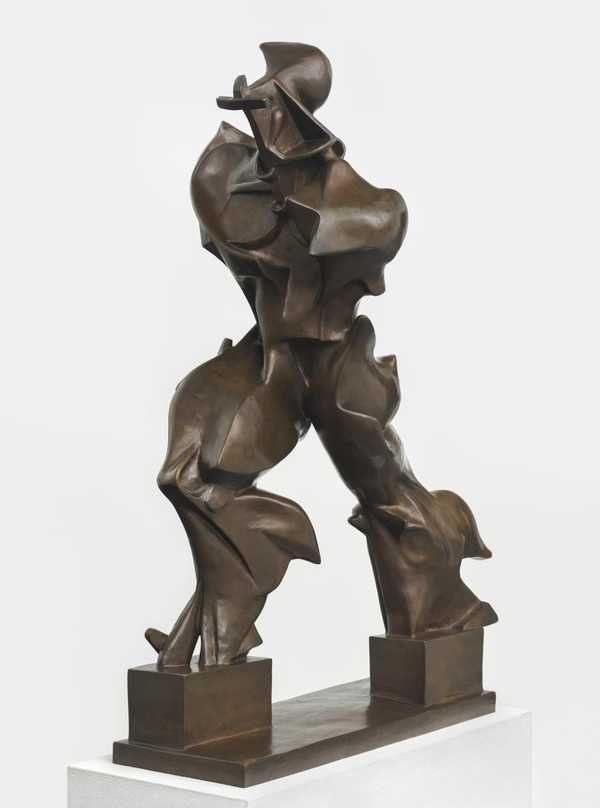
A figure strides forward. No clear face. Calves, thighs and shoulders stretch backward into flowing masses, like cloth blown by wind or flame trailing an object in flight. The feet rest on small blocks.
Tate's version is bronze, more than a metre ten high and weighing 55 kilograms. Umberto Boccioni made the work in 1913. This bronze was cast in 1972.
In the early twentieth century industrialisation swept across Italy. The Futurist movement, founded by writers and artists like Boccioni, was thrilled by new inventions such as cars and electricity. Tate describes the figure as aerodynamically deformed by speed. Boccioni exaggerated the body's dynamism so that it embodied the urge towards progress.
Tate also suggests the sculpture may reflect ideas of the mechanised body in Futurist writing, and the superman imagined by the philosopher Friedrich Nietzsche.
Force lines
Boccioni began making sculpture in 1912, as an extension of his painting and grounded in Futurist theory. On 15 March 1913, in the magazine Lacerba, he published his manifesto on the plastic foundations of Futurist sculpture and painting.
Its core idea: what must be shown is the living object in its growth and motion. For Boccioni the object has no form in itself. What can be defined is the line revealing the relation between the object's weight and its expansion. From this came the notion of force lines, which let us see the object as a living whole.
Unique Forms of Continuity in Space is his largest surviving work and shows these principles most clearly. Before it came three other striding figures, now known only from photographs: Synthesis of Human Dynamism, Speeding Muscles and Spiral Expansion. Step by step he worked towards the final synthesis.
It was first shown in Boccioni's solo sculpture exhibition at the Galerie La Boétie in Paris in June and July 1913. In a letter of 4 September that year he called it his latest and most liberated work.
Fragments of plaster
Boccioni died in 1916. That December a memorial exhibition opened at the Palazzo Cova in Milan, running into January 1917. All four plaster striding figures seem to have been shown there.
After it closed, the sculptures were stored in a courtyard. Workmen clearing that part of the building hacked them to pieces.
Two were saved: Unique Forms of Continuity in Space and Development of a Bottle in Space. The poet Filippo Tommaso Marinetti, founder of Futurism, and the painter Fedele Azari, the movement's secretary, collected the pieces and stuck them back together. Marinetti, years later, would even write a manifesto of Futurist cooking.
In Boccioni's lifetime none of his sculptures was cast in bronze. What he left was plaster, the most fragile material in sculpture.
The earliest bronze was probably cast around 1925 or 1926 and belongs to the collector Gianni Mattioli in Milan. In 1931 Marinetti had two more cast in Rome, later acquired by the Galleria d'Arte Moderna in Milan and the Museum of Modern Art in New York. In 1949 Marinetti's widow had two further casts made, this time including the base, as in the original plaster.
In 1952 she sold the original plaster to the Brazilian industrialist Francisco Matarazzo Sobrinho. In 1963 he gave his whole collection to the Museum of Contemporary Art of the University of São Paulo when it was founded.
Tate's bronze was cast in 1972 at a foundry in São Paulo, directly from that plaster, made specially for the Tate Gallery. Tate bought it the same year. Also in 1972 a gallery in Rome commissioned an edition of eight other bronzes, cast not from the original plaster but copied from an existing bronze.
Each bronze steps out of the same plaster fragments glued back together after the memorial show. The figure still strides. The movement is held in metal, while its story has crossed three cities and more than half a century.
Modern Art