
Essays · Modern Art
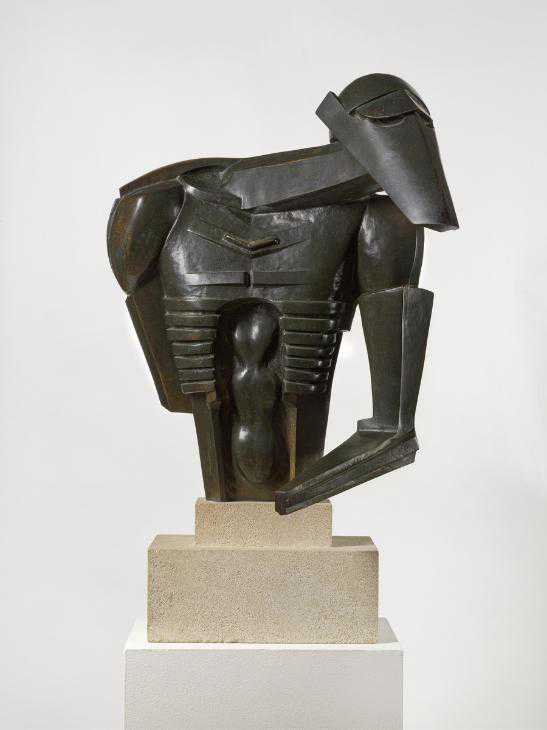
Jacob Epstein. Torso in Metal from 'The Rock Drill'.
This work was finished by taking away.
Tate · Tate
A robot on a rock drill
In 1913, in London, Jacob Epstein was taken by the pull of machines. These were the years when Cubism, Futurism and Vorticism were exploring the novelty of mechanisation. Epstein bought a second hand industrial rock drill. On it he built a tall plaster figure, as if riding and operating it.
Born in New York, Epstein said the rock drill was something he knew well from that city. He did not want the work to be entirely abstract. He wanted to translate his feeling of the machine as a living entity into sculpture.
In March 1915 the work was shown at the London Group, the plaster figure mounted on the real drill. Viewers saw something half human, half machine: an angular body, a head like a visored helmet, and in its chest a small curled form.
A robot carrying its young
In his 1940 autobiography Epstein described the original as a machine like robot, visored and menacing. He wrote that it carried its own offspring inside, protectively sheltered. The small form in the chest is that offspring.
This detail makes the work more complex than praise of machinery. The robot is both a force that drills and breaks, and a being that bears and protects. Mechanical power is imagined as a new species able to reproduce itself.
Epstein also wrote that his passion for machinery was short lived. He called the figure the Frankenstein's monster we have made ourselves into. Looking back, he saw it as prophetic of the great war.
War and the cut
The First World War was the first in which machines killed on an unprecedented scale. Machine guns, artillery, gas. According to Tate, Epstein's attitude to machines changed completely in the face of those casualties.
After the 1915 showing he removed the drill. He cut the figure at the waist. He took off the left hand and the right arm. Tate's catalogue is more precise: in the plaster, the right arm had a forearm and hand, omitted in the bronze; the left arm, truncated in the plaster, reaches across the body in the bronze.
Then he cast what remained in bronze. In 1916 it was shown again at the London Group under a new title: Torso in Metal from The Rock Drill. An early cast bought by the National Gallery of Canada in 1956 was probably the one shown that year.
The once threatening figure now looks vulnerable. Tate describes it as more victim than perpetrator. No machine to drive, no legs to stand on, no hand to grip. Only the helmeted head, the angular torso, and the offspring still inside the chest.
Half a figure at Tate
The Tate bronze is about 70 centimetres high, 58 wide and 44 deep. It was bought from Lady Epstein, the sculptor's widow, in 1960. It carries no inscription. Today it is shown in the galleries of British art from 1920 to 1940 at Tate Britain.
Compared with the real drill and tall figure of 1915, this half torso is surprisingly small. It is no longer a statement about the future. It is what is left after that future arrived and took what it took.
Set beside the thin figures of Giacometti after the Second World War, Torso in Metal shows something shared by twentieth century sculpture: after each war the human body in art grows thinner, breaks, loses a part.
Epstein did not make a sculpture about war. He let war work on his sculpture. The cut at the waist is the trace of a specific moment, when an artist stopped believing in machines.

Modern Art