
Essays · Modern Art
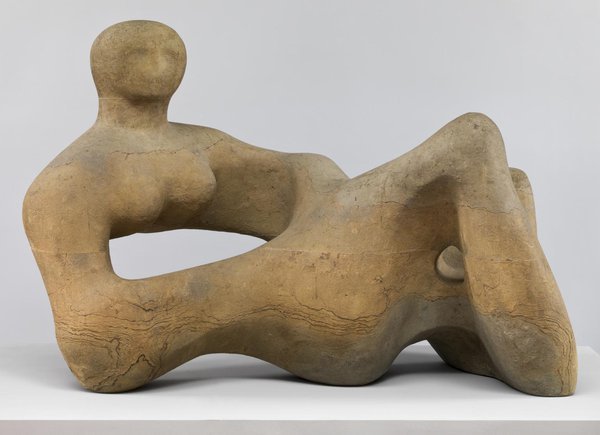
Henry Moore. Recumbent Figure.
A figure lies down in order to see far.
Tate · Tate
A long, low house
In 1936 the architect Serge Chermayeff, a Russian émigré living in Britain, invited Henry Moore to Sussex to see the site of the house he was building for himself. It was called Bentley Wood, at Halland. Chermayeff wanted to know whether Moore could picture one of his figures at the meeting point of terrace and garden.
Years later Moore described what he saw. The house was long, low, horizontal. Before it lay a wide view of the long curving lines of the Downs. Everything was lying flat.
He saw no point in opposing all those horizontals. A tall upright figure would have been more a rebuff than a contrast, and would have brought needless drama. So he carved a reclining figure, to be the focal point of all the horizontal lines.
Chermayeff commissioned the work in 1938. Recumbent Figure was completed the same year.
Three points of contact
The figure is carved from a rectangular block of Green Hornton stone from a quarry near Banbury in Oxfordshire. Moore, like others at the time, used many native British stones. The finished piece is over a metre and thirty centimetres long, nearly ninety centimetres high, and weighs about five hundred and twenty kilos.
Seen from the front it falls into three parts: head, shoulders and arms on the left; belly and hips in the middle; legs on the right. It rests on exactly three points, the elbow, the belly and the feet, each wider than the last. Between them are two arches. The whole reads as a run of peaks and hollows along a diagonal from elbow to knee.
The head, the highest point, is almost a sphere. The face is nearly flat, with shallow hollows for eyes and the bridge of a nose. Below the breasts, between the arms, the stone is carved through so the viewer can see across the body. That empty space runs through torso and back, against the dense mass at the centre.
Tate counts it among the earliest works in which Moore shows the female body undulating like landscape. The hip rises like a hill. The hollow opens like a valley. Body and land begin to speak the same language.
A far seeing gaze
Moore said that it was while making this figure that he understood outdoor sculpture needs a far seeing gaze. The figure at Bentley Wood looked across a great sweep of hills, and its gaze took in the horizon.
He was also clear that it had no specific tie to the architecture. It had its own identity and did not need to be on that terrace. But in his words it seemed to enjoy being there, and it brought a human element, a mediator between a modern house and very old land.
Tate's label reads it the same way: visually, the figure was a bridge between the rolling hills and the new house. In 1939 the Contemporary Art Society presented it to Tate.
A lifetime of reclining figures
The reclining figure is the subject Moore returned to all his life. Tate holds many of his Reclining Figures, made between the late 1930s and the mid 1960s in wood, bronze and stone. Recumbent Figure of 1938 sits near the start of that line.
What makes it memorable is not only its shape but how it was conceived: by standing on a piece of land, looking at a house, and choosing not to compete with either. In the same years his contemporary Barbara Hepworth was also opening wood and stone so that light and space could enter the sculpture.
Standing before it in a gallery today, you cannot see the Downs. But the shape carries them. The curves of the stone are a record of a stretch of southern England, and of a figure lying down to look at it.
Modern Art