
Essays · Olfactory Art
Alejandro Ros, Pablo Schanton. Cerca.
To smell, you must come closer than manners allow.
BP.19 Bienal de Performance · BP.19 Bienal de Performance (Buenos Aires)
Four sleepers in the dark
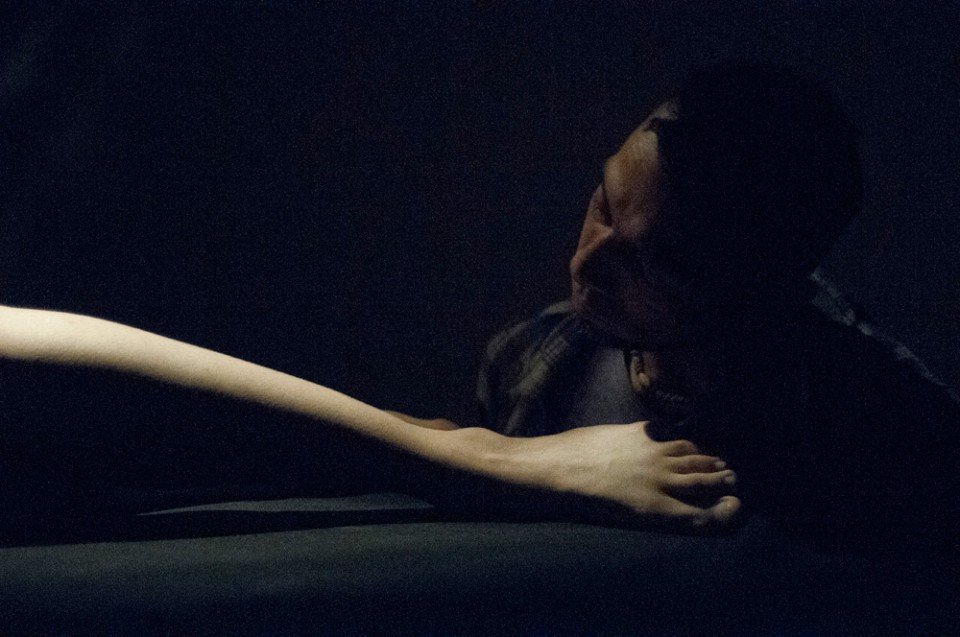
In May 2019, as part of BP.19, the Buenos Aires Performance Biennial, visitors entered a dark room at Complejo Art_Media on Avenida Corrientes. Inside were four naked people, asleep. They lay raised about 1.4 metres above the floor.
Each body carried four different scents in four different places on the skin. The smells did not fill the room. They stayed on the skin. To smell them, visitors had to come very close, to within a few centimetres of a stranger's body.
There was sound in the dark: heartbeats, insects, hints of what the sleepers might be dreaming. The work is called Cerca, Spanish for close.
It ran for five days, from 12 to 16 May, a few hours each day. Five performers took turns in the room: Leandra Levine, Mariana Moreno, Erica D'Alessandro, Mariano Rapetti and Juan Pablo Sierra.
A designer and a music critic
Neither author came from perfume. Alejandro Ros, born in Tucumán in 1964, is a graphic designer trained at the University of Buenos Aires, with a Platinum Konex award in 2002 and several Gardel awards.
Pablo Schanton, born in Buenos Aires in 1965, studied literature at the same university and has long worked as a journalist and music critic. The biennial presents him as an artist working with sound and smell.
The scents were made with several perfumers at IFF Argentina, the local branch of an international scent company. The sound was designed by Aldo Benítez and Roger Delahaye. In 2020 Cerca was a finalist for the Institute for Art and Olfaction's Sadakichi Award for experimental work with scent.
The ethics of proximity
The question Cerca asks is plain: how close may we come to someone who is asleep?
In daily life the distance between bodies is governed by unwritten rules. With strangers we keep a gap. With those close to us it shrinks. To smell someone is to cross nearly all of those gaps. Skin reaches the nose only from the zone of lovers, or of a parent beside a small child.
Cerca opens that zone to strangers. And it chooses sleepers, people unable to consent or refuse at that moment. Visitors are left in an awkward place. The work invites them in. Yet every step closer makes them ask whether they are intruding.
The authors speak of an unconscious morality of touch. Nobody touches anybody. But the nose goes nearer than a hand would normally be allowed.
Eavesdropping on a dream
The sounds in Cerca work as hints, like echoes of what is passing through the sleepers' minds. The scents on the skin do the same. Each is a small clue, a fragment of a dream the visitor can never see whole.
The work uses a precise word for what the audience does: eavesdropping. Visitors are not invited into the dream. They stand at its edge, lean in, and catch what leaks out through skin and air.
That is what separates Cerca from scent works held in bottles, tubes or diffusers. Here the carrier of the smell is a living person, breathing and warm. The smell cannot be separated from the person. To have it, you must accept being near them.


Olfactory Art