
Essays · Olfactory Art
Alisa Banks. History of a People.
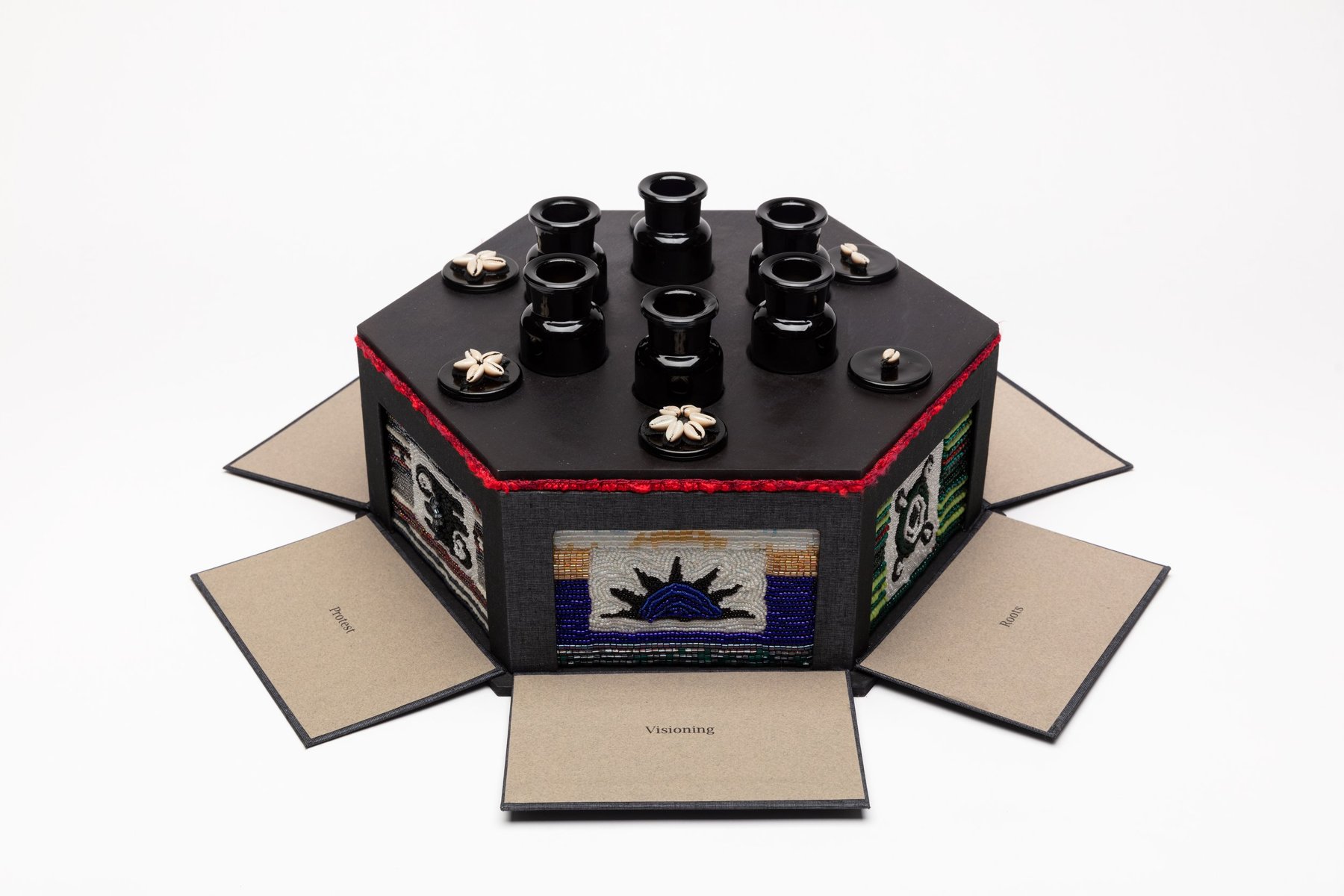
Each jar is a page, read with the nose.
© Alisa Banks · Alisa Banks (official site)
A book that opens into six jars
History of a People is an artist's book, but it has no pages to turn. Closed, it stands about half a metre tall, made of wood, cloth and other materials. Opened like an accordion, it lowers and spreads nearly half a metre each way, revealing six glass jars. The jars are the pages.
Each jar holds its own blended scent. Each scent stands for a period in African American history. The names are short: Roots. Journey. Arrival. Harrow. Protest. Visioning.
Read in order, the names describe a story with a direction. From an old homeland, through a forced passage, through years of suffering, to a voice, then to a future. The book tells no details. It sets six markers and lets scent do the rest.
The list of materials is long: wood, cloth, human hair, beads, shell, cotton, ink, graphite, paper, paint, glass, thread. And scent, listed on equal terms with the rest.
Scent as a charged material
On her site, Banks describes scent in this work as a charged material, something loaded with meaning. It is an important stance. Scent is not used to make the work more pleasant. It is used like wood or cloth: a material with weight and a history of its own.
The materials beside it are not chosen at random. Cotton recalls the fields where enslaved Africans were forced to work in the American South. Shells were currency and ornament across much of West Africa. Hair is body and identity, something judged and also cherished. Each object is already a page of history.
There is also a Deluxe edition, cylindrical, about twenty centimetres across and close to twenty five tall when closed. It swaps some materials: yarn, indigo. Indigo too is a plant with its own history, tied to plantation labour.
Both versions keep one rule: history is not told in sentences. It lives in objects, and in the air released when a jar is opened.
Reading with the nose
A book usually asks its reader to know letters. History of a People asks for something else: slowness. The viewer must open each jar, bring it close, and wait. Scent does not arrive at once like words on a page. It comes gradually, and each person receives it differently.
This brings history near. Reading about a century in a textbook is standing at a distance. Smelling a scent made to stand for that century is letting it into one's body, if only for a breath.
Banks does not spell out what each jar contains. The silence matters. The viewer is not handed an answer. They must ask: what does a journey smell like? What does protest smell like? What does a future smell like?
The work was a finalist for the 2024 Sadakichi Award for experimental work with scent. It sits beside other works that place smell inside colonial and labour history, such as Otobong Nkanga's Amnesis. But History of a People is smaller and more private: a book on a table, six jars, and one person reading.
Olfactory Art