
Essays · Olfactory Art
Amalia Ulman. Stock Images of War.
A pleasant smell can cover what is not pleasant.
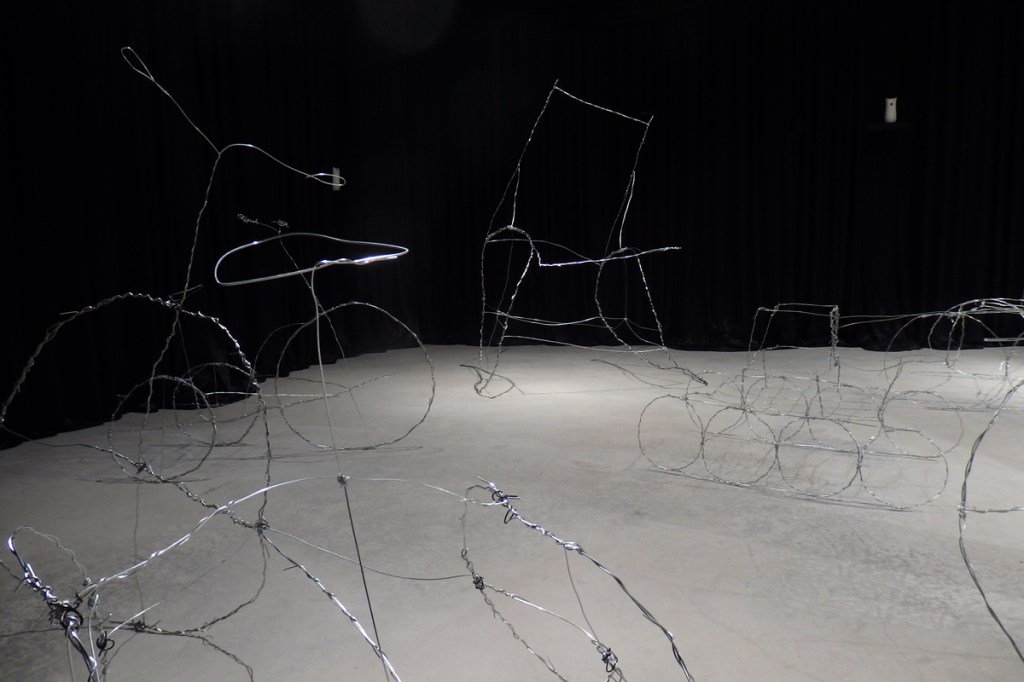
View of Amalia Ulman's exhibition "Stock Images of War," 2015, at James Fuentes · Art in America
Twelve months of war
In early 2015, from 11 January to 8 February, Amalia Ulman showed Stock Images of War at James Fuentes in New York. It was her first solo exhibition in the city.
The room held twelve sculptures. Each was named for a month: War in January, War in February, and so on through December. They were made of wire, nothing but thin outlines, like sketches drawn in the air. Their shapes were vehicles: wheelchairs, tricycles, military tanks, a bicycle, a car.
The wire frames were precarious, easy to bend. A tank made of a few strands of wire cannot fire. It is only the idea of a tank, like an illustration in a children's book or an icon on a website.
Black curtains, metal, apple cinnamon
Ulman did not leave the sculptures in a neutral white room. She built a set. Black drapery with scalloped edges ran around the walls, the kind that suggests a stage or a banquet hall. An eight song playlist of heavy metal and rap metal played, loud and aggressive.
And there was a smell. Twenty four Air Wick air fresheners stood on pedestals, spraying at automatic intervals. The scent was Apple Cinnamon Medley: baked goods, holidays, a warm kitchen.
The three layers did not match. The eye saw weapons and wheelchairs. The ear heard shouting music. The nose smelled a living room at Christmas. The visitor was pulled three ways at once, and that mismatch made the room hard to settle into. Cosy, and at the same time like a place where someone is questioned.
Stock images and canned smells
The title refers to stock photography, pictures sold ready made to newspapers, advertisers and websites. Stock images of war are a real genre: a soldier against a sunset, a tank on a dune, children beside rubble. They are made to illustrate, not to bear witness. They are clean, clear and easy to use.
Ulman's wire frames resemble stock images in that way. They are the outlines of war, without blood or weight. The air fresheners work the same way. The apple cinnamon coming from a machine comes from no apple and no cake. It is a canned smell, designed to suggest comfort, sold in supermarkets.
Side by side, the two reveal what they share. Both images of war and pleasant smells can be mass produced, packaged and consumed. We watch news of fighting in a room that smells nice. Nothing seems strange.
An artist of surfaces
Amalia Ulman was born in Argentina and grew up in Spain. She is best known for Excellences and Perfections, a months long performance on Instagram in 2014 in which she built a persona whose life, look and story were entirely staged. Many followers believed it.
Stock Images of War came right after, with the same concern: how surfaces are made, and how easily we trust them. This time she used no photographs. She used wire, curtains, sound and smell.
Smell is the layer hardest to notice. A visitor might not register it at all, only that the room felt pleasant. Rosenkranz, in Our Product, also put a designed smell into a room to question pleasantness. Ulman took another route: she did not commission a scent, she bought one off the shelf. And because it is so ordinary, it works.

Olfactory Art