
Essays · Contemporary Art
Anri Sala. Dammi i colori.
Colour covers the walls. Underneath, the old city remains.
Tate · Tate
A city at night
Dammi i colori is a video by the artist Anri Sala, made in 2003. It is shown as a digital video projection, in colour with sound, fifteen minutes and twenty five seconds long. The title is Italian and means give me the colours.
The camera moves through Tirana, the capital of Albania, at night. The streets are empty. The lights are weak. On either side stand apartment blocks built under communism, identical, grey, repeated row after row.
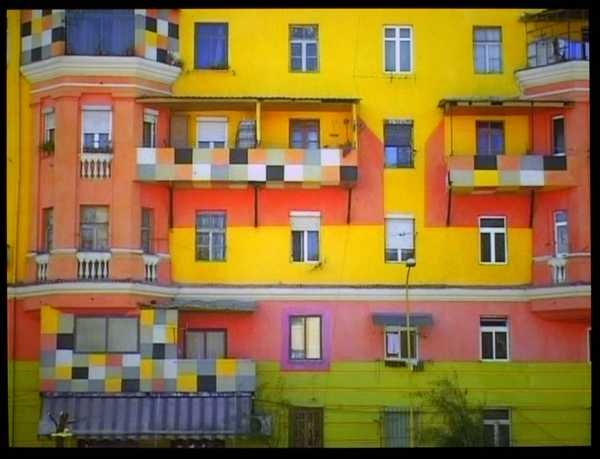
But the walls are no longer grey. They have been repainted in large, loud fields of colour, sometimes covering an entire facade.
Behind these colours is Edi Rama. He was mayor of Tirana, and before politics he was a painter. Painting the old blocks was a programme of the city government under him.
Colour as a political decision
Albania came out of communism in the early 1990s with a poor, run down capital. The grey blocks were the most visible trace of the old era. Rebuilding them properly would be slow and costly. Painting them was quick.
In the video, colour is not presented as decoration. It is spoken of as a project for the city: a way for residents to see where they live differently, a way to mark that something is changing.
The question the work leaves open is whether colour is enough. Does an orange facade improve the flat behind it? Or does it only change how the city appears to those looking at it?
Sala does not answer for the viewer. He films slowly, letting the colours surface from the dark and sink back. Night keeps everything in between. The colour is not as bright as by day; the old walls do not fully disappear.
Coming back to film his own city
Anri Sala was born in Tirana in 1974. He studied painting there, then left Albania to study video and film in France. Dammi i colori is therefore the view of someone returning, familiar with the city but having looked at it from far away.
Many of Sala's works turn on the distance between image and sound, between what is said and what is seen. Here the distance lies between paint and daily life. The colour says one thing about the future. The dark streets and old walls say something else about the present.
There is a coincidence worth noticing. The person filming is an artist who trained as a painter. The person painting the city is a painter too. Both use colour, one to change the city, the other to look closely at that change.
The work is in the Tate collection in London, and was issued in an edition of six plus three artist's proofs.
Why it is worth remembering
Dammi i colori was made more than twenty years ago, but its question has not aged. Many cities still repaint their facades as the quickest way to say they have changed.
The work does not mock that choice. Nor does it praise it. It records a moment when a city tried to use colour as a language, and lets viewers weigh how much that language can say.
In the computer built worlds Harun Farocki studies in Parallel I-IV, the colour of an object is a property assigned to it. In Tirana, colour is assigned too, by a decision. But beneath the paint is a real city, with qualities no one chose.
Perhaps that is why the film is shot at night. When the colour is at its weakest, both layers are easiest to see.

Contemporary Art