
Essays · Contemporary Art
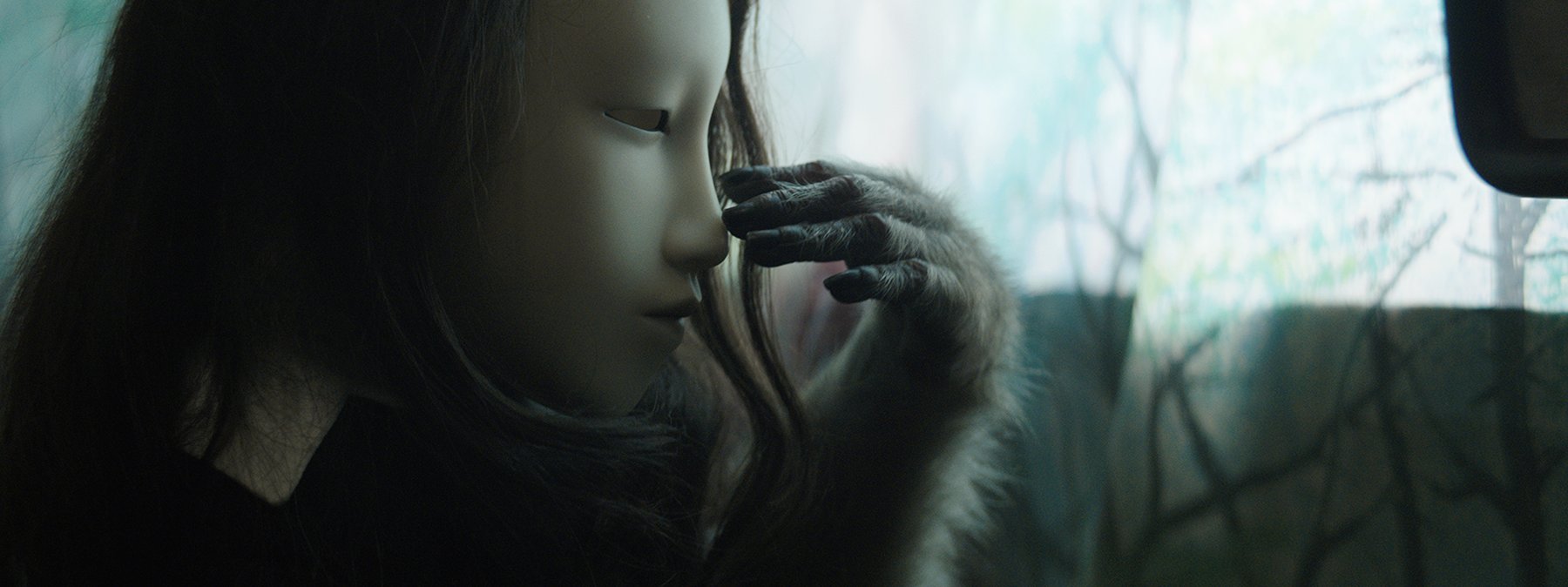
Pierre Huyghe. Untitled (Human Mask).
The people have gone. The habits stay.
Guggenheim Museum Bilbao · Guggenheim Museum Bilbao
A monkey in an empty bar
Untitled (Human Mask) is a single channel video Pierre Huyghe made in 2014, about nineteen minutes long. Its only character is a monkey. It wears a white mask in the style of traditional Japanese theatre, a woman's wig, a white shirt and a skirt like a schoolgirl's uniform.
The monkey moves through a dim interior. It is a bar with no one left in it. The furniture is still there. The monkey walks, pauses, sits, walks again, in a place where no one calls for it any more.
There is no dialogue. No one else appears. The camera follows the animal as it would follow an actor, but the animal is not performing for anyone.
The film was shot in an area devastated by the tsunami and the nuclear disaster at Fukushima. None of this is explained on screen. The viewer sees only a place people have left, and a creature that has stayed.
From a true story
Huyghe started from something he had read: in Japan there were monkeys trained to serve and entertain customers at a traditional sake house. They carried towels and drinks and moved between the tables like staff.
From that detail he built a question. If the people all leave, what does an animal that has learned human habits do? Does it keep the gestures it was taught? Or does it go back to being a monkey?
The film does not answer cleanly. At moments the monkey looks almost like someone waiting for a shift to start. At others it moves in a way only an animal moves, and is plainly an animal. Both states sit in one body, in one frame.
The work is jointly owned by LACMA and The Metropolitan Museum of Art. In 2017 the Guggenheim Museum Bilbao showed it in its Film and Video gallery from late March to mid July.
Person, animal, mask
Huyghe often works with living things, as in UUmwelt, where flies and images share one room. He rarely handles them as props. He sets up an environment and lets things happen. In Human Mask the monkey follows no script. The camera waits.
That is why the film carries a feeling that is hard to name. We know this is an animal. But the mask, with its open eyes and fixed features, keeps pulling us towards reading it as a person. Every small movement is seen as an emotion: sadness, boredom, loneliness.
This is the trap Huyghe sets. We look at an animal and see ourselves. We give it the sadness of an abandoned place. But is the monkey sad? It is simply there, in a room it knows.
The artist has said he is interested in this paradox: watching an animal's behaviour in an almost surreal setting as a way to think about reality and the human condition.
Why the film stays
Human Mask shows no disaster. No flood, no collapsing houses. The catastrophe is outside the frame. Inside there is only its smallest consequence: a quiet room, a habit that has not switched off.
That indirect telling makes the film heavier than many news reports. We are not told how many people left, where they went, or why. We only see a creature carrying on with a task no one needs any more.
The title is Untitled. The part in brackets, Human Mask, names only the thing covering the face. Huyghe gives no name to the monkey or to the place. Everything is left open, like the room itself.
When the film ends, what stays with the viewer is usually not a particular image. It is a sense of time inside an abandoned place: slow, repeating, witnessed by no one but an animal and a lens.
Contemporary Art