
Essays · Contemporary Art
Camille Henrot. Grosse Fatigue.
No drawer can hold the whole world.
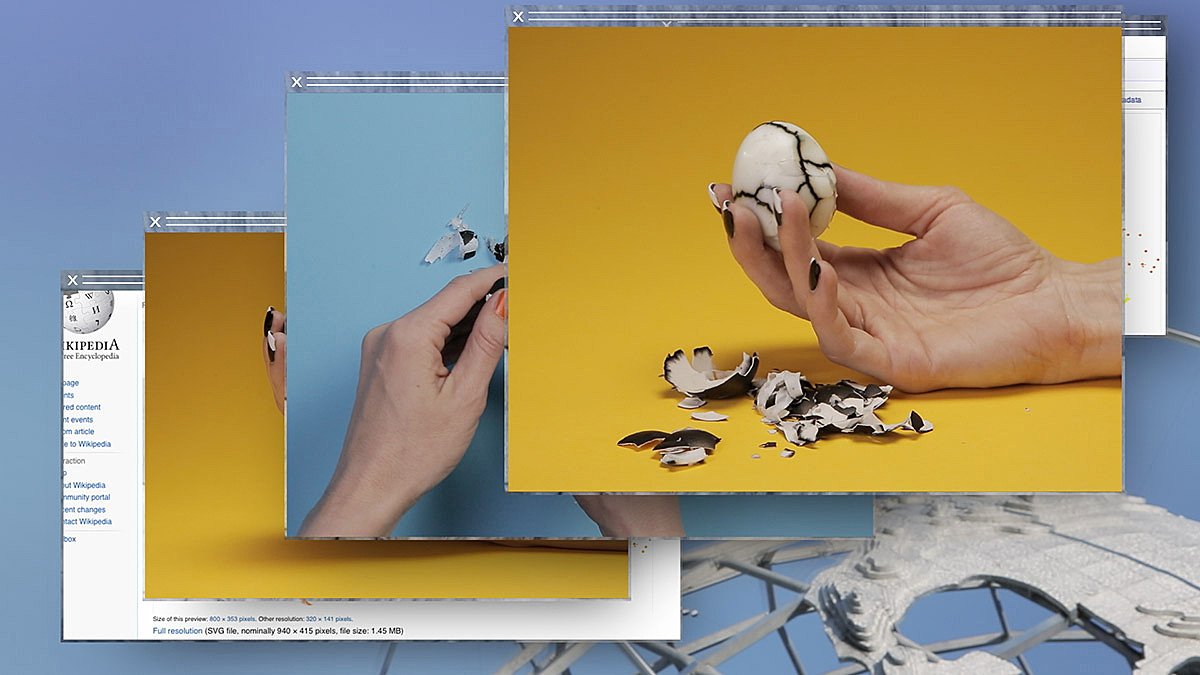
Solomon R. Guggenheim Museum · Solomon R. Guggenheim Museum
The universe on a desktop
Grosse Fatigue is a 13 minute colour video with sound that Camille Henrot completed in 2013. The French title means something like great exhaustion, a very large tiredness.
The video tells the story of how the universe was born. But not in grand cinematic shots. It tells it on a computer screen. Windows pop up, pile on one another, collide and collapse. A folder opens onto a picture of an artefact. A clip plays in a small frame. A hand appears and sets an object on a desk. Then another window.
Underneath runs a fast voice, almost without pause, in the cadence of spoken word poetry. Henrot wrote the poem with the poet Jacob Bromberg. It starts from the time before anything existed and rushes on: light, water, earth, life, people.
Filmed inside the Smithsonian
The work came out of a Smithsonian Artist Research Fellowship in Washington. Through it Henrot was allowed to film the collections of three institutions: the Archives of American Art, the National Air and Space Museum and the National Museum of Natural History.
So the video is full of images people rarely see. Wooden drawers slide open onto rows of stuffed birds, bones, shells, insects pinned to card. Gloved hands lift objects toward the lens. This is the back room of the museum, where everything is named, numbered and put away.
Henrot places those images beside things taken from the internet and daily life: search results, online videos, objects on a desk. The archive of a great research institution and the endless image bank of the web are treated alike, opening in the same kind of window.
Every creation story at once
The poem in Grosse Fatigue does not choose one story. It mixes the history of science with creation stories from major religions: Buddhism, Christianity, Hinduism, Islam, Judaism. It borrows from Freemasonry and Kabbalah, and from Dogon, Inuit and Navajo traditions. The accounts follow one another and sometimes cut across each other.
As the Guggenheim describes it, the work relates the vastness of the universe to the vastness of the internet, and points to the impossibility of a single system of knowledge that holds everything. This is where the title starts to mean something. Whoever wants to know everything gets tired. Whoever wants to classify everything gets more tired still.
Henrot works like a researcher. She digs into archives, reads anthropology, ethnography and the history of technology, and makes sculpture, film, installation and drawing from it. What she looks at is not each object but the way people arrange objects: who names them, who files them, who decides what sits next to what.
Why it is remembered
Grosse Fatigue was shown at the Venice Biennale in 2013 and earned Henrot the Silver Lion for a promising young artist. The video later entered the Guggenheim collection.
Many remember it for a feeling that is uncomfortably familiar. Anyone who uses a computer has opened too many tabs, jumped from one question to ten others, and ended the evening with a heavy head and nothing learned. Henrot gives that feeling a shape. It sits close to Hito Steyerl's video from the same year, another work that treats the screen as a place where people live.
Yet Grosse Fatigue is not a complaint about technology. It sees technology as the latest step in a very old habit: people have always wanted to gather the world into one place. Once it was the glass cabinet and the encyclopaedia. Now it is the screen. The tiredness is the same.
Contemporary Art