
Essays · Contemporary Art
Omer Fast. CNN Concatenated.
Every word is real. The sentence was never said.
Tate · Tate
One word at a time
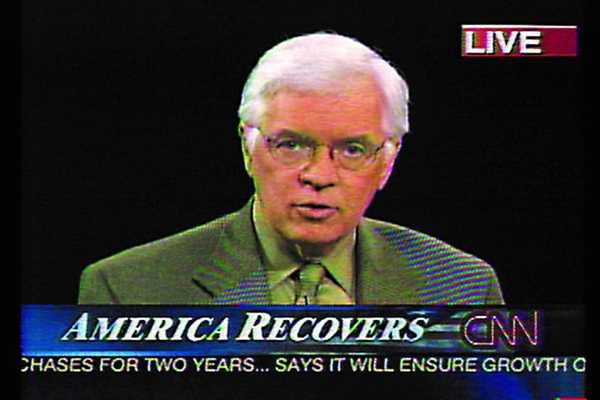
CNN Concatenated is a single channel video by the artist Omer Fast, made in 2002. Its raw material is television news from CNN. But Fast does not use the broadcasts as they are. He cuts them into the smallest possible pieces: single words.
Each word is spoken by a news anchor. A woman says one word. A man says the next. Then someone else. Faces, hairstyles, background colours and voices change constantly, word by word.
Fast arranges those words into a new monologue. No anchor ever said it. Yet every word in it was spoken by them, on air, in real broadcasts.
Concatenated in the title is a technical term meaning linked into a chain, one link at a time. The title describes exactly how the film was made.
The language of television
News anchors are the most disciplined speakers on screen. Even, clear, neutral voices. Calm faces. Everything is arranged so viewers believe what they hear is information, not opinion.
CNN Concatenated uses that credibility to do the opposite. It shows that trusted voices can be cut up and rejoined to say anything. Not a single word has to be faked. Only the order changes.
The viewer is put in a strange position. The eye sees the familiar faces of the news. The ear hears a sentence that makes sense. The mind knows the sentence never existed. That mismatch is where the work operates.
The work appeared in 2002, when news channels ran for many hours a day and anchors' faces were in almost every living room. The reach of those voices is part of what makes taking them apart so striking.
The artist and found material
Omer Fast was born in Jerusalem and lives and works in Berlin. Many of his works deal with how a story is told, retold and rebuilt through images. He is interested in the gap between what happened and how it is told.
In CNN Concatenated he filmed nothing. Every image already existed, had been broadcast, had been watched. His task was to choose, cut and arrange. The work is closer to an editor's than a director's.
The method has deep roots in art: collage. Early twentieth century artists cut words from newspapers to make poems. Fast does the same with video, but his units are smaller and the work far more painstaking. Each word has to be found, lifted from its original sentence and set in the right place.
More than a decade later Julian Rosefeldt also cut and rejoined existing words in Manifesto, this time art manifestos. Both works ask the same thing: who owns speech once it has left the speaker?
Why it is worth remembering
Today cutting and rejoining voices and images is far easier. Machines can make someone say what they never said in minutes. CNN Concatenated was made before all that, by hand, word by word. It reads now like an early warning.
But the work is not only about forgery. It also shows that language is already something assembled. Every sentence we speak uses words others have said before. We only change the order.
Viewers leave with a new habit: hearing a sentence and wondering how many mouths its words passed through before arriving here.
The film is in the Tate collection.
Contemporary Art