
Essays · Photography
Bieke Depoorter. Ou Menya.
One night is enough to see a house from the inside.
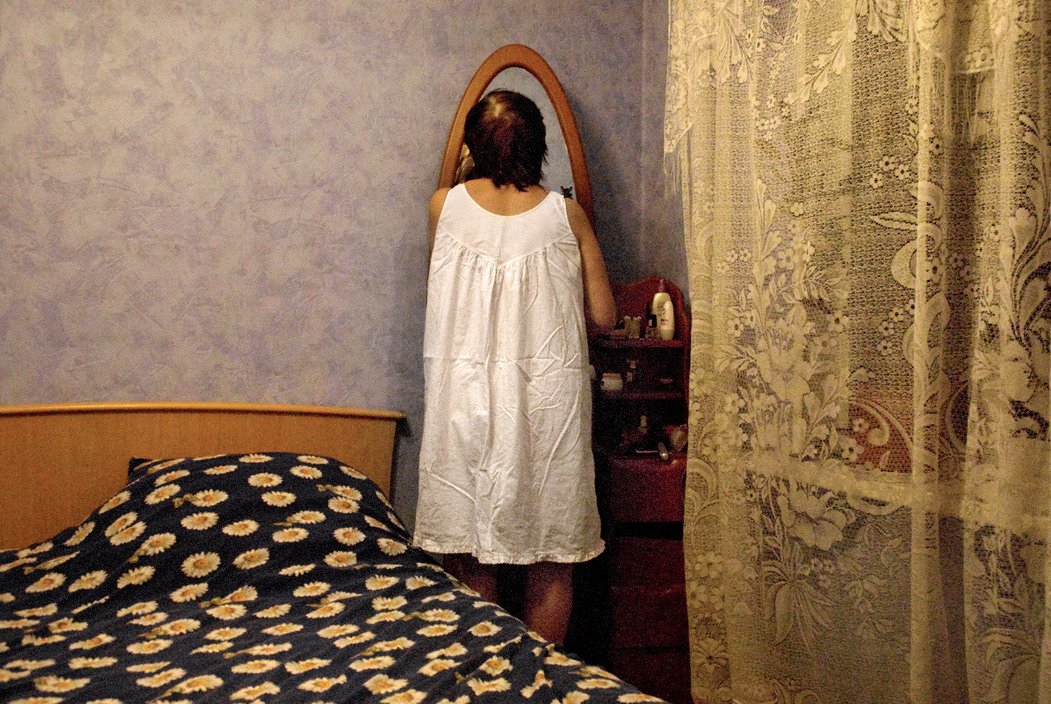
© Bieke Depoorter · Magnum Photos
A note in Russian
In 2009 Bieke Depoorter, a young Belgian photographer, travelled alone through Russia. She carried a small piece of paper with a few Russian words scribbled on it: a request to sleep over for one night.
She followed the Trans Siberian railway, stopping in small villages along the line, places rarely mentioned. In each one she showed the note to whoever she met. Some shook their heads. Some opened the door.
She made three trips of about a month each. Every night a different house. She moved from living room to living room, and a stranger's couch became her bed for one night.
The Trans Siberian line links Moscow with Vladivostok, crossing almost the full width of Russia. Trains run for days through forest, open steppe and small stations. Most passengers see the villages only through the window. Depoorter got off the train, walked into those villages, and knocked.
The living room at the centre
Depoorter photographed where she slept: the living room. She has called it the epicentre of family life. In rural Russian homes the living room is where people eat, watch television, argue, where children play and the old doze. And that night, where a stranger lies down.
Her pictures are in colour, made in small rooms full of the things of family life. There are people going about their business as if no stranger were in the room. There are people looking straight at her, impossible to read.
She did not stage anything. She had no time to. Every encounter was accidental, and every picture was made within a few hours, between supper and the next morning.
At my place
Ou Menya transliterates a Russian phrase meaning at my place, at my home. It is what a host might say to a guest: sleep at my place. So the title does not belong to the photographer. It belongs to those who opened the door.
Depoorter speaks of these stays as brief but very powerful shared moments. The host lets a stranger into the most private room they have. The stranger, in return, sees them as they live, without putting on a face for company.
There is a strange trust in it. Neither knows who the other is. No contract, no promise. Only a note, a door, and one night.
The viewer is placed in the guest's position too. We stand in a corner of the room as she did, watching a family go through an ordinary evening, one person, one task at a time. We do not know their names. We only know we are inside their home, which feels both intimate and slightly awkward. That awkwardness is what makes the pictures real.
Why it stays
Ou Menya won Depoorter the HP Magnum Expression Award. In 2011 the Belgian publisher Lannoo released it as her first book. She later became a member of Magnum Photos, and went on to make more projects in the same way: entering strangers' homes, staying the night.
Beside Larry Sultan's Pictures from Home, two ways of looking into a house appear. Sultan photographed his own parents' home, where he belonged, and searched it for what he had never seen. Depoorter photographed the homes of complete strangers, where she did not belong, and saw at once what the family had forgotten.
Ou Menya is not a portrait of Russia. It is a string of nights. Each is a door that opened, and that alone was worth recording.
Photography