
Essays · Fashion as Design
Burberry. The Burberry Trench: Crafting an Icon.
A coat made to stand the weather.
© Burberry · Victoria and Albert Museum (V&A)
A small room in South Kensington
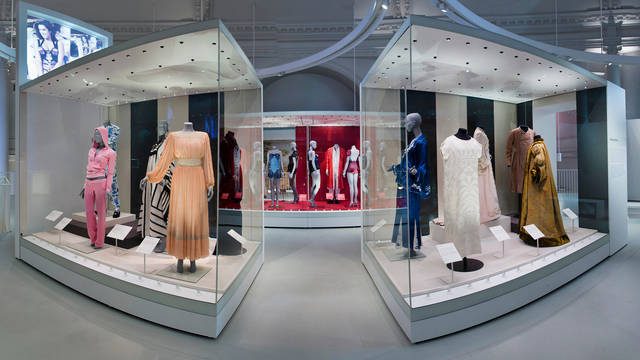
The Burberry Trench: Crafting an Icon is a compact display in the Prince Consort Gallery at V&A South Kensington, London. Entry is free, with no booking. It runs until 3 January 2027.
The museum presents it as a short history of the Burberry trench: from practical outerwear and military dress to a fashion symbol recognised worldwide, rooted in contemporary British design.
The word short matters. This is not a large exhibition over many rooms. It is a case, a row of objects, a story told quickly. That brevity suits the coat: a shape settled long ago that needs few words.
Trench means a dug ditch. The name still holds the years of the First World War, when officers wore this kind of coat on the Western Front. The garment carries the name of the place it stood in: wet ground, mud, rain that did not stop.
Cloth first, shape later
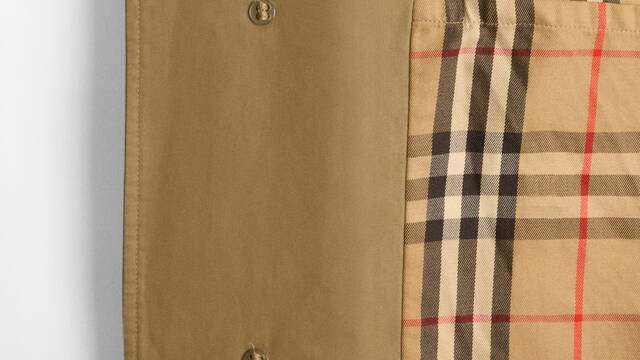
Burberry began with Thomas Burberry's shop in Basingstoke, in the south of England, in the mid nineteenth century. What made the name was not a shape but a cloth: gabardine, tightly woven, resistant to rain and wind yet breathable, developed by Thomas Burberry in the late nineteenth century.
The coat came after the cloth. Gabardine coats were worn for hunting, fishing, long walks, and further journeys. When war came, the fabric went into uniform. Every trench detail has a practical reason: a collar to turn up against cold wind, a belt to hold the coat close, shoulder straps, a double row of buttons.
The V&A collection holds Burberry objects across the decades, showing how long the coat has lived. There is a Burberry pattern book made in London around 1908 to 1910. A ski suit from around 1929. Raincoats from the early 1970s and from 1988. A trench from 2014 designed by Christopher Bailey.
Moving from one to the next, one thing is clear: the shape barely changes. What changes is the cloth, the colour, the cut at the shoulder, the length of the skirt.
Trenches that are not quite trenches
The display does not only show classic coats. It sets side by side the moments when the coat was questioned.
A women's catalogue from around 1937 to 1944, where the trench is already familiar in a woman's wardrobe. A Hardy Amies car coat of 1979 with a personalised label. A men's trench in pink metallic silk, Spring/Summer 2013. A men's trench with mirror embroidery, Autumn/Winter 2015. A women's fringed trench in a purple baroque print, Winter 2025. And a men's knitted duck hat, Winter 2023.
The duck hat may be the odd one out. Yet it says something about English weather: a duck does not fear rain.
The pink metallic and mirrored trenches could no longer stand the mud of a trench. They keep the shape while the function has moved. The coat no longer shields someone from rain. It lets others recognise a familiar form.
When a shape becomes a symbol
The word icon in the title can sound like advertising. Looked at closely, the story is about a shape clear enough to survive every variation.
A trench can be silk, wool, printed, mirrored. Viewers still name it. Collar, belt, buttons. Those few lines are enough.
That is what designers often look for and rarely find: a shape remembered by the body, without a label. The trench has it because it was worn through a great deal of real rain before it was worn on a runway.
For more on how the V&A has looked at men's clothing across centuries, Penta has written about Fashioning Masculinities. The trench, once an officer's coat, belongs to that story too.
Fashion as Design