
Essays · Contemporary Art
Cai Guo-Qiang. Head On.
The leader hits the wall. The pack keeps running.
Solomon R. Guggenheim Museum · Solomon R. Guggenheim Museum
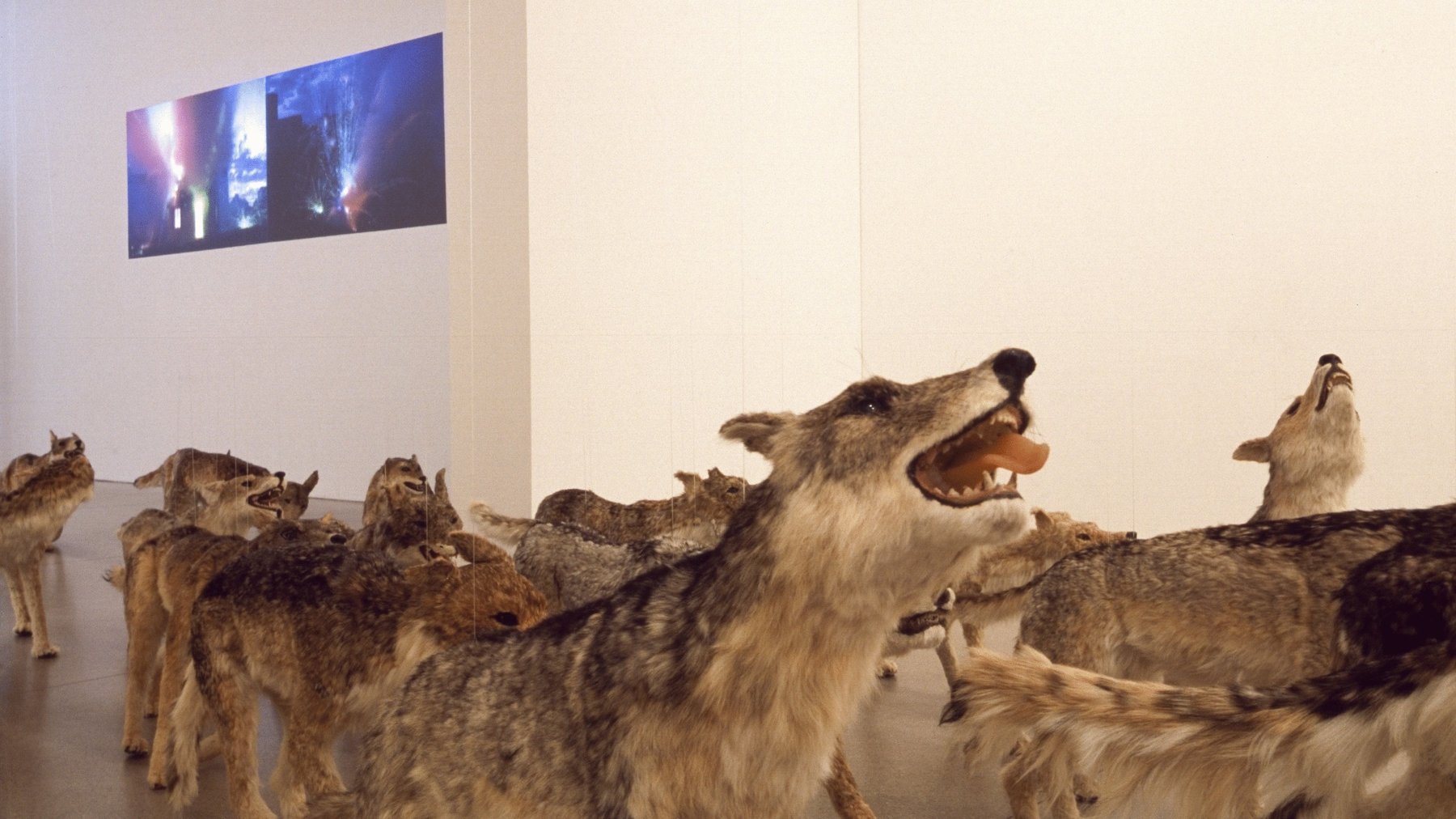
A pack of wolves in a gallery
In 2006, from 26 August to 15 October, the Deutsche Guggenheim in Berlin held Cai Guo-Qiang's first solo exhibition in Germany. Its central work was called Head On.
In the room were ninety nine wolves, life sized, made of gauze, resin and hide. They ran in a long stream, left the ground, arched through the air, and charged straight at the gallery's eastern wall. At the end of their flight stood a pane of glass.
The leader strikes the glass. Those behind are still charging, bodies frozen mid leap. Seen from end to end, the stream reads as a loop: run, fly, collide, run again.
Not one wolf could see the wall. Each could only see the wolf in front.
A wall in Berlin
The museum presented the exhibition as a concept with a particular link to Berlin. It is hard to stand before a wall in that city without thinking of the wall that once divided it.
But the glass in Head On differs from the old wall in one way: it is transparent. It does not block the view, only the path. The Berlin Wall has fallen, yet invisible borders between people remain: habits, prejudice, what a whole pack believes without anyone checking.
Cai does not explain the work with slogans. He offers an image: a strong, handsome, living pack rushing into something it cannot see. Viewers decide for themselves where they stand in that image. In the pack, at its head, or outside, looking through the glass.
Gunpowder, feng shui and a vortex
Cai Guo-Qiang was born in China and lives in New York. Across his career he has drawn on a wide range of symbols, stories and materials: feng shui, Chinese medicine, and above all gunpowder.
Before the Berlin opening he gave a performance to make Vortex, a drawing in several kinds of gunpowder, nine metres by four. On the paper, thousands of wolves swirl into a single organic, forceful shape. It is the pack from Head On, in the form of burn marks.
The exhibition also showed the video Illusion II, documenting a firework performance made before the opening. The three works belong together: a pack of wolves in matter, a pack in ash, and an explosion that survives only as an image.
Head On was commissioned by Deutsche Bank as part of a series of exhibitions drawn from its corporate collection, curated by Friedhelm Hütte and Ariane Grigoteit. In 2009 it was shown at the Guggenheim Bilbao.
Why the crash keeps repeating
A painting usually holds one moment. Head On holds a loop. There is no last wolf. There is no point where the pack stops to see what happened to the leader.
What makes the work stay in the mind is not the crash but what follows it. One collision could be an accident. Ninety nine is a collective habit. The work offers no answer. It only gives viewers another place to stand, far enough away to see the pack and the wall at once.
In the room, viewers find themselves where the wolves are not: outside the loop. From there, the wall is plain to see. The question left is where we usually stand in our own lives. Another essay on invisible walls, this time made of sound, is Lawrence Abu Hamdan's Walled Unwalled.
Contemporary Art