
Essays · Olfactory Art
Carla Bengtson. Every Word Was Once an Animal.
Every species has a language. Some can only be smelled.
© Carla Bengtson · Carla Bengtson (official site)
A lizard that nods
The western fence lizard, Sceloporus occidentalis, lives along the American West Coast. It communicates in two main ways. The first is gesture: head bobs, push ups, each pattern with its own rhythm. The second is smell: chemical molecules left on rock and soil.
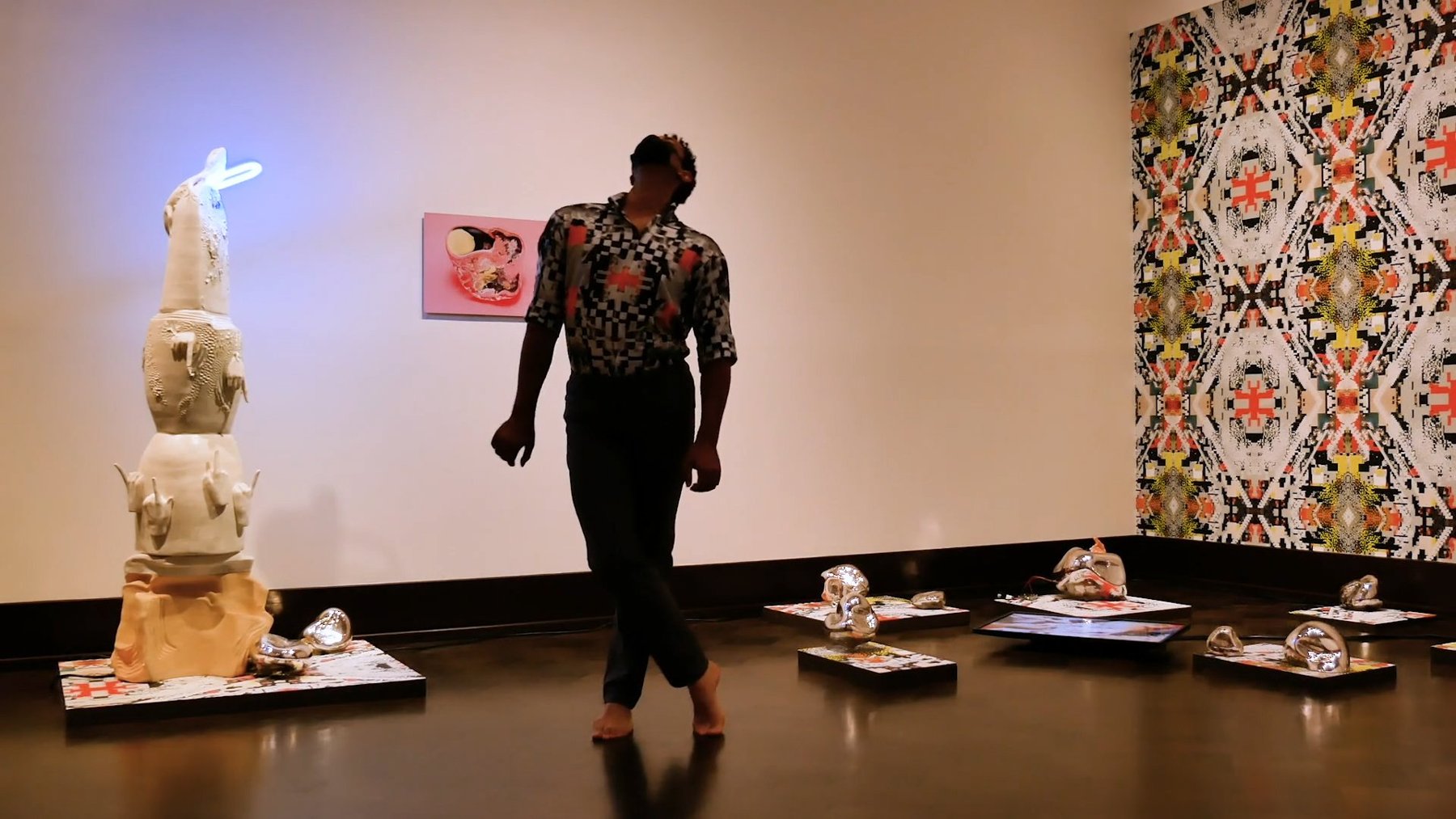
The artist Carla Bengtson spent years studying that language, working with Emilia Martins, a researcher of this lizard's communication behaviour. Every Word Was Once an Animal is the exhibition that came of it, presented at the Jordan Schnitzer Museum of Art, the University of Oregon's museum in Eugene, in 2020.
The show was scheduled to run from 7 March to 26 July 2020 and was later extended to 29 November. It was the year of the pandemic, and some of the dance performances had to be cancelled.
According to the artist's site, the project was one of five finalists for the Sadakichi Award of the Art and Olfaction Awards in 2019.
A perfume called Sceloporus sp.
At the olfactory centre of the exhibition is a perfume named after the lizard: Sceloporus sp. It is built from the main scent compounds the species uses to communicate, described by the artist as floral jasmonates and pyrazines.
The result is a smell humans find familiar. The project's description mentions facets found in white wine, citrus, coffee and chocolate. This is worth pausing on. A smell a lizard uses to claim territory or find a mate, placed under a human nose, recalls a dinner table and a glass of wine.
One species' language, passed to another, does not vanish. It changes meaning. The lizard reads information in it. The human reads a memory. Same molecule, two readings, neither wrong.
Hands, voices, dance
Smell is only one part. Bengtson built a whole system of other languages around it.
Silicone robotic hands were programmed to repeat the actual head bob patterns of Sceloporus occidentalis. Mirrored glass rocks were scattered through the space, recalling the stones on which lizards perform their displays.
The composer Juliet Palmer wrote a piece for five voices in which the singers respond to the perfume, as if singing what they smell. The choreographer Darion Smith performed dances in costumes based on camouflage. The artist Jessie Rose Vala made the video work, including a projection of people imitating the lizards' push up displays.
None of these parts explains another. They stand side by side. Visitors move among them as among several languages, each speaking about the same animal.
Humans at the edge
The title suggests an idea: every word was once an animal. One reading is that human language did not begin from nothing. Before words there were gestures, calls, smells. Those layers are still somewhere beneath our speech.
The work places humans in the role of learner, not teacher. For centuries people observed animals in order to classify and use them. Here the question changes: if we really wanted to understand a lizard, what would we need to learn?
That question is close to other multispecies projects in olfactory art, such as Maki Ueda's Dog's Nose, in which people follow a dog to learn how it smells a city. Bengtson follows a smaller, quieter animal and uses more languages to come near it.
What stays with you is the patience. There is no finished translation. Only attempts, through smell, hands, voice and body, to listen to a species that does not speak our tongue.


Olfactory Art