
Essays · Contemporary Art
Cecilia Vicuña. Brain Forest Quipu.
Each knot is a way to remember.
Tate Modern · Tate Modern
Two white skeletons in the turbine hall
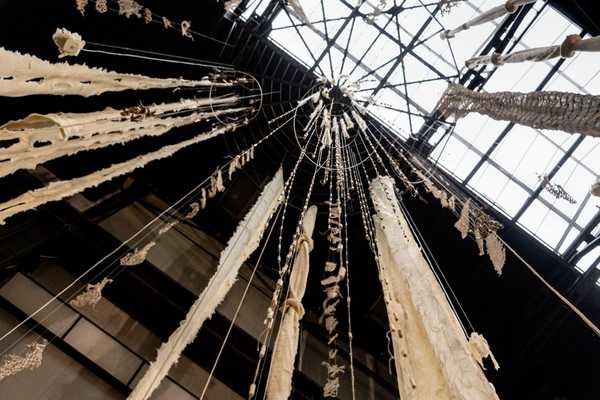
In October 2022, at either end of the Turbine Hall at Tate Modern in London, two masses of white fibre hung from the ceiling. Each was twenty seven metres tall. From afar they looked like dead trees, their bark bleached by drought or fire. Closer, they looked like shed snakeskin, like bone, like things drained of water.
Tate calls the pair Dead Forest Quipu. They are the sculptural part of Brain Forest Quipu, Cecilia Vicuña's Hyundai Commission, on view from 11 October 2022 to 16 April 2023.
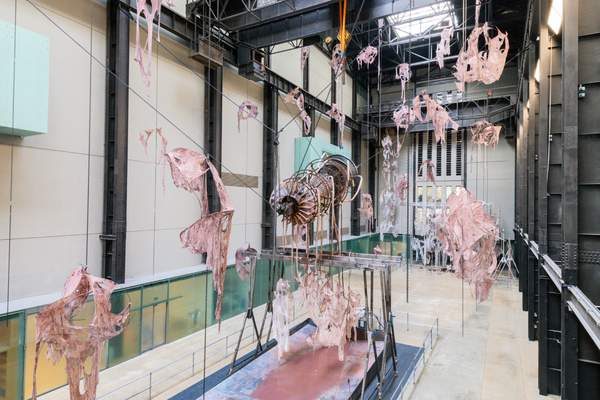
The list of materials reads like an inventory. Unspun wool, cotton tape, cotton gauze, cotton rope, hemp rope, jute net, twine, recycled packing paper, cardboard, khadi paper, bamboo sticks, plant fibre. Clay paint, resin and paint. Bones, pipes, sticks, glass and ceramic mudlarked from the Thames. All of it hung from two steel structures.
The riverbank objects were gathered by women from Latin American communities in London. Vicuña returned to the city through September and October to build the work with local makers. Placing the two masses at opposite ends, she set a second architecture inside the old one: two anchors, and a span between them for visitors to cross.
The quipu, a poem in space
Quipu, also written khipu, means knot in Quechua. A main cord from which many smaller cords hang, knotted in different ways, dyed in different colours. Andean peoples used it from around 2500 BCE until the sixteenth century. It is thought to have recorded numbers, and perhaps poems and stories. Many of its knots can no longer be read.
After the European conquest, quipus were banned and burned. In Vicuña's telling, the idea survived. It lives on in Andean culture as an image of connection: body, community and cosmos tied by a single cord.
Vicuña was born in Chile in 1948 and is both poet and artist. She studied fine art at the University of Chile in Santiago, then at the Slade School of Fine Art in London in 1972. After the coup against President Salvador Allende she stayed in London in exile until 1975, as a founding member of Artists for Democracy. She then lived in Bogotá until 1980 and now divides her time between Chile and New York.
She has worked with the quipu for more than fifty years. Her quipus do not copy the old form. They are poems, sculptures, performances, sound, film. A word, a gesture, a group of people can each become a knot.
Eight hours of breathing
Brain Forest Quipu is not only to be looked at. Sound comes from inside the two masses and from beneath the bridge. Tate calls it the Sound Quipu, conceived by Vicuña, directed by the Colombian composer Ricardo Gallo and arranged with Ariel Bustamante.
Indigenous music from several regions, composed silences, new pieces by Gallo, Vicuña and others, field recordings. Four tracks of about eight hours each, 168 files from 23 contributors and one archive. Walking through, you meet sound, then none. Tate describes it as eight hours of the earth breathing.
A further layer, the Digital Quipu, played on screens around the building and online: videos by Indigenous people defending land, forest and water in many countries, using digital platforms to carry their voices further. Vicuña calls this web of connections social weaving.
An elegy with an invitation
Tate reads the work as an act of mourning: for destroyed forests, for a changing climate, for violence against Indigenous peoples. But also as a space where other voices and other ways of knowing can be heard.
Vicuña wrote that the Earth is a brain forest, and the quipu embraces all its interconnections. In that view a forest is not a collection of trees. It is a network that remembers. Cut part of it, and the whole loses a stretch of memory.
The Turbine Hall once held a power station's generators, where coal and oil became electricity for the city. To hang a dead forest of fibre and river debris there is to set two histories side by side. In the same commission series, Máret Ánne Sara also brought Sámi knowledge into the hall, in a very different way.
The two white forms promise nothing. They grow no leaves. But a cord is always waiting for another knot. Walking between the two ends of the hall, through sound and silence, visitors walk the length of such a cord.
Contemporary Art