
Essays · Modern Art
Magdalena Abakanowicz. Embryology.
Every living thing begins with fibre.
Tate · Tate
Soft forms on the floor
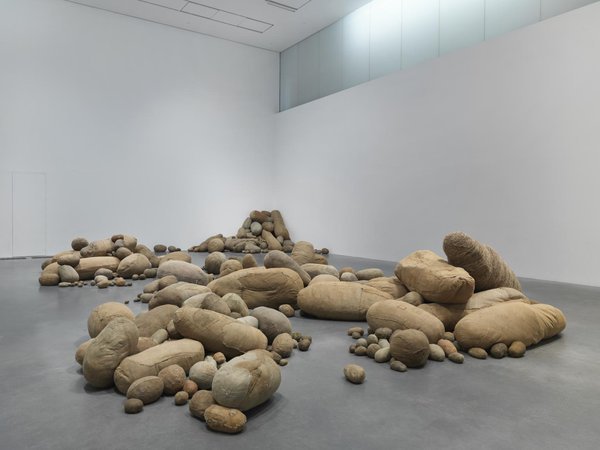
In 1978 Magdalena Abakanowicz began a new series of ambiguous forms she called Embryology. The group Tate holds is dated 1978 to 1980. Its materials are burlap, cotton gauze, hemp rope, nylon and sisal.
Each form was made by bundling fabric and fibre together, binding it tight and stitching it, until it became a rounded, soft, irregular mass. Some are small, some large. No two are quite alike.
They are not hung and not placed on plinths. They lie scattered across the floor, close together, like a clutch of eggs, a nest of cocoons, or the organs of some creature just opened up.
In a film from 1982 she holds a crescent shaped needle, stitching up the soft interior of a burlap sack. The movement is slow and sure, like closing a wound. The work does not come from carving or casting. It comes from bundling, binding, stitching, gestures closer to tending a body than to building a statue.
Eight hundred forms in Venice
In 1980 Abakanowicz was invited to exhibit in the Polish pavilion at the Venice Biennale. Eight hundred Embryology forms were shown together there. That same year, in Poland, the Solidarity trade union was founded, after a decade of political unrest that began in 1970.
She explained what drew her: the contents, the inside of soft matter. Soft, for her, meant organic, alive. She asked what makes matter alive, and where its individuality begins. The forms, she said, answered an almost physical need to make bellies, organs, an invented anatomy. In the end, a soft landscape of countless related pieces.
In hindsight the title is exact. Embryology studies what happens before a body takes shape. Her forms stand at that threshold: already shaped, not yet anyone.
Fibre beneath all living things
In 1978, at a fibre art symposium in Oakland, California, Abakanowicz said she saw fibre as the basic element constructing the organic world on our planet. The tissues of plants, of leaves, of ourselves are built from it. Nerves, genetic code, veins, muscles. We are fibrous structures.
That explains why she never treated burlap and rope as lesser materials. They are the materials closest to the body. She called rope a petrified organism, a muscle devoid of activity. Moving it, rearranging it, touching it, she learned its secrets.
Her childhood was bound to the forest around her grandfather's manor house in Poland. All her life she kept horns, hides, shells, cocoons and other organic things near her, sometimes working them into sculpture. Embryology carries that attention: looking at living matter as something both familiar and strange.
She disliked being labelled a fibre artist. From the 1980s she used other materials too, while keeping burlap and sisal for increasingly figurative work. In 2022 Tate Modern opened a major exhibition of her work, Every Tangle of Thread and Rope. Contemporaries such as Louise Bourgeois built spaces around the body and memory, each in her own way. Embryology still lies there, on the floor, soft and silent, as if waiting for something yet to come.
Modern Art