
Essays · Photography
Claudia Andujar. The Yanomami.
Some things only appear when the edges blur.
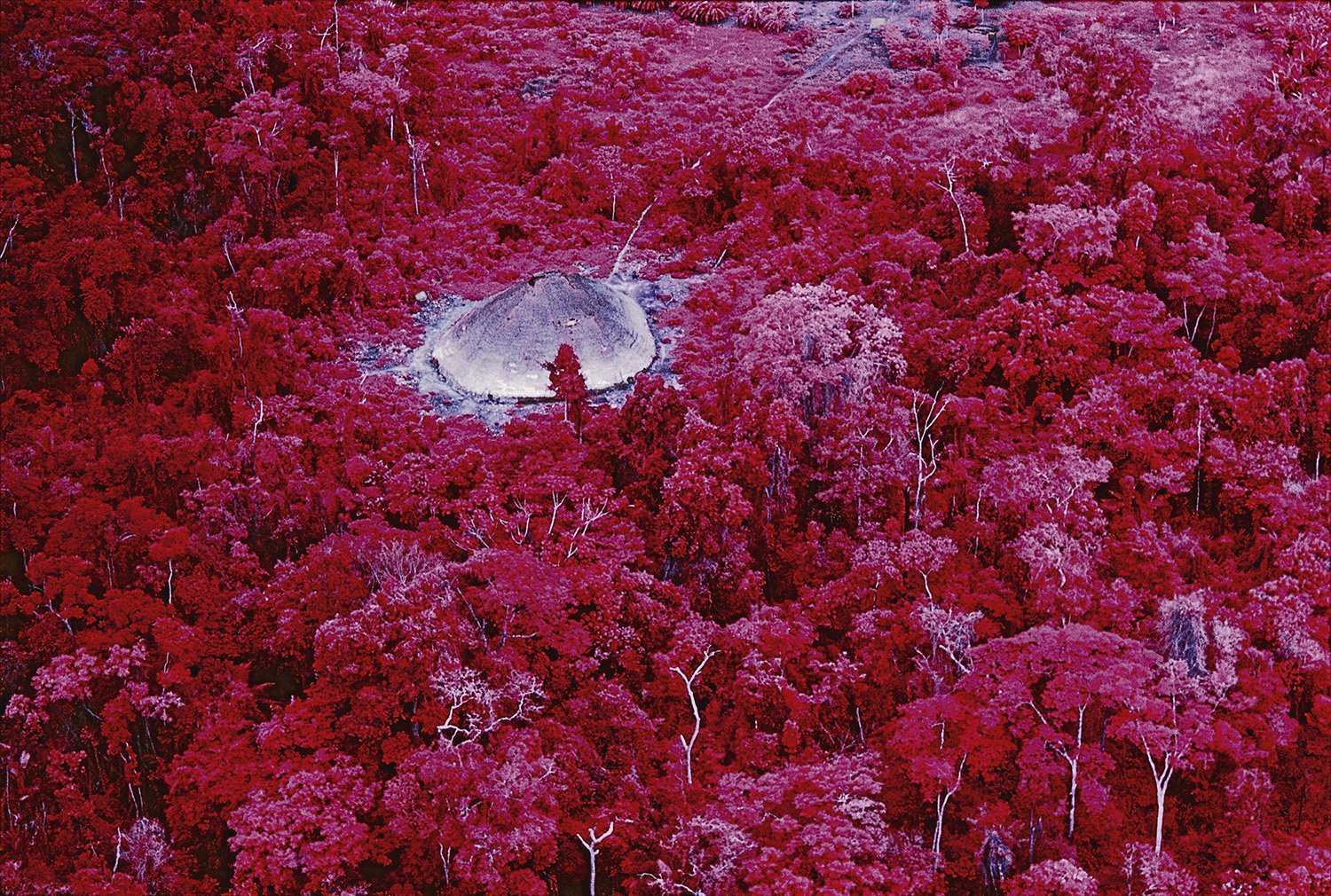
Courtesy the artist and Galeria Vermelho, São Paulo · Aperture
A survivor reaches the Amazon
Claudia Andujar was born in Neuchâtel, Switzerland, and grew up in Oradea, in Transylvania. Her father was a Hungarian Jew. In 1944 he was deported and died in a concentration camp. Her Swiss mother fled with her to Switzerland. In 1947 Andujar reached New York as a refugee. In 1955 she moved to São Paulo.
In Brazil she gave up painting and taught herself photography. From 1966 to 1976 she worked for the magazine Realidade, photographing communities on the margins of Brazilian society. Her pictures also appeared in Life and in Aperture.
In 1971 Realidade produced a special issue on the Amazon. On that trip Andujar met the Yanomami for the first time. The meeting shaped the rest of her life.
It is hard not to set these two parts of her life side by side. Someone who lost her father to a policy meant to erase a people later spent her life standing beside another people under threat. Andujar never made this a slogan. But it explains why she was never a photographer merely passing through.
Photographing what cannot be seen
After the first trip Andujar went back many times and stayed for long periods, supported by two Guggenheim fellowships. She photographed daily life in the large communal houses in the forest, children, elders, gatherings. Gradually she saw a limit: the camera sees only surfaces, while what matters most in the Yanomami world lies in what the eye cannot see.
The Yanomami live among spirits. Shamans enter trance to meet and speak with them. Andujar wanted her pictures to reach that far.
She tried everything. Vaseline on the lens to soften the image. Flash and oil lamps so light would smear into streaks. Infrared film so colour would drift from reality. Long exposures, multiple exposures, so a dancer would leave several shadows.
The result is pictures in which the line between person and smoke, body and light, almost dissolves. No one looking at them understands everything. But they carry the sense that something else is in the frame besides what we see.
Much of this work was in colour, at a time when documentary photography was still largely black and white. The red of fire and the shifted hues of infrared became part of her own language.
Photography as taking a side
From 1974 the Brazilian government cut the Perimetral Norte highway through Yanomami land. The road brought outsiders, and with them diseases the community had never met. Andujar saw this from the inside.
In 1977 the authorities forced her to leave Yanomami territory. She did not stop. From the late 1970s she campaigned with others for Yanomami land to be recognised and protected. In 1992 the territory was officially demarcated. From then on, photography for her was not only art but a political act.
Today her work has a permanent pavilion at Inhotim, in Minas Gerais, opened in 2014. In 2015 the Instituto Moreira Salles in Rio de Janeiro mounted a major exhibition organised by Thyago Nogueira.
Like Cecilia Vicuña in Brain Forest Quipu, Andujar treats the forest not as scenery but as a place with people, memory and a voice. Her pictures remind us that what is under threat is not only the trees.
Photography