
Essays · Photography
Diane Arbus. A box of ten photographs.
Choosing ten means deciding what stays outside.
Fraenkel Gallery · Fraenkel Gallery
Ten prints, one box
Around 1970, Diane Arbus began making a portfolio. She chose ten photographs she considered the most representative of her work, printed each on a 20 x 16 inch gelatin silver sheet, and placed all ten in a box.
The box was clear Plexiglas, designed by Marvin Israel, a painter and designer and a close friend of Arbus. The box carries no decoration. It looks like a block of frozen water holding black and white pictures.
Arbus planned an edition of fifty. When she died in 1971 she had finished printing eight sets. Only four sold in her lifetime. Richard Avedon bought two, one for himself and one as a gift to his friend, the director Mike Nichols. Jasper Johns bought one. The fourth went to Bea Feitler, art director of Harper's Bazaar.
Four buyers, all insiders. At the time, the idea that a photographer could sell prints as works of art was still new. The box made a quiet claim: these pictures are not there to illustrate an article. They stand alone.
Titles as long as sentences
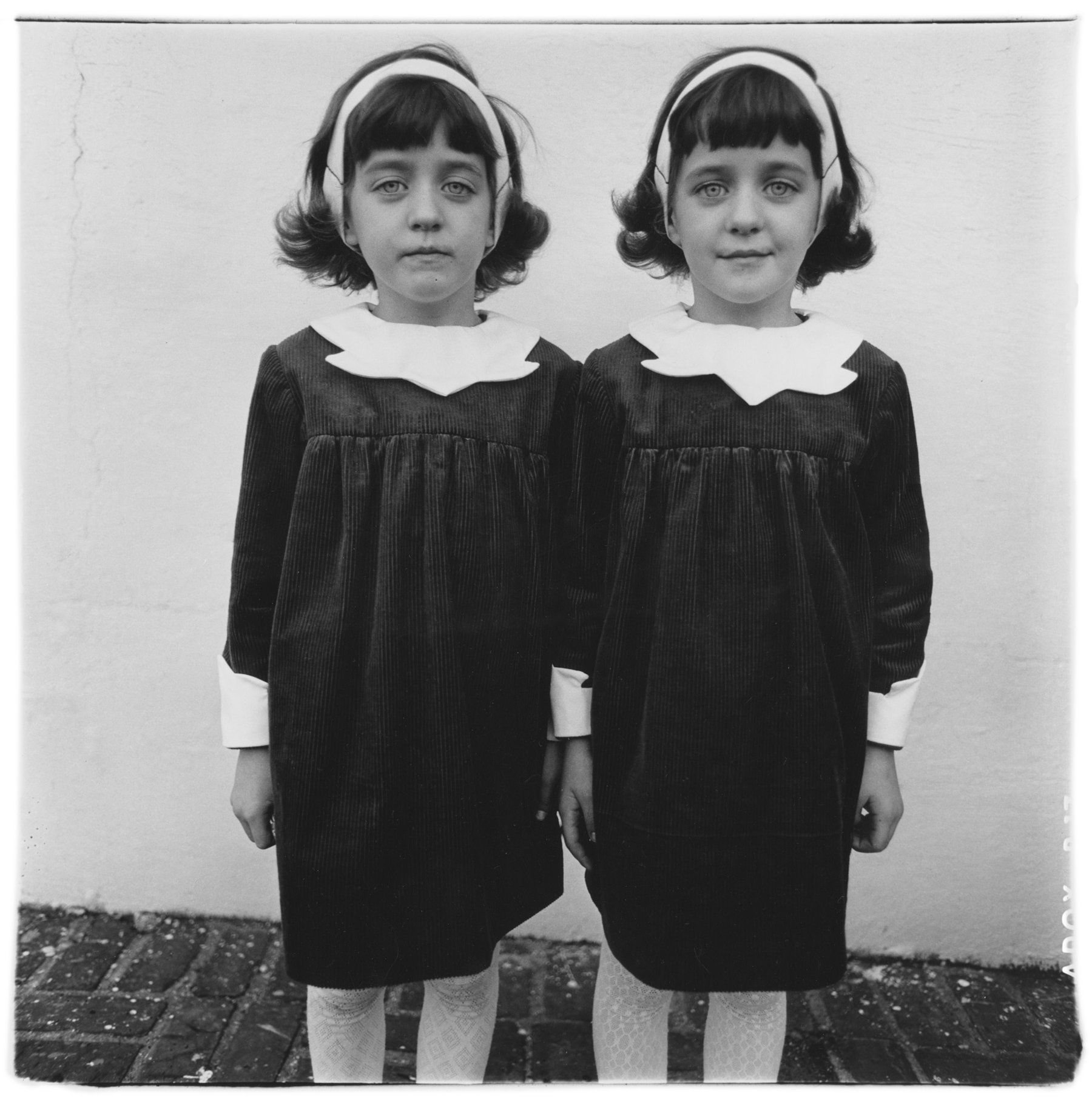
The ten photographs were taken between 1963 and 1970. Their titles read like field notes. Identical twins, Roselle, N.J. A young man in curlers at home on West 20th Street. A Jewish giant at home with his parents in the Bronx.
Some scenes are so ordinary they are easy to pass over. Xmas tree in a living room in Levittown. A family on their lawn one Sunday in Westchester. The king and queen of a senior citizens' dance.
Arbus's titles hardly interpret. They say who, where, sometimes when. Like a passerby noting an address. The rest is left to the viewer.
Together the ten pictures tell no single story. They are a cross section of America in the sixties: families, small celebrations, people living at the edges of the image society wanted of itself.
A last project
A box of ten photographs was one of the last projects Arbus was working on when she died. It carries a weight she perhaps did not intend. The box became an artist's own selection, arranged by her hand, at a moment when she could make no more.
Choosing is hard for anyone who makes things. Choosing ten means deciding that others, however good, stay outside. Arbus did not let anyone do it for her. She printed, she selected, she asked her friend to design the box.
Later the box came to be seen as one of the foundations of her posthumous career. It also helped move photography into the place of a serious art, collected and hung in museums. Surviving sets now sit in major collections and are shown as complete works.
Yet what stays with the viewer is perhaps not that history. It is the feeling of standing before a clear box and knowing that the ten faces inside were chosen by someone who looked at them for a long time, very closely, and did not turn away.
Photography