
Essays · Contemporary Art
Do Ho Suh. Staircase-III.
A home that can be folded and carried.
Tate · Tate
A staircase not for climbing
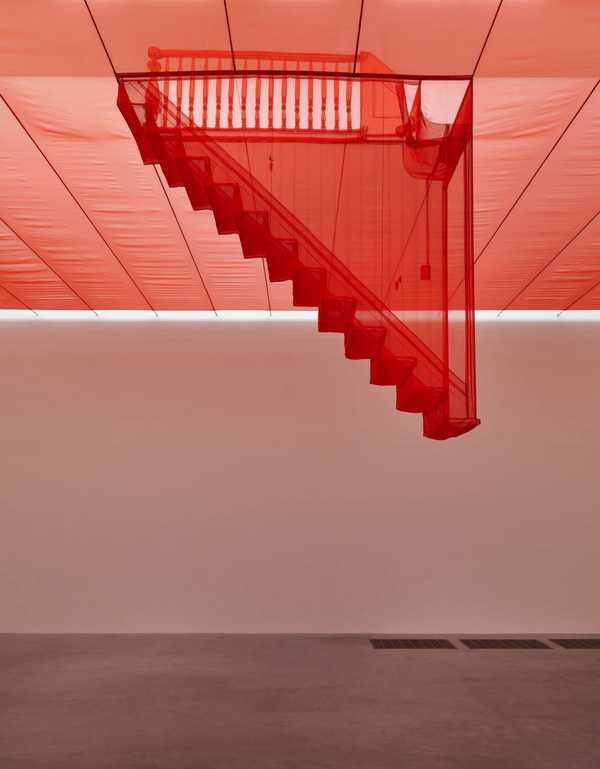
Staircase-III is a staircase made of fabric. According to Tate's record, the materials are polyester and stainless steel. The fabric is red, thin and translucent. The steel is slender and gives the fabric its form. Its display size varies with the space.
The staircase is suspended, hanging in mid air. Viewers stand beneath and look up. They see each step, each handrail, each baluster, all in fabric and all see through. The room's light passes through the polyester and stains the ceiling and walls behind it red.
The model is the staircase in the building where the artist once lived in New York. Tate links the work to Chelsea in Manhattan. Do Ho Suh measured that staircase and sewed it again at its real size.
He made the work in 2010. Tate bought it in 2011 with funds from its Asia Pacific Acquisitions Committee.
Measuring a home in fabric
Do Ho Suh was born in Seoul in 1962. He moved to the United States in the early 1990s to study art, then stayed, working between several cities. Living away from home became his central subject.
From the late 1990s he began sewing again the places he had lived. First his parents' traditional house in Seoul, in silk. Then his New York apartment, then rooms, corridors and doorways in other cities. All at a scale of one to one.
The process is exacting. The artist and his team measure every detail of the real room: sockets, door hinges, handles, steps. Then they cut, sew, stitch edges and build frames. The result is a complete copy with no weight.
Because they are fabric, these homes can be folded. They fit in a suitcase, can be shipped, can be raised in another museum. A person who leaves home can carry the home along, quite literally.
A staircase is a passage
In a house, a staircase is not a place to live. It is a place to pass. From one floor to another, from private to shared, from inside to the street. Few people stop on a staircase. Yet everyone remembers the number of steps, the one that creaks, the worn part of the rail.
Choosing a staircase means choosing the moment in between. People living far from where they were born know that feeling: not quite belonging to the old place, not yet to the new. Staircase-III hangs free, touching no floor, joined to no level. It is a passage that leads nowhere.
The red makes the work both vivid and soft. It does not look like a technical drawing, nor like decoration. It looks like a memory that has been dyed: every line clear, yet impossible to touch as a real object.
Tate files the work under memory. That may be the closest reading. Memory cannot bear our weight, but it keeps the shape of the places we have passed through.
Why it stays
Rachel Whiteread filled an entire London house with concrete to keep the empty space inside it, in her work House. Do Ho Suh does the opposite. He keeps the shell and makes it so thin it almost dissolves into air. One heavy and solid, the other light and hollow, both ask: what remains of a home once people leave?
Staircase-III answers very lightly. A red staircase, suspended, that no one can climb, yet everyone standing beneath it remembers a staircase of their own.
Contemporary Art