
Essays · Olfactory Art
Ed Ruscha. Chocolate Room.
Ink can also be a smell.
LACMA; © Ed Ruscha · LACMA Unframed (Los Angeles County Museum of Art)
A tube of chocolate in a supermarket
The story starts at a shelf. Ed Ruscha came across tubes of chocolate paste in a supermarket. They looked exactly like tubes of oil paint. For someone used to printing ink and silkscreens, the likeness was enough to become a question: if this also squeezes out of a tube, can it be printed?
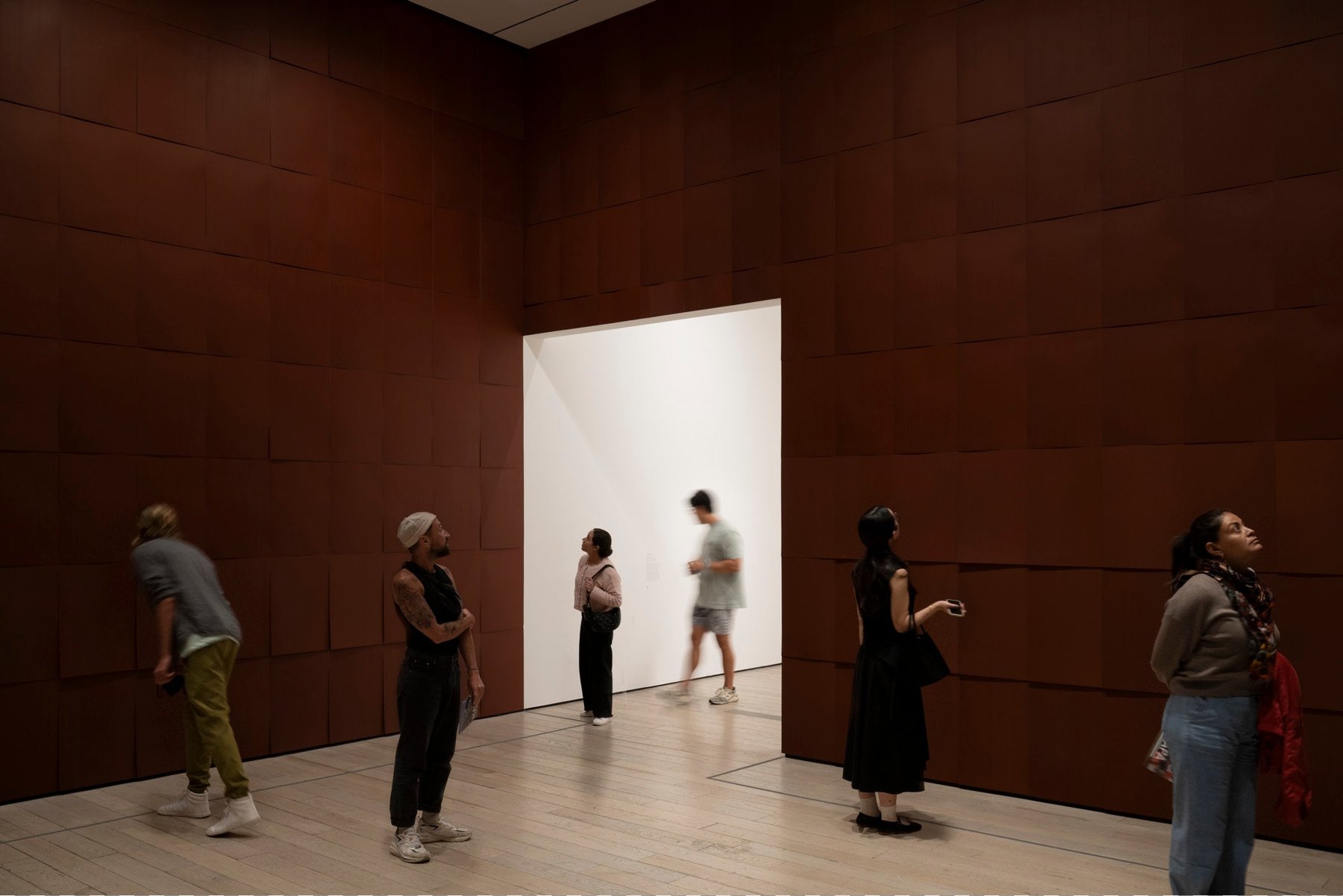
In 1970 Ruscha was invited into the American Pavilion at the 35th Venice Biennale. The room he was given was the one devoted to printmaking. He answered his question there. Nestlé chocolate was screen printed onto 360 sheets of paper, and the sheets were tiled across all four walls.
No image. No words. Only an even brown, repeated sheet after sheet, like shingles running from floor to ceiling.
Ruscha was known for word paintings, gas stations, photobooks of Los Angeles streets. Around this time he was also printing with organic substances in place of ink. Chocolate Room is the moment such a material grew to the size of a room.
A room that would not keep still
An ordinary silkscreen is finished once it dries. Chocolate never quite dries. Summer in Venice is hot and humid. The room gave off a sweet smell, the paper surface softened with the weather, and ants found their way in.
Visitors did not only look. They smelled the room before they understood it. Chocolate smells of sweets, of the grocery counter, of childhood. It does not belong in a museum. Putting it on the walls of a national pavilion placed something ordinary in the most formal setting there is.
So the work was never fixed. It shifted with the day, the temperature, the people coming through. The brown on opening day was not the brown on closing day.
That is also why Chocolate Room cannot be packed away and rehung. Each time it is shown, the room has to be made again from the start.
Remaking a sweet room
In 2003 the Museum of Contemporary Art in Los Angeles acquired the work. MoMA in New York holds a single sheet from the Venice room, titled Untitled (Chocolate Sheet). One brown page, standing alone, is the trace of a room that no longer exists.
In 2024, for the retrospective ED RUSCHA / NOW THEN at LACMA, from 7 April to 6 October, the room was rebuilt on the second level of BCAM. According to LACMA, the team used about 100 pounds of Belgian chocolate, printed on glossy white paper with La Paloma Fine Arts, a local family print shop. The printing happened right on the gallery floor, beside the installation.
The sheets were shingled, overlapping like the roof of a California bungalow. Every rebuild is an experiment: what temperature, how thick a layer, which paper will hold. Visitors may walk in and smell it, but not taste it.
The material did not stop with Ruscha. In 1994 Anya Gallaccio coated gallery walls in dark chocolate for Stroke, and let visitors scratch into it. Two rooms more than twenty years apart ask the same thing: how sweet can a wall become before it stops being a wall.
More than fifty years after Venice, Ruscha's question is intact. What is a work when its material softens, gives off scent, and must be made fresh each time it appears? Perhaps the work is not in the paper. It is in the sweet air between four walls.
Olfactory Art