
Essays · Olfactory Art
Edme Bouchardon. The Sense of Smell.
A counterproof is the trace of a trace.
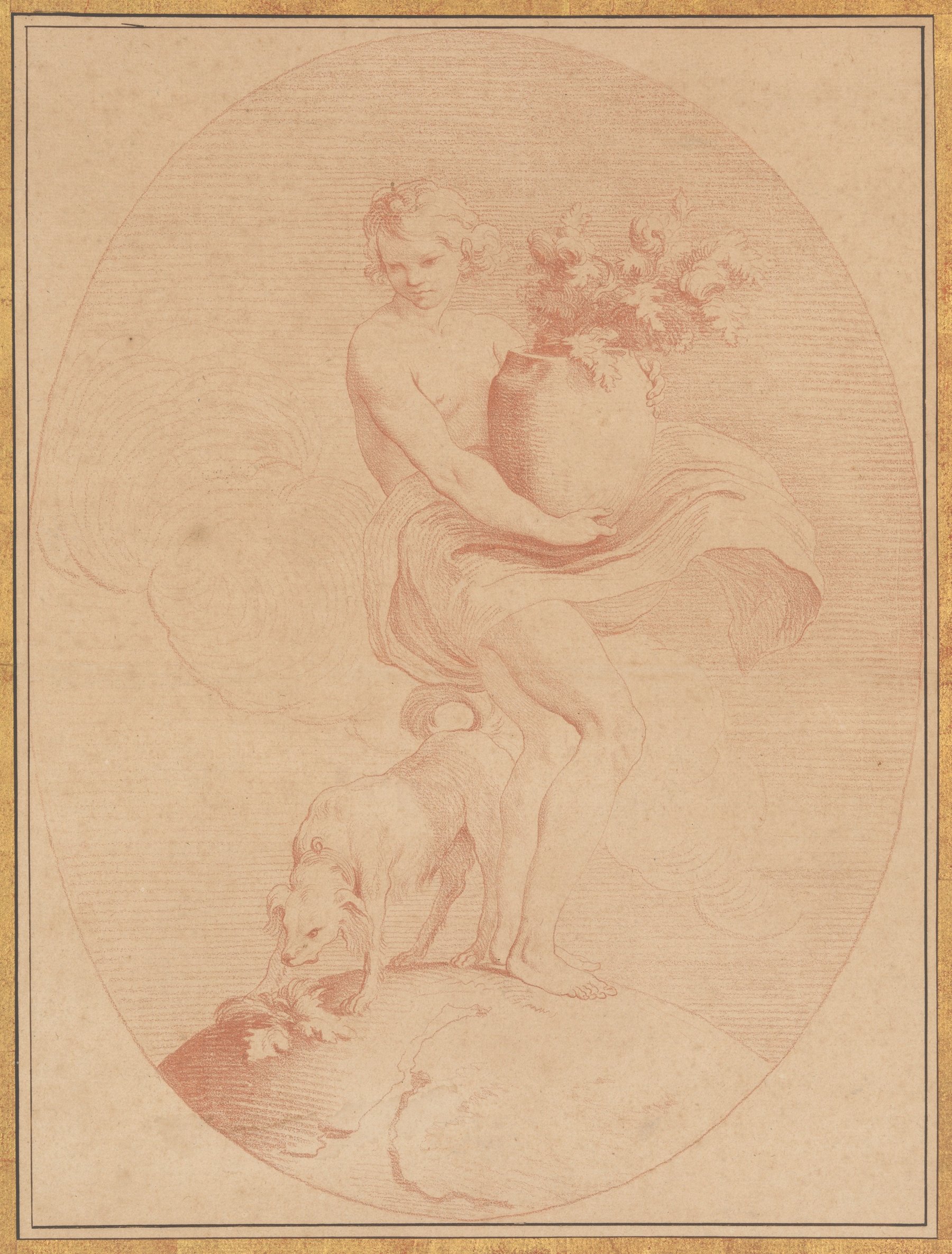
The Metropolitan Museum of Art, Harry G. Sperling Fund, 1973 (Open Access, public domain) · The Metropolitan Museum of Art
A boy, a potted plant, a dog
Inside an oval, a boy stands on a rounded mound of earth, like a small hill. The cloth around his hips swings to one side. In both arms he holds a large earthenware pot, from which a spray of broad leaves rises. His head is lowered; he does not look at us.
At his feet, a small dog with a curled tail puts its nose down to a patch of leaves on the ground. It has no interest in the pot. It is scenting something else, lower down.
Behind them are clouds and a dense ground of horizontal chalk hatching. No room, no garden, no furniture. Only two figures and two ways of approaching a smell.
The title is The Sense of Smell. In European allegory, each sense was often given a human figure and an animal companion. For smell, the dog was the familiar partner, because of its nose. Bouchardon keeps the convention but sets it very close to the ground, very concretely.
A sculptor with red chalk
Edme Bouchardon was born in Chaumont in 1698 and died in Paris in 1762. He is known first of all as a sculptor. In Paris, the fountain on the rue de Grenelle is one of his major works.
He also drew a great deal, often in red chalk. The French call it sanguine, close to sang, blood, because of its colour. Red chalk is soft and warm, well suited to flesh and volume.
Look closely at the background: horizontal strokes run in even parallels around the figure. They recall the marks of a sculptor's chisel on stone. The boy is barely shaded. He is built from contour and a few passages of light and dark, like a low relief on paper.
The Met gives no precise date for the sheet. The museum acquired it in 1973 and describes its medium in two short phrases: red chalk; counterproof. The sheet is about 39 cm tall.
What a counterproof is
A counterproof is made like this. A blank sheet is dampened, laid face down on a chalk drawing or a print, and both are run through a press. The moisture loosens the chalk and some of it transfers to the new sheet. The result is a mirror image, paler than the source.
Red chalk suits the process especially well. It releases readily, and the mark it leaves stays legible.
Why make one? Sometimes to see a composition reversed. Sometimes to keep a second version. Sometimes to start a new image from an old one. The counterproof is an early form of replication, long before photography.
This gives The Met's sheet a small paradox. It is Bouchardon's work, yet no line on it was drawn directly by his hand. Every line has passed through contact. In the original drawing, the dog faces the other way. That is the image we are not looking at.
Smell close to the ground
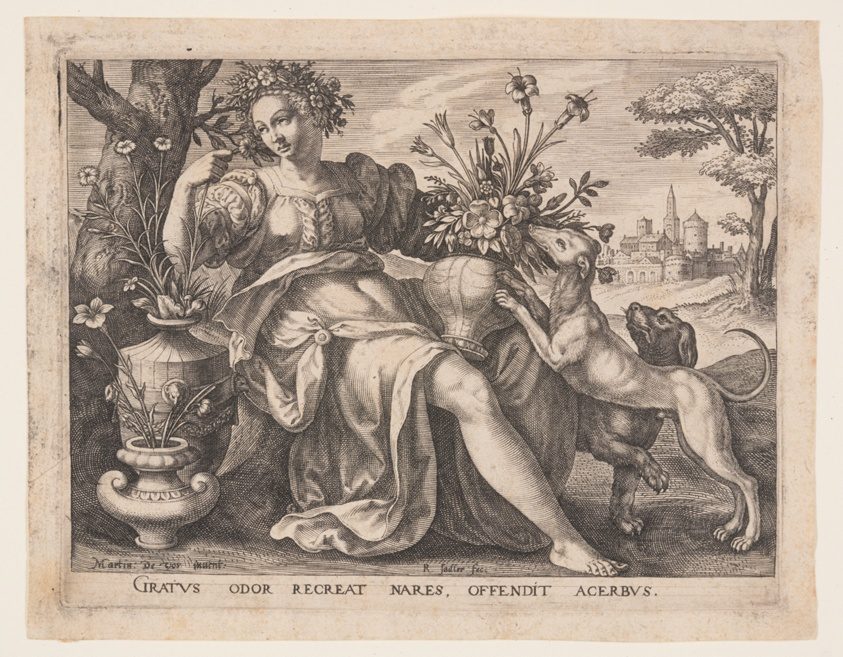
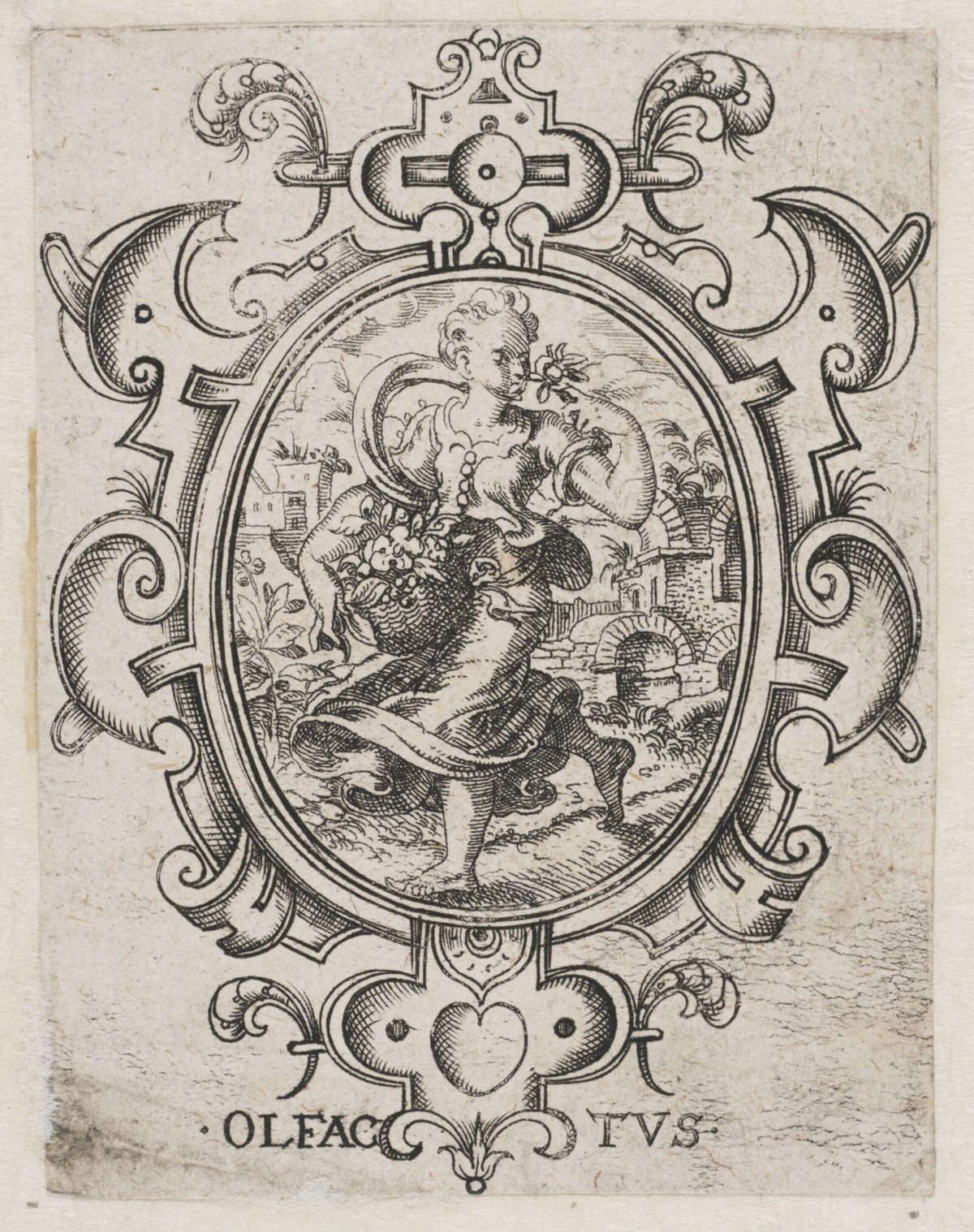
Eighteenth century France produced many allegories of smell, such as Joseph-Marie Vien's Allegory of Smell. Bouchardon's choice is restrained. No perfume bottle, no elaborate bouquet, no lady. Just a potted plant and a dog.
The two figures show two sides of smell. The boy carries scent up high, holding it to his chest like something on display. The dog looks for scent down low, where it clings to leaves and soil after something has passed. One treats smell as a gift. The other treats it as a sign.
Perhaps that is why the sheet rewards a long look. It speaks about smell through a silent image. And it exists the way a scent does: a mark left on a surface after the original has gone.
Olfactory Art