
Essays · Olfactory Art
Edward Kienholz. The Beanery.
A bar is not only seen. It is smelled.
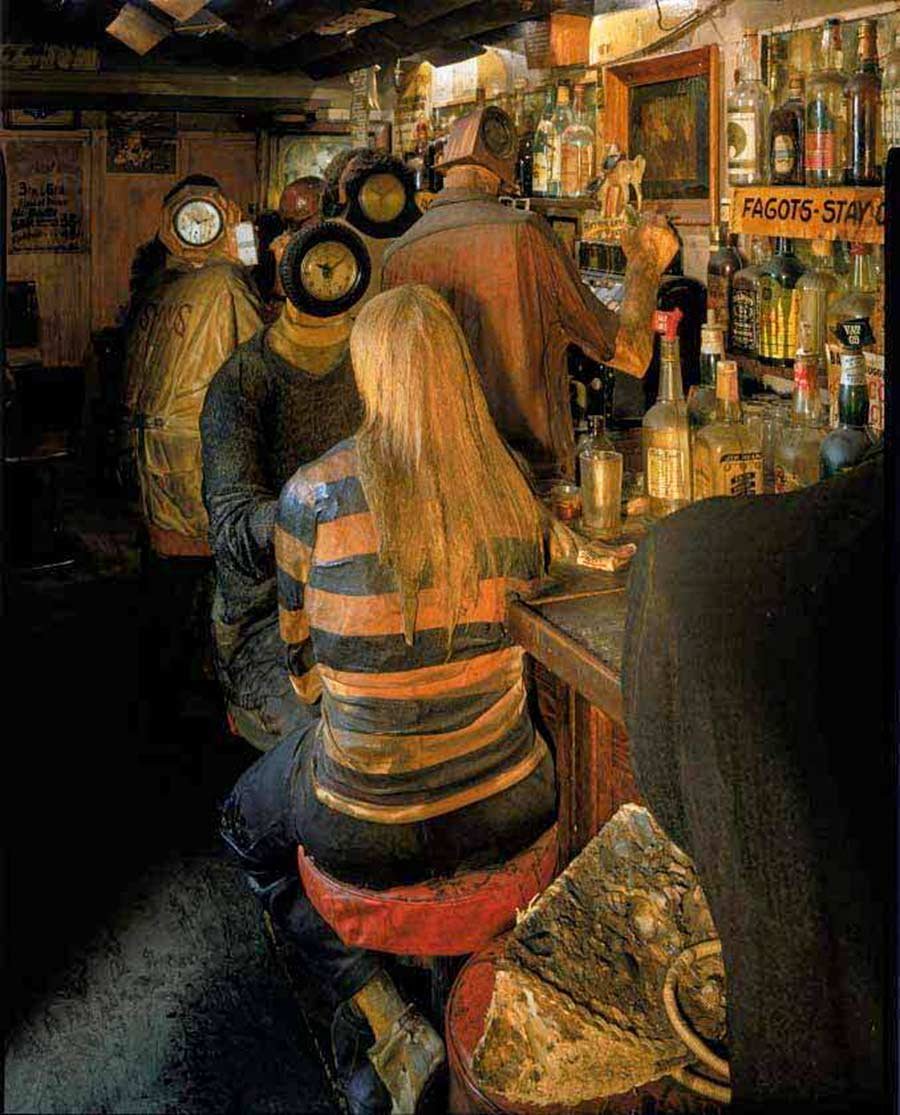
Edward Kienholz, The Beanery, 1965, Stedelijk Museum Amsterdam · Stedelijk Studies (Stedelijk Museum Amsterdam)
A bar you can walk into
In 1965 Edward Kienholz made The Beanery. He rebuilt a Los Angeles bar he frequented, Barney's Beanery on Santa Monica Boulevard, as a life size room. Visitors do not look in from outside. They walk into the bar.
Inside is a dim, worn bar. A counter, stools, customers. Kienholz called this kind of work a tableau: a complete staged scene with furniture, figures and an atmosphere of its own. Not a sculpture on a plinth, not a painting on a wall. An environment.
The Beanery is now in the collection of the Stedelijk Museum Amsterdam. A Los Angeles bar sits in a Dutch museum, nearly half a world from where it began.
Seventeen clock faces
The bar holds seventeen figures. They have no human faces. Their heads are clock faces, the hands fixed at a stopped hour.
That detail changes the whole room. A bar is where people go to kill time. Kienholz stops time altogether. The customers sit, faceless and expressionless, amid jukebox music, side by side and unseen by one another. In Jonas van Kappel's essay for Stedelijk Studies, the work stresses alienation and detachment through its careful staging.
Sound is the second layer: jukebox music fills the room. The third, and the most unforgettable, is smell.
A homemade smell
Kienholz did not want his bar only to look like a bar. He wanted it to smell like one. So he mixed a synthetic odour himself. According to Stedelijk Studies, the recipe combined beer, grease, mothballs, cigarette ash and his own urine.
None of these is anything one wants to smell. Together they are a bar near closing time: beer spilled on the counter, grease from the kitchen, a full ashtray, the toilet in the corner. Anyone who has been in such a place knows it at once, before the eyes adjust to the dark.
Van Kappel argues that the unpleasant smell draws visitors closer to the work. It brings the evoked place near and strengthens the emotional bond between visitor and room. The image tells us this is a bar. The smell makes us believe it.
Keeping a smell in a museum
A painting can be conserved through temperature, humidity and light. A smell cannot. It evaporates. To keep the work whole, the museum has to remake the smell from the artist's recipe.
According to accounts of its conservation, the Stedelijk's restorers have mixed The Beanery's odour many times. After a restoration lasting several months, the work went back on view. It raises a real question for conservation: is what is preserved the object, or the recipe? If the smell is gone, is the work still whole?
For museum staff this is unusual work. They are used to keeping things unchanged. Here they must actively produce an unpleasant smell, just as the artist wanted, so the work remains itself.
The Beanery came almost thirty years after the dark, coffee scented room of the 1938 Surrealist exhibition in Paris. The two rooms are a generation apart but do the same thing: use smell to turn a space into somewhere a visitor truly enters.
Olfactory Art