
Essays · Olfactory Art
Minetta Rogers. Ruminant Dance, Instructions Towards.
Desire takes four steps, then becomes memory.
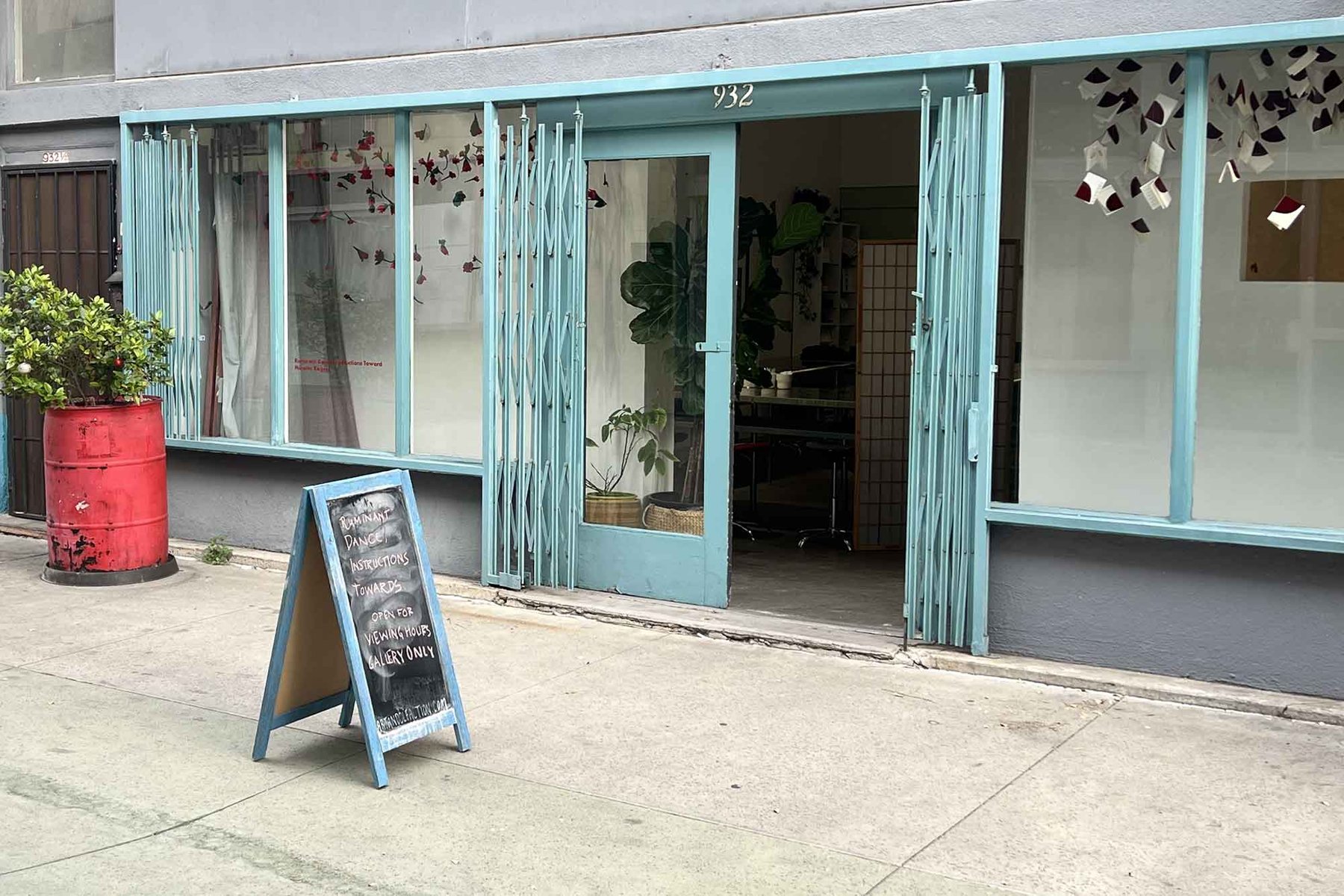
Image credit: Minetta Rogers · Institute for Art and Olfaction
An oyster a hundred years ago
M.F.K. Fisher is among the most remembered American writers on food. In her essay The First Oyster, she recalls eating raw oysters for the first time as a schoolgirl, at a Christmas dance at her school in 1924. The piece is not only about the oyster. It is about a young person learning to want, learning to like a strange taste, and noticing it among the music and the steps.
A century after that moment, Minetta Rogers staged Ruminant Dance, Instructions Towards at IAO Gallery on Chung King Road, Los Angeles, from 6 to 29 December 2024. It opened on the evening of 6 December.
Rogers is based in Los Angeles. Before turning to art, Rogers studied architecture at California College of the Arts and worked in architecture and design, then became Director of Programs at The Institute for Art and Olfaction. Rogers's practice centres on small, disposable, everyday objects.
A ruminant is an animal that chews the cud. The word also means turning a thought over and over. The title suggests a dance of recollection: chewing over a night that has passed, this time through the nose.
Four jellies, four stages of desire
At the centre of the installation are four scented jellies, arranged from left to right. Each is a stage on the path of desire.
The first is Flush, anticipation. A sweet woody scent of pine, fir and honey. The moment the cheeks colour, when nothing has happened yet but everything is ready.
The second is Florid, overwrought emotion. Spicy and earthy: clove, blackcurrant, oakmoss. Everything stronger than it needs to be, like the speech of someone smitten.
The third is Flagrante, pure sensation. Herbal and marine: chamomile, seaweed, ocean. The moment the oyster meets the tongue: salt, cold, no words needed.
The fourth is Flattened, fading memory. Amber and aldehydes, with a note of wine barrel. Desire has passed. What remains is warm, round and distant.
All four names begin with F, like a dance repeating one step. And the chosen material is jelly, both food and something that trembles as if dancing, an object on the line between taste and smell.
Corsages, dance cards and a waltz
Around the jellies are the objects of a dance. A diagram of the Hesitation Waltz, a popular waltz of the 1920s, drawn from the follower's steps. One hundred scented corsages of felt, wire and string. One hundred scented dance cards of paper, velvet and paint, each carrying an epigram.
On a display table sit oyster shells, books and perfume.
The dance card has all but disappeared. At dances of the past, guests wrote in it the name of their partner for each piece of music. After the night, the card became a keepsake, proof that the evening had happened. The corsage too: it wilts in a few days, yet people pressed and kept it.
Rogers already works with small, disposable things. Cards and corsages are exactly that. They are made for one night. And because they are made for one night, they carry that night longer than anything else.
Desire into action, action into memory
The installation traces a path: desire becomes action, then action becomes memory. Fisher's essay walks the same path. A curious girl, an oyster swallowed, a story told years later.
Scent suits this path better than any other material. A smell has a life: it rises, is strongest for a few minutes, then thins until only a trace is left. Rogers's four jellies lay that life out in four points, so that visitors can walk along it as they would walk through an evening.
Putting food in a gallery is not new. Decades ago, Daniel Spoerri opened a restaurant and made meals into works. Rogers does something else. These jellies are not for eating. They are for smelling, for remembering, for seeing that taste and smell have always been partners who never leave the floor.
Olfactory Art