
Essays · Olfactory Art
Eric Fong. Thanatos: Scent of Death Perfume.
The smell of death sits closer to the forest than we think.
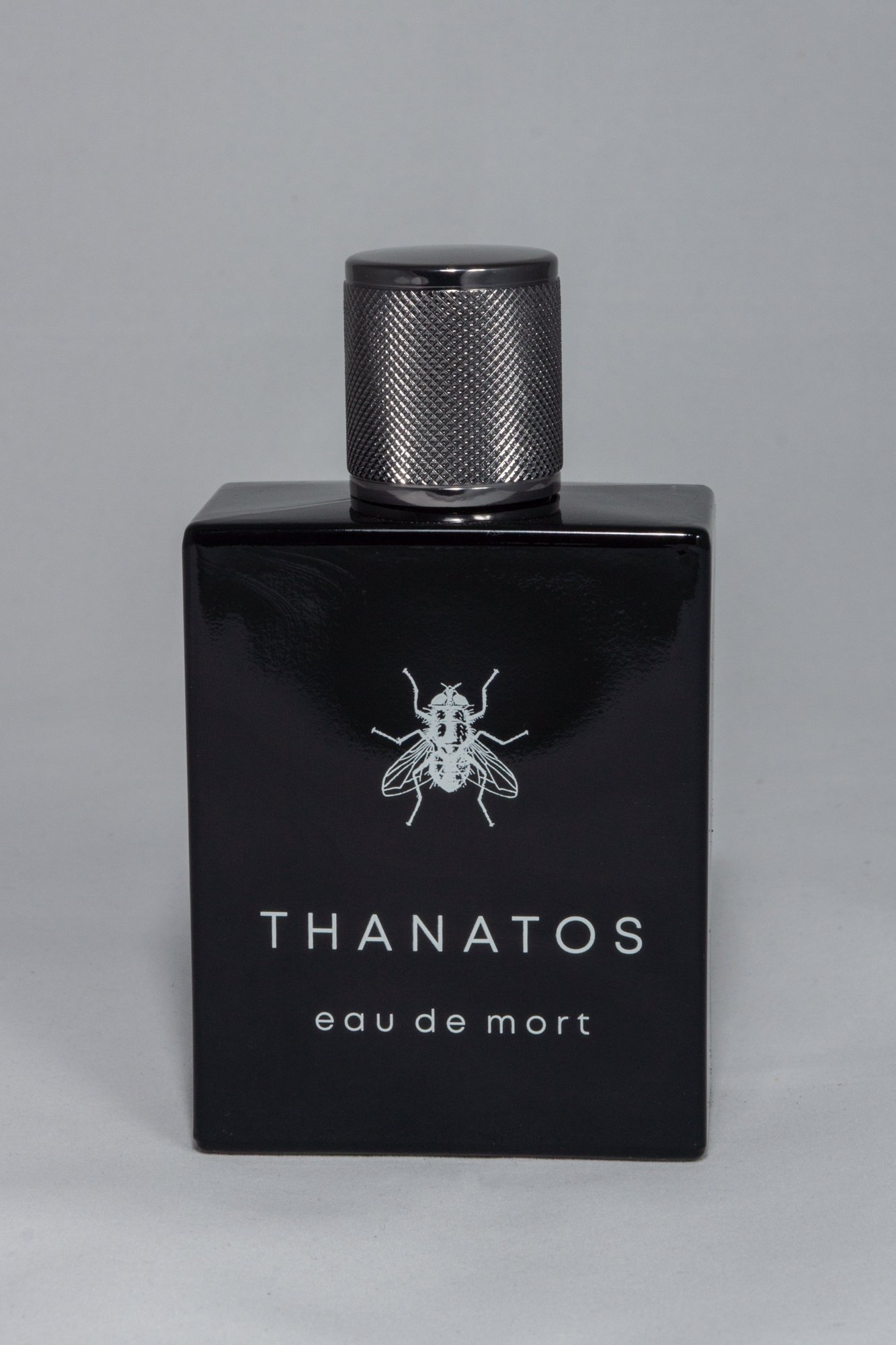
© Eric Fong · Eric Fong (official site)
A perfume about death
Thanatos is the personification of death in Greek myth. The artist Eric Fong gave the name to a perfume. Its smell evokes a decomposing body found in a woodland.
It sounds like a stunt. In fact the project rests on science. Fong worked with the forensic anthropologist Anna Williams, whose research covers more than 400 volatile organic compounds released during decomposition. The scent was composed by the perfumer Euan McCall of Jorum Studio in Scotland.
The perfume does not reproduce the smell of a corpse. It selects certain decomposition compounds and sets them beside floral and woody notes. The wearer is led from an open meadow into the middle of a secluded forest, where a body is found.
Where forest and corpse share molecules
The core idea of Thanatos is an overlap. Many compounds released as a body breaks down also appear in natural materials perfumers have long used. Flowers, soil and wood share part of their chemistry with death.
That overlap unsettles a familiar boundary. We sort smells into pleasant and repellent. At the level of molecules the two groups are not cleanly separate. Whether we like or fear a smell often depends on context, on what we know of its source, and not only on the molecule itself.
Thanatos places the visitor at exactly that crossing. Flowers and wood reassure the nose. Then something strange slips in. The visitor cannot be sure whether they are smelling a forest or a body. That uncertainty is the work.
An autopsy table, a film, crime scene photographs
The perfume is the centre of a multipart installation. Visitors smell it through a sculpture modelled on an autopsy table. The place for the nose becomes the place for the body.
Alongside it runs The Search, a tense short film about finding a body in a forest. On the walls hang staged crime scene photographs from the Forensic Anthropology Department at Teesside University.
In 2020 the installation was shown at Cube Gallery, Phoenix, in Leicester, and at the Constantine Gallery, Teesside University, in Middlesbrough, with support from Arts Council England through National Lottery funding. Thanatos was later longlisted for the Aesthetica Art Prize and, in 2022, named a finalist for the Institute for Art and Olfaction's Sadakichi Award.
Why smell death at all
Modern society hides death carefully. The dead are removed quickly, cleaned, kept cold. Smell is the first thing erased. For most city dwellers the smell of death is something they have heard described, never smelled.
Thanatos brings that smell back, inside a frame that can be controlled: a gallery, a small bottle, a story with a beginning and an end. Its aim is not to disgust. It shows that death belongs to the same cycle as the forest we find beautiful.
There is one more layer. For forensic scientists and cadaver dogs, the smell of decomposition is information, a clue. The work lends ordinary people their nose for a few minutes. In that setting smell is no longer a feeling. It is evidence.


Olfactory Art