
Essays · Olfactory Art
Eugène Rimmel. Rimmel's programme fan.
The performance ended long ago. The fan still holds its air.
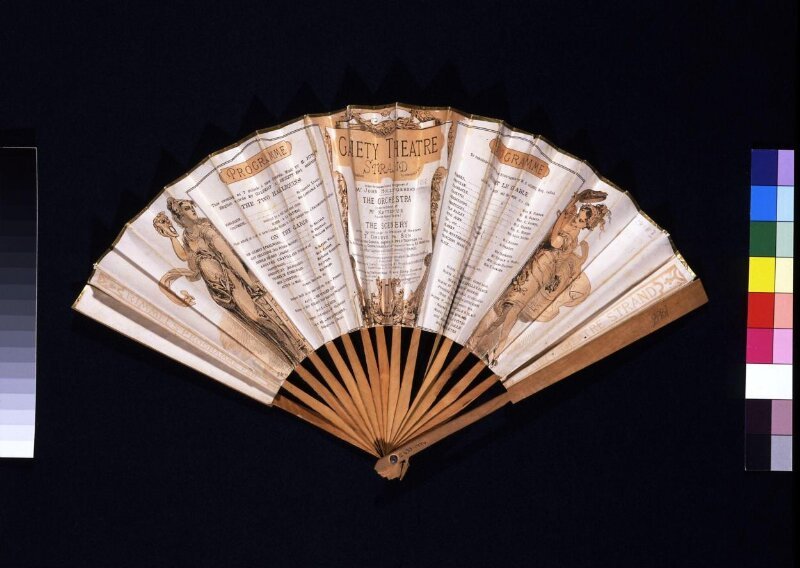
© Victoria and Albert Museum, London; Gabrielle Enthoven Collection · Victoria and Albert Museum (V&A)
A programme printed on a fan
The fan was made in London in 1868, of printed paper and wood. Closed, it is 23.5 cm tall and under 2 cm thick. Open, it spreads to 43 cm. It belongs to the Theatre and Performance collection of the Victoria and Albert Museum, part of the Gabrielle Enthoven Collection.
The front carries the programme for the opening night of the rebuilt Gaiety Theatre, 21 December 1868. Three pieces: W. S. Gilbert's Robert Le Diable; the operetta The Two Harlequins by E. Jonas, with English words by Gilbert A'Beckett; and the comedy On the Cards. Cast lists and credits fill the paper, flanked by fine line drawings of women in apricot.
The back is an advertisement for Rimmel's perfumery, again with female figures at each side, this time in pale green. Along the edges of both sides runs the same pair of phrases: Rimmel's Programme Fan on the left, Gaiety Theatre Strand on the right.
So the fan is a programme, an advertisement and a working object at once. The audience held it to read the cast, to cool themselves in a crowded auditorium, and to take home as a keepsake.
Opening night on the Strand
The Gaiety Theatre stood on the Strand, at the heart of London's theatre district. The fan was made to mark the night the theatre reopened after being rebuilt.
The main piece, Gilbert's Robert Le Diable, was a parody of Meyerbeer's opera of the same name, subtitled The Nun, the Dun, and the Son of a Gun. Gilbert's lyrics were set to music by Meyerbeer, Offenbach and other composers of the day. Light, fast, full of wordplay: right for an opening night.
According to the V&A, to mark the occasion Rimmel the perfumers supplied more than the fans. They also placed scented fountains in the theatre's lobbies. The audience entered through a zone of perfumed air, then sat down with a Rimmel fan in hand.
Eugène Rimmel was born in 1820 and died in 1887. He came to England from France and, with his father, set up a perfumery business in London in 1834. His name survives today on a cosmetics brand, but in the nineteenth century he was first a perfumer, and a gifted one at putting scent before the public.
The scented fountain was not new at the Gaiety. At the Great Exhibition in London in 1851, Rimmel's fountain sent out jets of perfume, and visitors held out their handkerchiefs to carry the scent away. The fountain later travelled to exhibitions in Dublin and New York.
Rimmel also made scented fans for women to take to the opera, theatre and ballet. In the mid 1860s he wrote the Book of Perfumes, a history of perfume, and opened a shop on Regent Street. He understood that scent does not live only in a bottle. It lives in rooms, in crowds, in occasions people remember.
The Gaiety fan sits where those ideas meet: a printed thing to read, and a thing held in the hand inside air that has been made to smell.
Why the fan matters
The scent of 21 December 1868 is gone. No one can smell the fountains in the Gaiety lobby again. What remains is paper, wood, print and drawings in apricot and pale green. The fan is evidence that the evening had a smell, and that the smell was arranged as part of the show.
It also shows how scent entered the theatre. Not on stage, but in the lobby and in the audience's hands. Scent did not tell the story of the play. It surrounded it, the way light surrounds a stage.
Six years later Rimmel put his name on another printed object, a small almanac drawn by Jules Chéret: Rimmel almanac 1874. A fan and an almanac, two paper things, one man behind them. Both show a perfumer thinking about scent through objects people pick up, turn over and keep.
Today the fan rests folded in a theatre collection. Open it and you can still read the cast. Only the air has gone.
Olfactory Art