
Essays · Olfactory Art
Jules Chéret for Eugène Rimmel. Rimmel almanac.
A small almanac where scent is told through poems and printed colour.
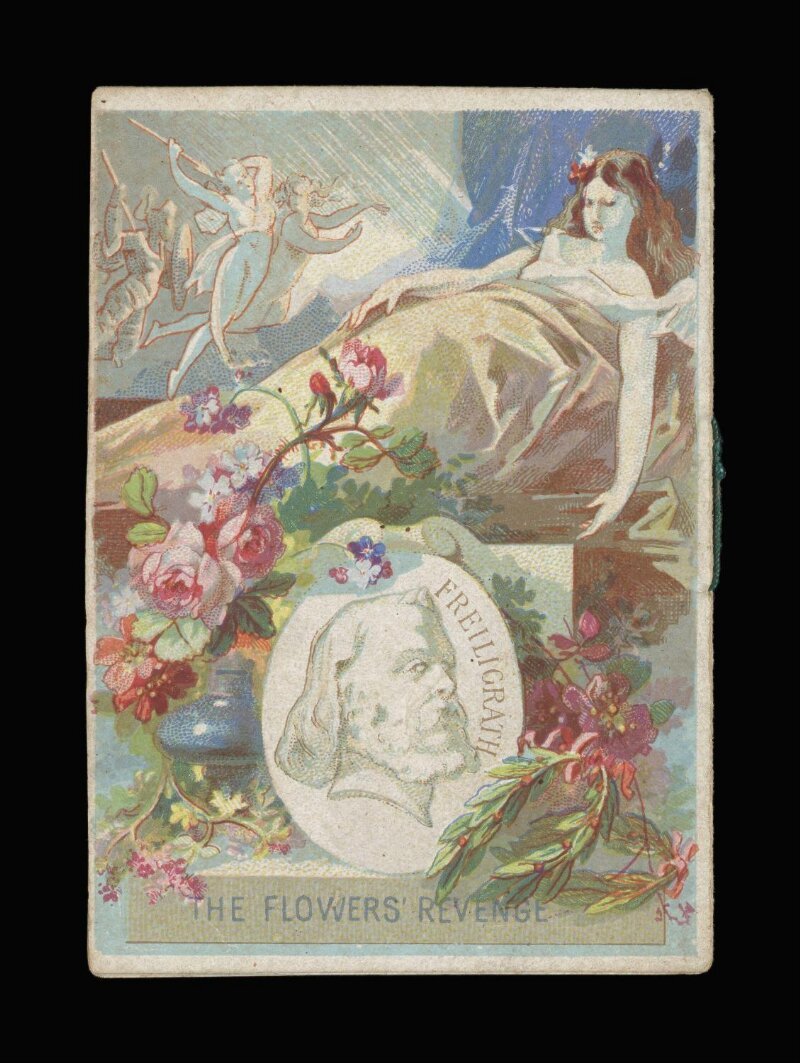
© Victoria and Albert Museum, London; Given by Philip Ward-Jackson · Victoria and Albert Museum (V&A)
Four scenes on a small almanac
The almanac was made in France in 1874 for Eugène Rimmel's perfumery. It was drawn by Jules Chéret. It is tiny: 9 cm high, 6.3 cm wide, the size of a palm, of a waistcoat pocket. The text is printed in two languages, English and French.
According to the Victoria and Albert Museum, which holds it, the almanac carries four colour lithograph scenes drawn from European literature. On the front, Faust and Margaret, from Goethe. Inside the front cover, The Bard's Curse, from Uhland. Inside the back cover, Lurline, from Heine. On the back, The Flower's Revenge, from Freiligrath.
It came to the V&A in 2024, given by Philip Ward Jackson. It sits in the prints and drawings collection, catalogued as ephemera: things printed to be used briefly and thrown away, yet for some reason kept.
That survival is what makes it worth a look. An object printed to be used for a year, intact after a century and a half.
Jules Chéret was born in 1836 and died in 1932. He is remembered for the bright colour posters that covered Paris walls in the late nineteenth century, and is often seen as one of the founders of the modern poster. But his path ran through a perfumery.
In the 1860s Chéret lived in London and designed packaging for Rimmel. Rimmel became his patron and financed a commercial lithography studio for him in Paris. His first great success there was the poster La Biche au Bois in 1866.
Chéret's press on the rue Brunel in Paris printed a great deal of advertising for Rimmel: labels, packaging, almanacs, booklets. Many Rimmel almanacs carry his imprint. The 1874 almanac is one of them.
So before he drew dancers and balls on posters, Chéret learned his trade on small objects for a perfumer. Scent was one of the first clients of modern advertising graphics.
Literature as a label
Why Faust, Uhland, Heine, Freiligrath? These were familiar names to educated readers across Europe at the time. Putting them on the almanac told the recipient that Rimmel's scents belonged to the same world as books, poems and the theatre.
All four stories carry some darkness. Faust sells his soul. The bard is cursed. Lurline is the river spirit of the Rhine who wrecks boats. And in Freiligrath's poem, cut flowers placed beside a sleeping girl's bed take their revenge through their own scent. An almanac advertising perfume ends with a tale of flower scent doing harm. It is a bold choice, and a playful one.
This is very different from advertising today. It promises nothing. It does not say how anything smells. It simply places the perfumer's name beside good stories and lets the reader connect the two.
Why the almanac matters
Research on Rimmel notes that the house's almanacs were printed in colour and perfumed. Whether the V&A copy keeps any trace of scent today is not known. But the idea is clear: the paper was both an image to look at and an object to smell. Each time the owner opened it to check a date, the giver's scent was there.
The almanac also marks a moment in the history of graphics. Colour lithography was advancing quickly, and merchants like Rimmel paid for those experiments. Scent, something invisible, helped raise a craft of images.
Six years earlier Rimmel had put his name on another paper object, the programme fan for the Gaiety Theatre's opening night: Rimmel's programme fan. The fan lived in the theatre, the almanac in the pocket. Both were ways for scent to follow people out of the shop.
A nine centimetre almanac, four stories, one year. And somewhere between its pages, the trace of a scent that has flown.
Olfactory Art