
Essays · Olfactory Art
Friedrich Kunath. Frutti di Mare.
Sentiment needs no argument. It only needs a smell.
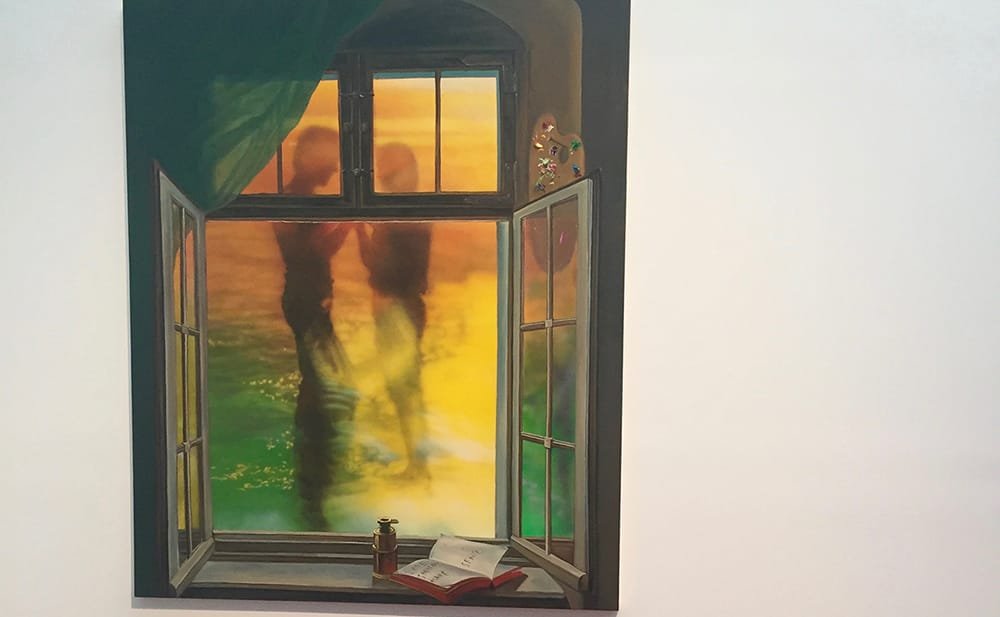
Photo for Hyperallergic · Hyperallergic
An exhibition like a novel
From 9 September to 14 October 2017, Blum & Poe in Los Angeles showed Frutti di Mare, a solo exhibition by Friedrich Kunath. The title borrows the name of an Italian dish, mixed seafood on one plate. The show worked the same way: many different kinds of things set together across several connected rooms.
Kunath was born in 1974 in Chemnitz, then in East Germany, and lives in Los Angeles. His paintings often hold dreamy landscapes, sunset skies and handwritten lines that are half joke, half confession.
Frutti di Mare was built around that idea. Writing for Hyperallergic, the critic Jennifer Remenchik described it as a love story in which the beloved is the work itself. An artist and his art, with all the devotion, melancholy and self mockery that involves.
Socks, mirrors and penguins
The rooms were carpeted. There were mirrors, penguin sculptures, a canvas spun by a motor, a piano standing on end. Everywhere lay tie dyed tube socks in loud colours, scattered on the floor and draped over television monitors.
A large piece of fabric read Gee, it's nice to be alone. An oil and acrylic painting was titled Love Shouldn't Make Sense.
In one room a film was screened. It opens on an older man on railway tracks. Many of the paintings and sculptures in the show appear in the film as props. Walking through the rooms felt like entering a film set after the crew had left.
Remenchik wrote that the show mixed sincere gestures with sudden, irreverent moments. Melancholy, whimsy, nostalgia. Love and death walking side by side.
Clusters of perfume bottles
Near some of the paintings, Kunath placed clusters of perfume bottles. No brand was pushed forward; they were not displayed as products. They stood in groups, like a small family of transparent objects.
And in the air of the whole space there was a light floral smell, introduced on purpose. No wall text announced it. Visitors only noticed it after spending some time in the room.
The smell did something the paintings could not. A painting stays on the wall; you approach it or step back as you like. A smell surrounds you. There is no distance from which to stand outside it. A romantic line on a canvas can be read with a half smile. A floral smell gives you no time to mock it.
Daring to be sentimental
Contemporary art is often wary of feeling. Romance is easily dismissed as cheap or thoughtless. Kunath walks straight into that territory. He uses sunsets, tender phrases and floral smells, things many artists would avoid.
But he does not use them naively. The bright socks, the penguins and the sock covered screens pull everything toward humour. Visitors are always caught between two states: wanting to believe, and wanting to laugh.
The floral smell is where those two states meet. It is light and unassuming, yet impossible to ignore. Like the bottles standing quietly beneath the paintings, and like scented objects other artists have brought into galleries, such as Anicka Yi's Biography perfumes, it reminds us that art can reach a viewer by another route, not through the eyes.


Olfactory Art