
Essays · Contemporary Art
Fujiko Nakaya. Fog Sculpture #08025 (F.O.G.).
The artist chooses the water. The weather chooses the shape.
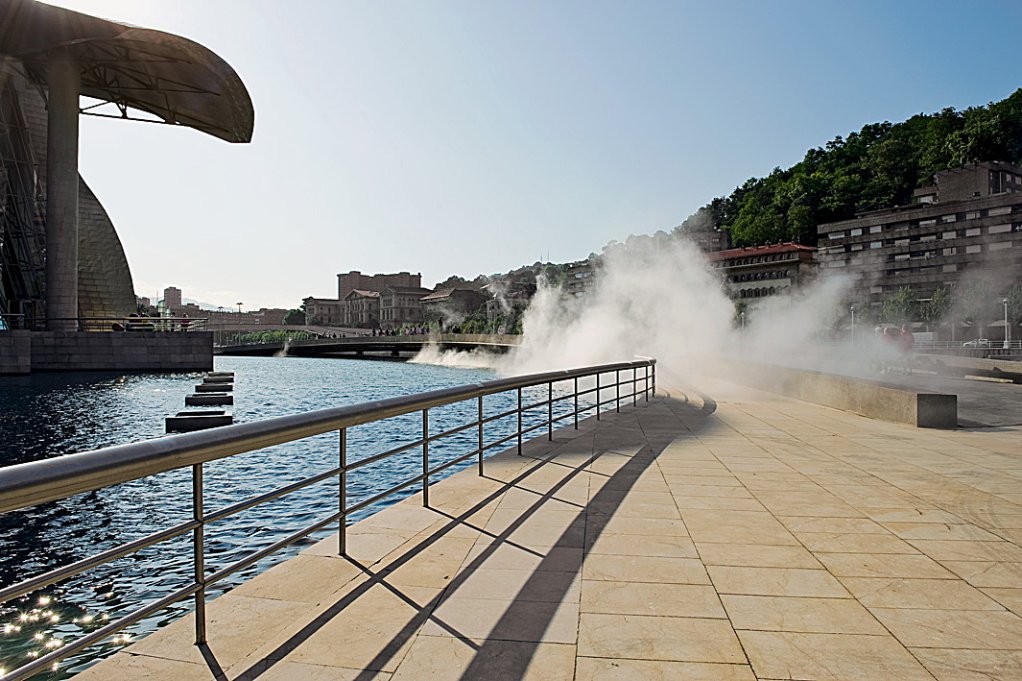
Guggenheim Museum Bilbao · Guggenheim Museum Bilbao
A pool, a thousand nozzles
Beside the riverfront facade of the Guggenheim Museum Bilbao lies a pool. Set into it are a thousand fog nozzles, linked to a high pressure pump and motor system. This is Fog Sculpture #08025 (F.O.G.), a 1998 work by Fujiko Nakaya, commissioned in connection with the museum's opening.
The system runs once an hour, on the hour, for eight minutes. From October to March the first release is at nine in the morning, the last at eight in the evening. In summer, from May to August, the fog rises until ten at night.
When the nozzles open, water is forced through tiny holes into droplets fine enough to hang in the air. The fog lifts, spreads over the pool, rolls across the walkway, and gradually hides the curved walls of the building. Eight minutes later the nozzles close. The fog thins and disappears.
The letters F.O.G. in the title are the English word and also the initials of Frank O. Gehry, the museum's architect. The work reads as a reply to the building: a gleaming mass of metal, and a veil of water vapour that comes and goes.
Shape decided by weather
Nakaya does not draw the shape of the work in advance. She sets the conditions: nozzle positions, pressure, timing. The rest belongs to the atmosphere.
According to the museum, the form of the fog depends entirely on the weather when it is released. Strong wind pulls it into thin bands drifting one way. On still days it stands thick and tall, like a mass of cotton. Humid air holds it longer; dry air makes it vanish fast.
So no two releases are the same. A person watching at ten in the morning and another at three in the afternoon do not see the same work. Nor does one person watching two releases in a row.
Because the schedule is fixed, the work has a part few people notice: the wait. Those who know the time stand by the pool a few minutes before the hour, watching the flat water, waiting. There is no fog yet, but the waiting is already part of looking. When the nozzles open, the whole group steps back, then forward again.
The first to shape fog
Fujiko Nakaya was born in 1933 in Sapporo, Japan. The museum describes her as the first artist to work with fog as a sculptural medium.
She collaborated with Experiments in Art and Technology, known as E.A.T., a group that brought artists and engineers together. In 1970 she helped create the fog that wrapped the Pepsi Pavilion at Expo '70 in Japan. From then on, fog became her main language.
Her method is closer to science than to traditional sculpture. No carving, no casting, no modelling. Only water, pressure, and patient observation of how air moves in a particular place.
A building that dissolves and returns
The work stays in the mind not only because the fog is beautiful. It stays because of what the fog does to what stands behind it. For eight minutes the city's most famous building blurs. Its outline goes. People walking the riverside suddenly find themselves inside a cloud.
Then the fog clears and the architecture returns. That return makes people look at it more closely. A familiar object, gone for a while, is seen again as new.
Nakaya adds nothing to Bilbao but water and time. Every hour the city is reminded that the air around it is real, with thickness and direction. Another work that brings mist and weather into a museum is Olafur Eliasson's The weather project.
Contemporary Art