
Essays · Modern Art
Georges Braque. Clarinet and Bottle of Rum on a Mantelpiece.
The space between things is a thing too.
Tate · Tate
What can still be recognised
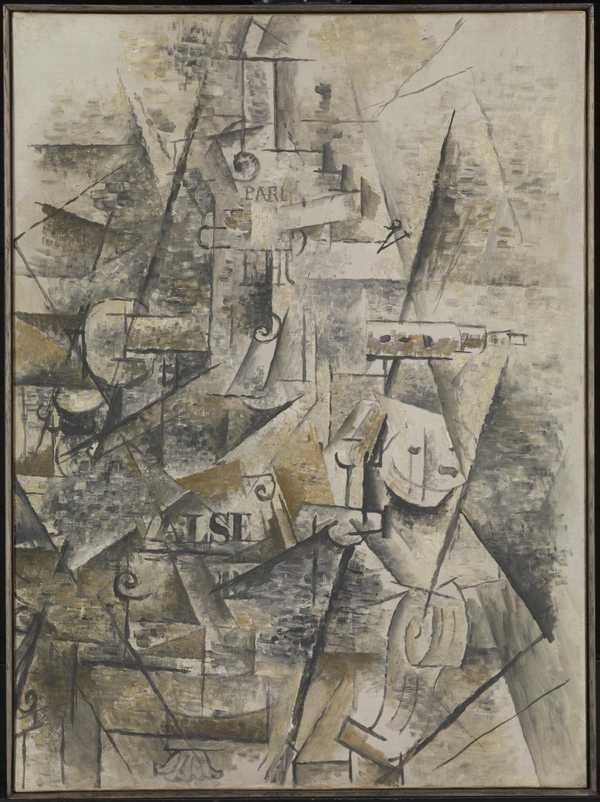
This upright oil painting, about 81 by 60 centimetres, dates from 1911. At first it is a web of small angular planes, overlapping, in a narrow palette: black, dull grey, muted yellow, brown. Only after a while do objects appear.
A clarinet lies horizontally just above the centre, seen from above. Two heavy black lines run diagonally from the lower left towards the top edge: the mantelpiece. A bottle stands upright on it, hiding the middle of the clarinet, marked with the letters RHU, the start of rhum, French for rum. To its right is a small nail with a cast shadow. Lower down sits the word VALSE, waltz, with scattered fragments of clefs suggesting sheet music.
Lower still, two scroll shapes read as corbels supporting the mantel. A scallop form may be the handle of a fire screen or, more likely, a decoration on the hood that keeps smoke from escaping. Ordinary things in a room: music, drink, fire.
The back of the canvas is inscribed G. Braque, Ceret. It tells us the picture was painted in Céret, a small town in the French Pyrenees, in the summer of 1911. Braque was there with Picasso. They had come at the suggestion of a friend, the Catalan sculptor Manolo, who had settled there three years earlier.
That summer the two worked so closely that they painted similar scenes and objects in the same manner. This is the phase called Analytical Cubism: objects split into facets, seen from several sides at once, then reassembled on a flat surface. Set beside Picasso's later fractured faces, one sees how far that way of looking would travel.
According to the historian Douglas Cooper, stencilled letters first entered Braque's pictures during this stay in Céret. They do something strange. Printed letters are perfectly flat, so they pull the eye back to the canvas and remind us this is a painting. The painted nail with its shadow does the opposite: it pretends to be real. Side by side, they expose the gap between painting and reality.
Why still life
Braque said he found a more objective element in still life than in landscape. He also explained that he painted instruments because he was surrounded by them and because their forms suited still life.
This was his first still life set on a mantelpiece, a theme he would return to many times. It ties him to a long line of French painting, above all to Cézanne, who taught painters to see objects as volumes.
What stays most is his idea about the space between. For Braque, what lies between objects is no less important than the object itself. The relation of objects to one another, and to that in between, is the real subject. In the painting, the short hatched strokes in the shadows describe no object. They describe air.
Those who kept it
The painting first belonged to the gallery of Kahnweiler, dealer to Braque and Picasso. In 1923, at a sale of Kahnweiler's stock, an architect bought it for 400 francs. His name was Charles Édouard Jeanneret, later known as Le Corbusier.
It stayed with him for years. In 1970 the Le Corbusier Foundation sold it. After several owners, Tate acquired it in 1978 with help from a special government grant.
The title has its own life. Kahnweiler's records list it as Clarinet and Bottle of Rum. A 1932 catalogue calls it The Mantelpiece. Tate keeps the longest name, holding all three: clarinet, bottle, mantel. Perhaps that is right for a picture in which everything only means something beside something else.
Modern Art