
Essays · Contemporary Art
Gustav Metzger. Recreation of First Public Demonstration of Auto-Destructive Art.
Form is born where the material disappears.
Tate · Tate
Acid on nylon
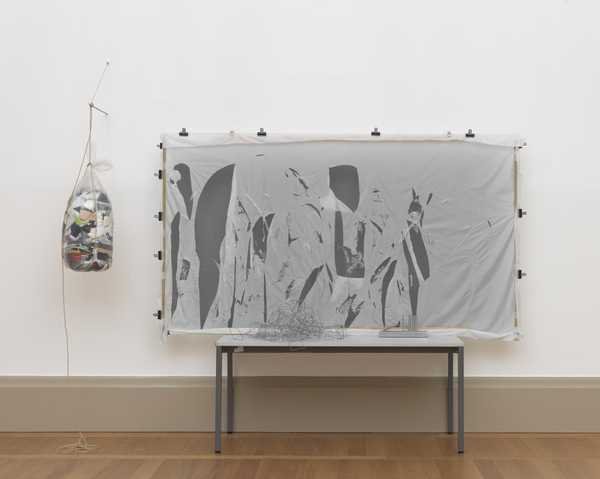
The work begins with a very simple action. Sheets of nylon are stretched on frames, like canvas for painting. Metzger brushes and sprays acid onto them. Where the acid lands, the nylon shrinks, thins, then opens. The holes spread, meet, and reveal the space behind.
Within minutes the sheet is transformed. There is no brushstroke by the artist. The shapes on the surface are shapes of corrosion: puckered, spreading, uneven edges. Then comes the point when almost nothing is left to see.
Tate, which holds the work, quotes Metzger on the acid paintings he made from 1959: destroy a canvas and you create shapes. The sentence sums up the method. Destruction is not erasure. It is a way of drawing.
Tate dates the original demonstration to 1960. What the museum holds is a recreation, made in 2004 and again in 2015. The list of materials is plain: glass, fabric, a table, a trash bag, paper, plastic and steel. Even what remains after the event belongs to the work.
Art against the bomb
Gustav Metzger was born in Nuremberg in 1926 to a Polish Jewish family. In 1939, as a boy, he was brought to Britain. He lived and worked in London for most of his life.
According to Tate, he coined the idea of auto-destructive art in the early 1960s as political protest: against nuclear weapons and the constant anxiety of the Cold War. A world that could erase itself in minutes needed an art willing to look destruction in the face.
Metzger wrote several manifestos. A few principles stand out. Works should return to nothing within twenty years. Once started, the process continues without the artist. And the work belongs in public space, not in one buyer's private possession. In 1962 he set out the idea in the essay Machine, Auto-creative and Auto-destructive Art, published in the journal Ark.
Those principles run against everything the art market needs: a durable, signed object that can be resold.
Destruction as a way of making form
Metzger was not alone. In 1960 Jean Tinguely built Hommage à New York, a machine made to wreck itself in front of an audience. In 1966, at the Destruction in Art Symposium in London, John Latham burned towers of books he called Skoob Towers, books spelled backwards.
Metzger's nylon has a different stillness. No explosion, no machinery. Only a liquid, a sheet, and the time a chemical reaction takes. Viewers watch something disappear slowly, almost quietly.
That is why the story is not only about destruction. The acid works in its own way. It finds its path through the thickness of the fibres, the tension of the frame, the amount of liquid. The artist starts it; the material decides the shape. Metzger hands most of the work to matter itself.
Remaking something that vanished
There is a paradox in a museum holding this work. Auto-destructive art was conceived to be impossible to keep. Yet today it has an accession number, a catalogue entry, a place on display at Tate Britain.
The recreation resolves the paradox honestly. It does not pretend to be the original sheet. It admits that what remains is a re-enactment and the debris afterwards. What is preserved is not an object but a gesture.
Like Anya Gallaccio's chocolate walls that change colour day by day, Metzger's work reminds us that an object can be most alive while it is changing. Looking at it, viewers do not ask what the work is. They ask what it is becoming.

Contemporary Art