
Essays · Olfactory Art
Hamada Shōji. Incense Box.
An object grows beautiful through daily use.
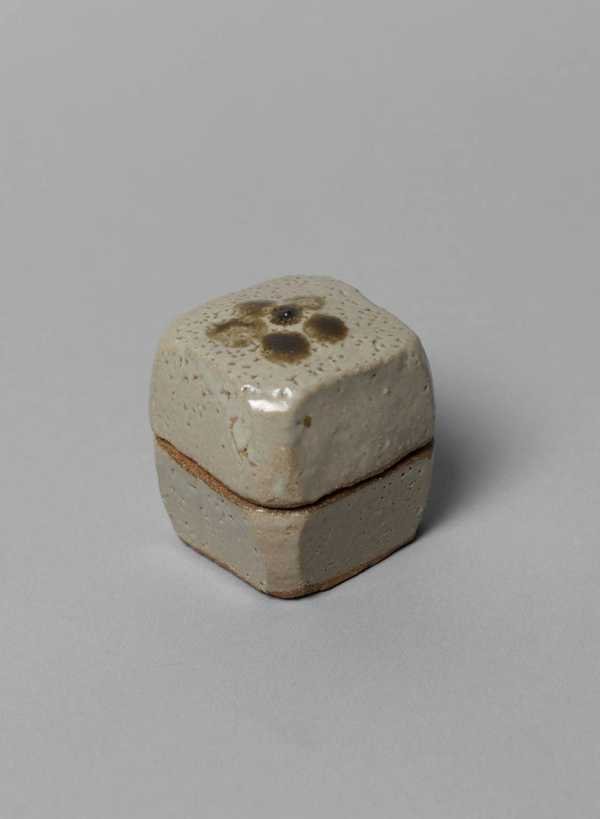
© The Board of Trustees of the Tate Gallery; © The estate of Shoji Hamada · Tate
A name and a year
Tate in London holds a work titled Incense Box, reference T12103. The maker is Hamada Shōji. The year is 1960. The material is stoneware.
Tate's online record for the box is very short. No introduction, no story attached. On the page it sits beside other works by Hamada in the collection: tea bowls, yunomi cups for everyday tea, a teapot, a square dish, a nine sided jar, a water jar for the tea ceremony. Most date from the 1940s to the 1960s.
So the box reaches the viewer almost without words. We know it is for keeping incense, who made it and when. The rest, its shape, its glaze, its weight in the hand, can only be known by standing in front of it.
Penta will not guess at those things. It can only say that an incense box, whatever it is made of, always does the same job: keeping pieces of incense dry and covered until they are placed by the fire.
Mashiko and St Ives
Hamada Shōji was born in 1894 and died in 1978. According to the V&A, he was one of the leading potters of the Mingei, or folk craft, movement in Japan.
Two people shaped his path. One was Yanagi Sōetsu, the philosopher and critic whose theories founded Mingei. The other was Bernard Leach, the English studio potter. In the early 1920s Hamada went to England and helped Leach establish the Leach Pottery at St Ives in Cornwall.
From 1924 Hamada lived and worked in Mashiko, a pottery centre northeast of Tokyo. It was a place where pots were made, not an art capital. Hamada chose it over a big city, closer to people who made pots for use than to people who collected them.
Later, Japan recognised him as a Living National Treasure, a title given to holders of a traditional craft. A potter in a country pottery village, named a treasure of the whole nation.
Objects for use, not wonders
The Mingei movement arose in early twentieth century Japan as a social and aesthetic campaign. The V&A notes that it shared ideas with John Ruskin and William Morris in England: valuing work by hand, worrying about industrialisation and mass production, and seeking to save and revive Japan's folk crafts.
In that spirit, beauty lives in ordinary things made to be used. A rice bowl. A tea cup. A box for incense. None of them needs a pedestal. They are beautiful because they do their work well, day after day.
Set Hamada's box beside bronze burners taller than a person, or gold lacquer boxes from earlier centuries, and the distance is clear. In those objects, scent is an occasion for display. Here, scent is part of life at home, on the same level as tea and rice.
The box is worth remembering for its very quietness. The museum says little about it. The Mingei spirit its maker followed valued objects that do not need to say much. And the incense once inside, like all incense, went somewhere long ago. What remains is a stoneware box, sturdy enough to be opened many more times.
Olfactory Art