
Essays · Olfactory Art
Incense Box (Kogo) with Pines and Plovers.
A small box that keeps a smell and a wish.
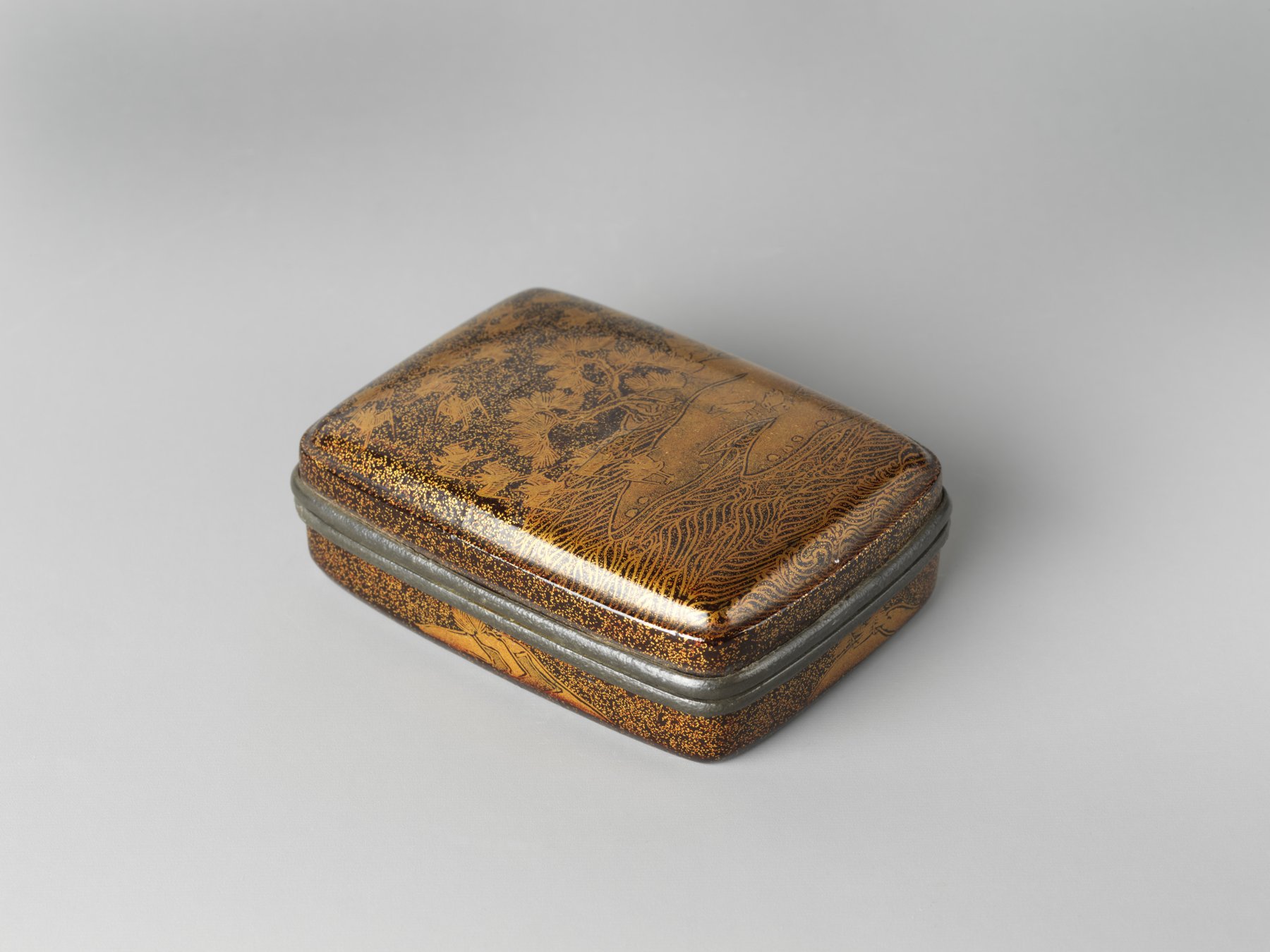
The Metropolitan Museum of Art, Mary Griggs Burke Collection, Gift of the Mary and Jackson Burke Foundation, 2015 (Open Access, public domain) · The Metropolitan Museum of Art
A shoreline in the palm
The box belongs to The Metropolitan Museum of Art in New York, accession number 2015.300.280a, b. The a and b are its two parts, box and lid. It is 3.9 cm high, 6.9 cm wide and 9.5 cm deep. On a table it takes up the space of a large matchbox.
The Met dates it to the early fourteenth century and places it in the Nanbokuchō period, 1336 to 1392, when Japan had two rival courts. The maker is not named.
The picture on the box is a shore. Pine trees, plovers flying or standing, and shells scattered on the sand. The Met calls it an auspicious composition. Pines stay green all year and have long stood for longevity. The plover, chidori in Japanese, has a cry heard as chiyo, a homonym for a thousand years.
So on a lid smaller than a palm, the maker set two wishes for long life side by side, then scattered shells to remind us this is a shore, where water rises and falls without end.
Gold polished flat
The box is lacquered wood. The design is in togidashi makie: gold powder is sprinkled onto wet lacquer along the drawing, the whole surface is lacquered over, then polished down until the gold appears again. The gold lies flush with the surface, not raised, as if seen through a layer of water.
The ground is nashiji, which the Met calls pear skin ground. Tiny flakes of gold float in the lacquer, glinting unevenly like the speckled skin of a Japanese pear. On that ground the pines and birds stand out in a denser gold.
Both techniques take time. Each layer of lacquer must dry. Polishing must be slow, because too much and the picture is gone. A box this small holds more layers of work than many large objects.
The box has come through some seven centuries. Even so, enough gold remains for a viewer to count every bird. Lacquer keeps images better than it keeps smells: the incense once inside is long gone, while the shore on the lid is still there.
Before it held incense
One detail in the Met's record is worth pausing on. Like many incense boxes used in the tea ceremony, this one may first have belonged to a twelve piece cosmetic set, a junitebako. In such a set it could have held tooth blackening material, a beauty custom of the Japanese aristocracy of that time.
So the box may have changed jobs. First it held something applied to the body. Later it held something burned for a room. The pines and birds stayed where they were; only what was inside changed.
In the later tea ceremony, the kōgō is the small box of incense brought out when the host adds charcoal to the brazier, so a piece of incense can sit by the fire and scent the room before the water boils. Because it is set before the guests, the kōgō is chosen with care, and old, fine boxes like this one were kept through many owners.
In 2015 the box came to the Met with the Japanese art collection of Mary Griggs Burke, a gift of the Mary and Jackson Burke Foundation. It is worth remembering because it shows that scent in Japan never travelled alone. It came with a box, a picture, a wish, and sometimes with the box's own earlier life.
Olfactory Art