
Essays · Olfactory Art
Korea, early Joseon. Incense box.
Before it becomes smoke, incense needs a place to wait.
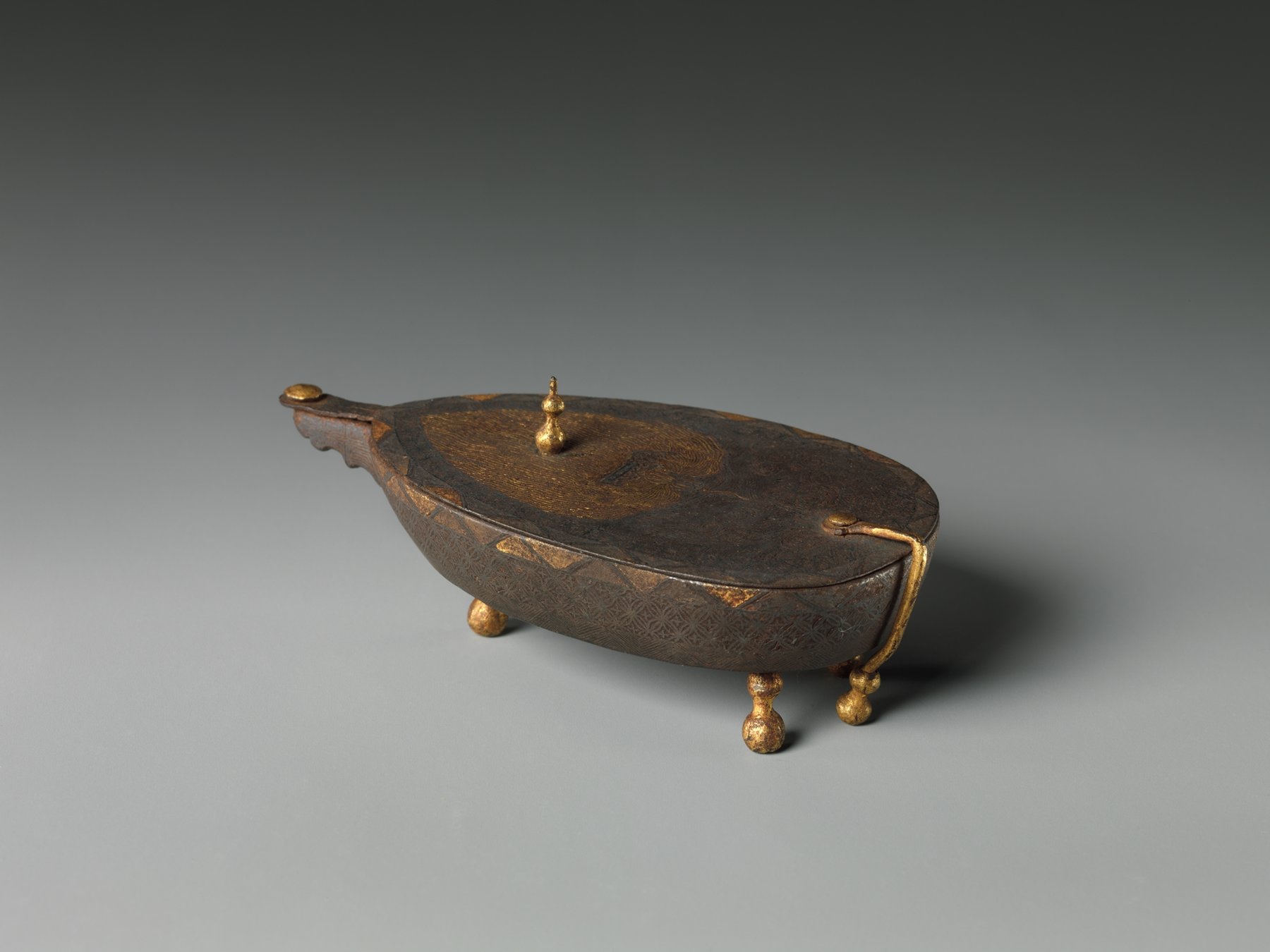
The Metropolitan Museum of Art, Rogers Fund, 1921 (Open Access, public domain) · The Metropolitan Museum of Art
A small object in a large museum
The box is in the Asian art collection of the Metropolitan Museum of Art in New York. The museum acquired it in 1921 through the Rogers Fund. Today its image is published as open access, free for anyone to view and use.
It is very small. 3.5 cm high, 11.7 cm wide, 6.4 cm deep. On a table it is lower than a notebook. In the hand it fits within one palm.
The museum dates it to the fourteenth to fifteenth century and places it in the early Joseon period. The Joseon dynasty began in 1392, replacing Goryeo. A box made in that span may have been born on the border between two dynasties, while religious and ritual life on the peninsula was shifting.
Its maker left no name. Only material, size and technique.
Iron, gold and silver
The museum describes the material briefly: iron inlaid with gold and silver.
Inlaying precious metal into iron takes many steps. The maker cuts very fine grooves into the iron surface, then lays gold or silver wire into them and taps it until it holds. When finished, bright lines of precious metal lie flush against the dark iron. In Korea this technique has a long tradition on bronze and iron.
What makes the choice notable is the contrast. Iron is heavy, dark, prone to rust, the stuff of daily work. Gold and silver are bright and lasting, the stuff of ritual and wealth. On the box they are not kept apart. They share one plane, making a surface both sturdy and precious.
Penta does not describe the specific pattern on the lid here, since the museum does not record it in words. What is known is that the gold and silver lines were set by hand, one length at a time.
Incense box and burner
In East Asian incense rituals the burner rarely stands alone. Beside it sits a box that holds unused pieces or powder of incense. The officiant opens the box, takes a little, places it on the embers in the burner. The box closes. Smoke rises.
On the Korean peninsula incense was part of Buddhist ritual under Goryeo and of ancestral rites under Joseon. The rites changed, but the pair of objects kept their roles: one keeps, one burns.
The Met's box belongs to the first half of that pair. It has no vents and needs no heat resistance. It only needs to be closed and durable. Spending gold and silver on such an object shows that incense was honoured before it burned.
Why the box stays with us
Most stories of scent are about the moment it is released. This box is about the time before, when the scent is still sealed, intact, unsmelled.
That time is usually overlooked. People remember the smoke and the smell filling a room; few remember how long the box held the incense before. Yet that waiting decides whether the scent is still good. Incense left open fades, takes on damp, picks up other smells. A closed iron box answers a very practical problem.
Six centuries later the lid has long been shut. There is no incense inside. But its form still tells of a habit: keeping safe what is meant to vanish, and doing that keeping in the finest materials one can.
Olfactory Art