
Essays · Olfactory Art
Helga Griffiths. L'Air du Charbon.
One breath of air taken from underground.
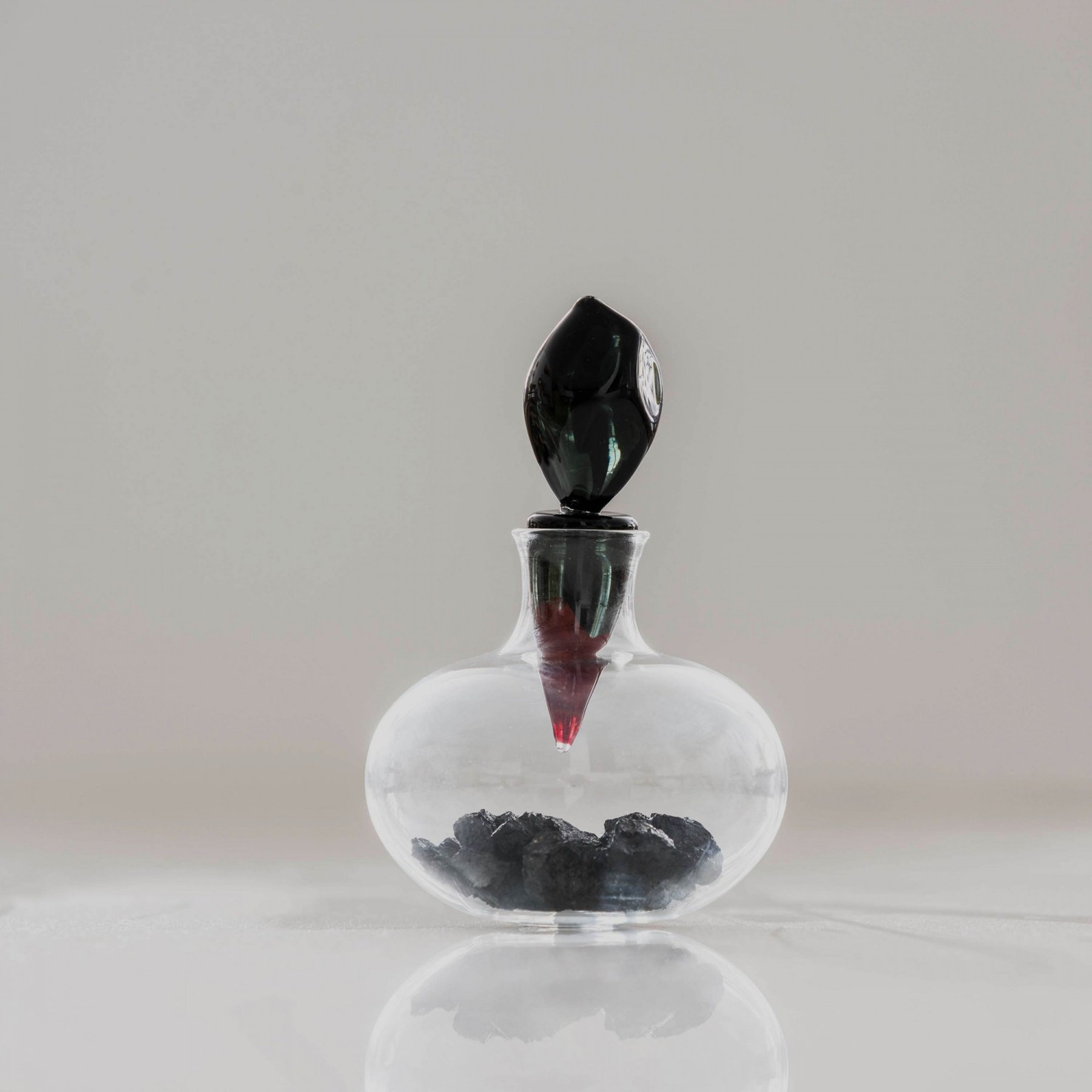
Photo: Tom Gundelwein · Helga Griffiths (official site)
Down the last mine
In 2018 the Prosper Haniel mine in Bottrop was Germany's last working coal pit. At the end of that year it closed, ending a nation's history of underground hard coal mining.
Before that happened, Helga Griffiths went down. She carried a vacuum flask. Underground she opened it, let the tunnel air rush in, closed it and brought it back to the surface.
The next step needed a laboratory. With help from staff at Saarland University, the sample was transferred into a glass vessel and sealed. The result is a small, clear object that looks almost empty.
Griffiths called it L'Air du Charbon: the air of coal. The French name sounds like a perfume. There is no perfume inside. Only one breath of the ground.
Ninety nine years after Duchamp
The French is no accident. In 1919 in Paris, Marcel Duchamp had a pharmacist make him a glass ampoule holding 50 cubic centimetres of Paris air. He called it Air de Paris. It is one of his best known readymades: an ordinary thing, chosen and named, and so made art.
Duchamp also played with the perfume bottle. Two years later he put a photograph of himself as Rrose Sélavy on a perfume bottle, in Belle Haleine. Air, bottles, labels: these were in his vocabulary very early.
Griffiths answers Duchamp exactly ninety nine years later. With one difference. Paris air in 1919 was the air of a city that would go on living. Prosper Haniel air in 2018 was the air of a place about to vanish. Duchamp kept a souvenir. Griffiths kept evidence.
An almost empty object
Looking at L'Air du Charbon, the viewer sees nothing but glass. No black dust, no image of miners, no fragment of coal. Everything of the mine lies in the invisible part.
That is the challenge of the work. The viewer has to believe. Believe that the vessel holds air from underground. Believe that this air differs from the air of the gallery. Believe that a place can be held in a breath.
According to the artist's site, Griffiths thinks of the object in two ways. It is a souvenir, like what people bring home from a trip. And it is a time capsule, the memory of a landscape shaped by coal and now disappearing.
In 2022 the work was shown at the Saarlandmuseum Moderne Galerie in Saarbrücken, in the Saarland, itself a region with a long mining history.
Air as a document
In the same year Griffiths also made Essence of Coal, distilling coal itself into an essence and a perfume. The two works go opposite ways. One opens the material to release its smell. The other shuts the air in to keep its smell. One lets visitors smell. The other lets no one.
L'Air du Charbon therefore asks how we archive a place. Photographs keep images. Recordings keep sound. But air, what miners breathed every shift for generations, is rarely kept by anyone.
This small glass vessel tries to keep exactly that. It cannot tell us how the mine smelled. It can only tell us the air was real, and is still there, inside a thin layer of glass, until someone decides to open it.
Olfactory Art