
Essays · Olfactory Art
Heman Chong. Smoke Gets In (Your Eyes).
No one made this smell. It piled up on its own.
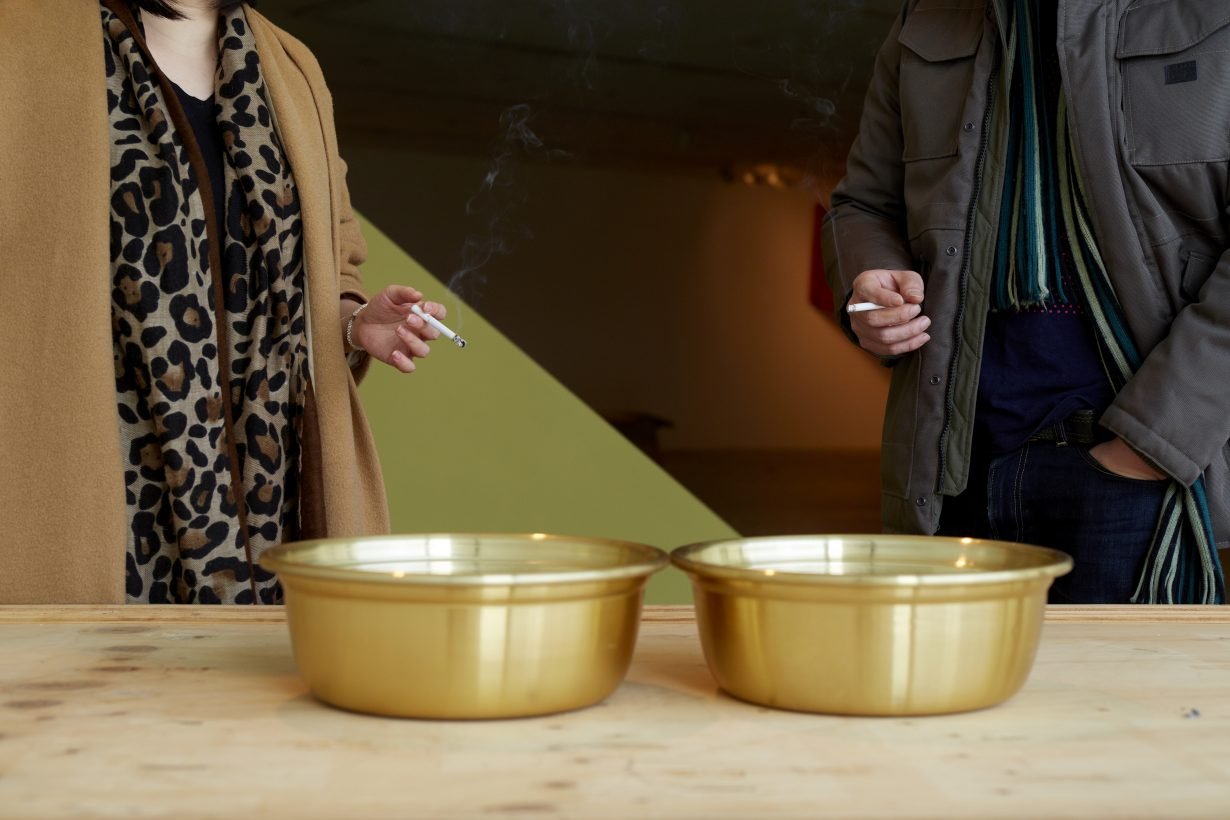
Photo: Sang-tae Kim. Courtesy the artist, Art Sonje Center, Seoul, and Wilkinson, London · ArtReview
Two ashtrays on a table
In early 2015, from 7 February to 29 March, Art Sonje Center in Seoul held a solo exhibition by Heman Chong, titled Never a Dull Moment. Among the new works made for it was something very modest: two identical ashtrays on a table.
The table was a smoking corner. Visitors could smoke there, inside the gallery.
The work is called Smoke Gets In (Your Eyes), borrowing the title of an old love song. But there is no music. No smoke rising on cue. Only two ashtrays slowly filling with butts, and a smell slowly thickening in the air.
Someone who came early in the run and someone who came near the end did not see the same work. They saw a different number of butts. They smelled a different room.
It is a quiet way of using time. No clock, no numbers. Only how full the two ashtrays are and how heavy the air has become. To know how long the show has been open, a visitor only has to look down at the table, then take a breath.
A smell no machine produced
In a conversation with the artist Haegue Yang published in ArtReview, Chong explained what he wanted. He wanted to bring in a smell not produced by a machine. He deliberately avoided scent diffusers. Instead, he let real cigarette smoke seep into the space.
Chong called the result a senseless accumulation within the space. Senseless is not a criticism here. It points out that the smell carries no prepared message. It simply builds up, one cigarette at a time, with no aim.
The work acts on several senses at once. The eye sees butts, ash, ashtrays filling. The nose smells cold smoke. Both tell the same story at different speeds. The eye sees each object. The nose takes in the whole room.
It is worth noting that after the opening, the work barely needs the artist. Visitors do the rest. Everyone who smokes a cigarette adds a little to it, whether they know it or not.
Smoking indoors, without pressure
Haegue Yang pointed to a detail that sharpens the work. In Seoul, smoking indoors is illegal. Outside the museum, smokers are pushed into small corners, standing hurriedly, under pressure. In Chong's room the same act was allowed, and, as Yang put it, happened under less pressure.
Yang also said the work lets visitors consider what to do without cornering them. No one had to smoke. No one was forbidden. The table was simply there, with two ashtrays and a possibility.
That is what gives the smell its meaning. Each butt is a choice made by a stranger. The accumulated smell is the sum of those choices. It is not the artist's smell. It belongs to everyone who passed through.
The exhibition favoured meeting works in space over viewing documentation. Smoke Gets In (Your Eyes) is the clearest case. A photograph of two ashtrays cannot carry a smell. To know the work, you had to stand in that room, on a particular day, and breathe.
Every show closes, and every room's air is eventually replaced. But for those weeks, the room kept a record no one wrote: how many people stopped, and for how long.

Olfactory Art