
Essays · Olfactory Art
Hicham Berrada. Mesk-ellil.
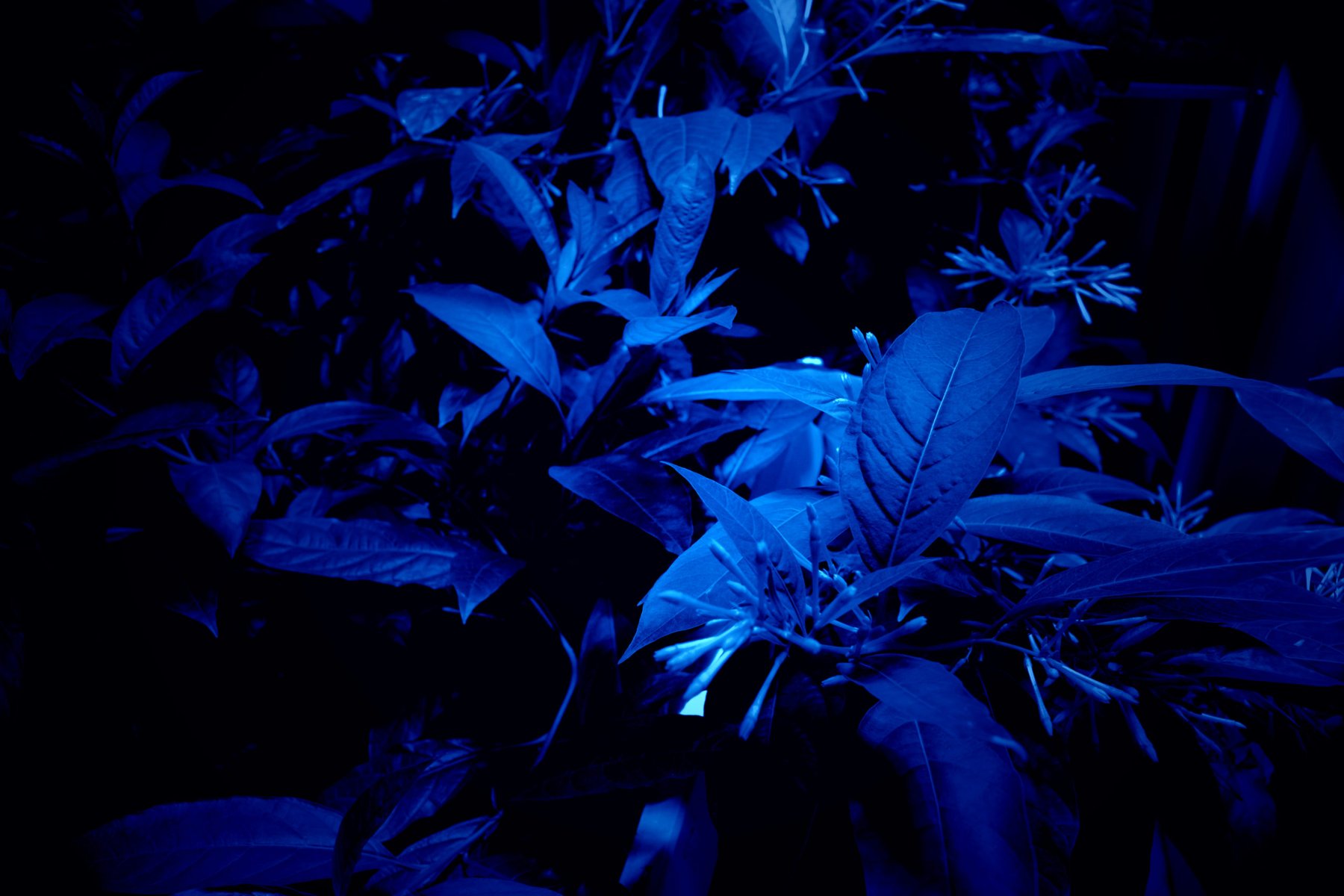
A night smell invited in by day.
Courtesy the artist and kamel mennour, Paris/London · Hicham Berrada (official artist site)
Seven vitrines, one flower
Mesk-ellil is a garden set in glass cases. According to the artist's site, the work consists of seven tinted glass terrariums, each measuring 250 × 200 × 50 cm. Together they fill a volume about five metres on each side. Inside grows a single species: Cestrum nocturnum, known in English as night blooming jasmine.
The plant has one defining trait: its flowers release scent only at night. By day the small greenish white clusters stand still, almost odourless. After dark the scent spreads, strong enough to fill a garden. Berrada's site describes it as jasmine with a touch of lime.
Hicham Berrada made Mesk-ellil between 2015 and 2019. It has been shown in several places. In 2019 it was part of the exhibition Luogo e Segni at Punta della Dogana in Venice. His gallery is Kamel Mennour.
Swapping day and night
A museum opens by day. Night blooming jasmine smells at night. The two schedules never meet. Berrada solves this with light.
Each vitrine is a closed environment with its own climate. Inside are two kinds of lamps: horticultural lights for the hours the plant treats as day, and moonlight lamps for the hours it treats as night. A timer controls the switch. The result is that the plant's night falls during the gallery's opening hours.
The plant is not forced to give off scent. It is only given another sky. It still waits for darkness and still responds to light like any of its kind outdoors. Only that darkness is made by people.
One detail deserves a pause. Smell does not stay inside the vitrine the way an image does. The glass keeps the climate for the plant, yet visitors are still invited to smell. The work therefore offers two ways of observing: the eye sees a night garden inside a frame, while the nose meets that garden as if it were right outside, in the open air, long after sunset. The eye knows this is a gallery. The nose is not so sure.
Visitors look into the vitrines and see a night scene, while the daylight of the gallery sits behind them. Two times of day stand side by side, a sheet of glass apart. On one side, the hour of people. On the other, the hour of the plant.
A garden set to another clock
Berrada often works with natural processes placed under controlled conditions: chemical reactions, growth, the transformation of matter. He builds the frame and lets the material perform. In Mesk-ellil the frame is light and time. The performance belongs to the plant.
The work points to something we rarely notice: plant scent follows the rhythm of day and night. Some species smell in the early morning, some in late afternoon, some only at midnight. Anyone who has walked at night past a hedge of this plant knows it by nose. Berrada brings that knowledge into a room and makes it something to observe.
Mesk-ellil has relatives among works that use grow lights as a tool, such as Martin Roth's lavender field, where lamps follow the pace of retweets. But Berrada is not speaking about the news. He is speaking about the clock inside a plant.
The work stays with us because it lets visitors smell time. Not the time on the wall, but the time of a flower, moved a few hours so that it can meet people.

Olfactory Art