
Essays · Olfactory Art
Martin Roth. I cultivated a piece of land in Midtown Manhattan nurtured by tweets.
Online noise becomes light. Light becomes smell.
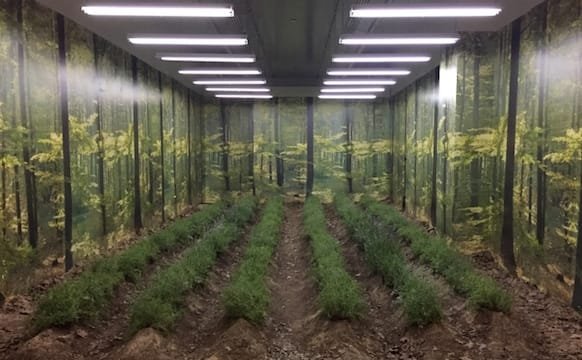
Installation view, photo for Hyperallergic · Hyperallergic
A field in a basement
The Austrian Cultural Forum New York sits at 11 East 52nd Street, in the middle of Midtown Manhattan. In the spring of 2017 its basement held a field: 200 lavender plants in six rows, under a rig of grow lights on the ceiling.
The work by the Austrian artist Martin Roth has a long title that reads like a diary entry: In May 2017 I cultivated a piece of land in Midtown Manhattan nurtured by tweets. Roth is known for literal titles like this. The name of the work is the description of the work.
The show ran until 21 June 2017. According to Hyperallergic, the lavender smelled so sweet and strong that it reached visitors from a distance, before they came near the rows.
Lights that follow retweets
The unusual part is the light. The lamps did not run on a timer. They were connected to a small Raspberry Pi computer tracking nearly two dozen Twitter accounts, among them @POTUS, @realDonaldTrump, press secretary Sean Spicer, White House counselor Kellyanne Conway, and major outlets such as CNN and Fox News.
When those accounts were retweeted heavily, the lights grew brighter. When the network was quiet, they dimmed, sometimes to darkness. The amount of light the plants received, which is to say their food, depended entirely on the rhythm of political argument online.
It is a very direct transformation. Words on a screen become electricity, electricity becomes light, light becomes leaves, leaves become smell. The people in the basement read no tweets. They only smell. But what they smell is the result of thousands of shares they never see.
Visitors therefore never meet the same field twice. On a day of some controversial statement, the room blazes. On a quiet day, the rows stand in the dark. The plants do not know who is saying what. They only know whether there is light. That indifference is part of the work: the plants respond to volume, not to content.
Lavender is not a random choice. It is a plant people grow for a soft, familiar smell tied to rest. Placing it under a light source driven by the loudest accounts in America at the time, Roth builds a contrast that visitors feel without explanation.
A temporary field
Hyperallergic records an idea that came with the work: the field is only temporary, and so is any calm it brings. How we move on is up to us.
That changes how the work reads. The field is not an escape from the news. It is a place where the news is translated into another language, slower and quieter. A tweet lives for a few hours. Lavender grows for weeks. Its smell stays in the room longer than any storm online.
Other works bring living plants into galleries, such as Precious Okoyomon's garden in a chapel in Rome. Few link plants to something as invisible as a data stream. Roth does not chart the data. He lets it grow.
The work stays with us because it shows that social media is not only on a screen. It consumes power, it takes up time, and in this basement it even has a smell.

Olfactory Art