
Essays · Olfactory Art
Precious Okoyomon. the sun eats her children.
The fragrant and the poisonous grow in one bed.
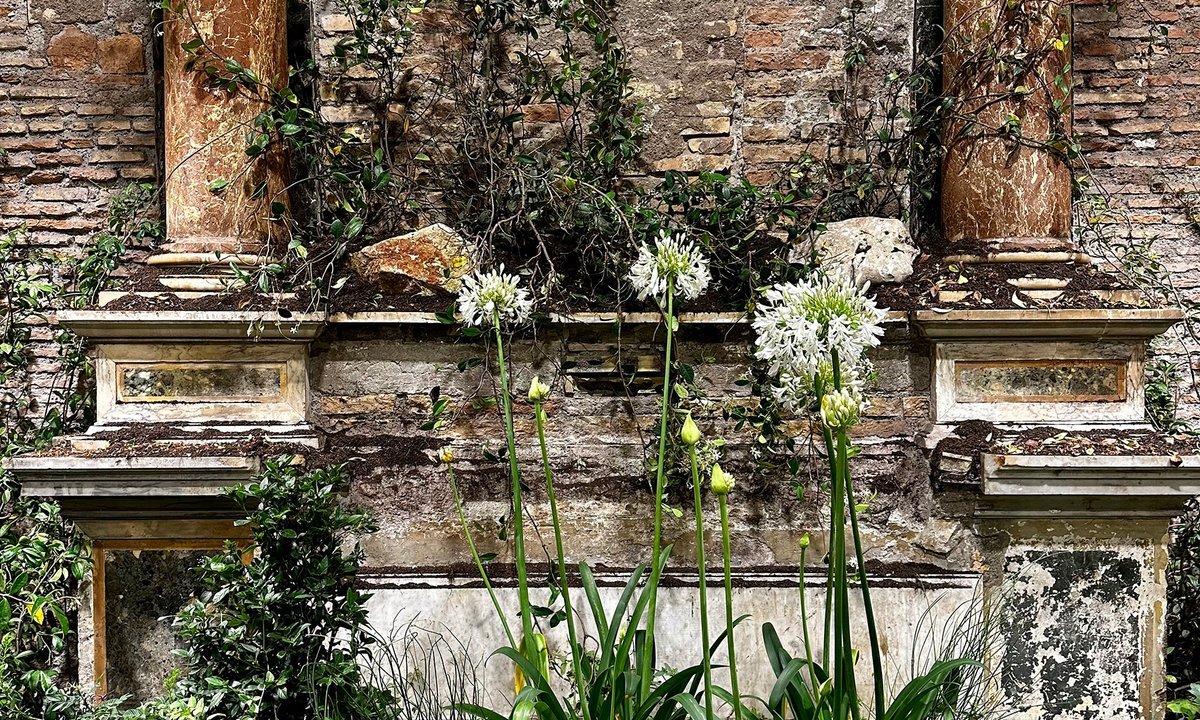
Installation view of Precious Okoyomon: the sun eats her children, Sant'Andrea de Scaphis, Rome. Courtesy of Sant'Andrea de Scaphis · The Art Newspaper
An abandoned chapel
Sant'Andrea de Scaphis is a small chapel in Rome dating from the ninth century, long deconsecrated. It stood abandoned for years before the dealer Gavin Brown took it over in 2015 and turned it into an exhibition space. Joan Jonas, Arthur Jafa and Jannis Kounellis have all shown there.
In the summer of 2023 Precious Okoyomon filled that stone room with a garden. The work is titled the sun eats her children, all in lower case, and it ran until 16 September 2023. A closed room full of flowering plants is a room where smell has no way out.
According to The Art Newspaper, the garden held jasmine, tall lilies, honeysuckle, white dogwood and red roses. There was also kudzu and sugar cane, two plants she had used in her installation at the 2022 Venice Biennale. Visitors walked gravel paths under LED light, among black butterflies with sky blue wings.
Sound belonged to the garden too. There was symphonic music by Kelsey Lu, and a recorded scream blending Okoyomon's own voice with those of the choreographer Okwui Okpokwasili and the scholar Saidiya Hartman.
The bear and the poisonous plants
In the middle of the garden lay an animatronic stuffed bear, about a metre tall and weighing 85 pounds. It wore white lace underwear and a white bandage tied in a bow, and it lay on its side as if fainting. It was named after a character in Beloved, Toni Morrison's 1987 novel about slavery and what it leaves in the body.
Okoyomon told The Art Newspaper that she wanted a lot of poisonous plants. Not out of spite. She was thinking of butterflies, which live on those very plants in order to raise the next generation. Poison here is not the enemy of life. It is part of the cycle.
Together, the bear, the poison, the scream and the smell of flowers make a scene that is hard to name. It is fertile and lush, but not at ease. The work touches Black bodies, power, migration, decay, family, and colonial wounds, in the language of plants rather than slogans.
A poet who plants
Okoyomon was born in London to Nigerian parents, lived in Lagos and then moved to the American Midwest. In Chicago she studied pataphysics and child psychology while working as a chef. In New York she volunteered at a community garden. She calls herself a poet first. Hans Ulrich Obrist found her through her poetry, at the Serpentine Gallery in 2017.
In 2023 she was 29, had shown at MMK Frankfurt, Performance Space New York and the Aspen Art Museum, and had been part of the central exhibition of the 2022 Venice Biennale. She had never joined a gallery roster. She says she has always played with soil and plants, without a plan, trusting that words would guide her.
the sun eats her children stays with us because it does not display a garden. It plants one, in a room once meant for prayer, and lets the smell of flowers do what prayer used to do: fill the space and reach the people standing in it, without asking permission. As in Hicham Berrada's night garden, plants are brought indoors so that visitors' noses can meet them. When the show closed, the garden remained only as a memory in those who had breathed it.
Olfactory Art