
Essays · Contemporary Art
Ilya Kabakov. Labyrinth (My Mother's Album).
The photographs tell of a happy life. The words tell otherwise.
Tate · Tate
A fifty metre corridor
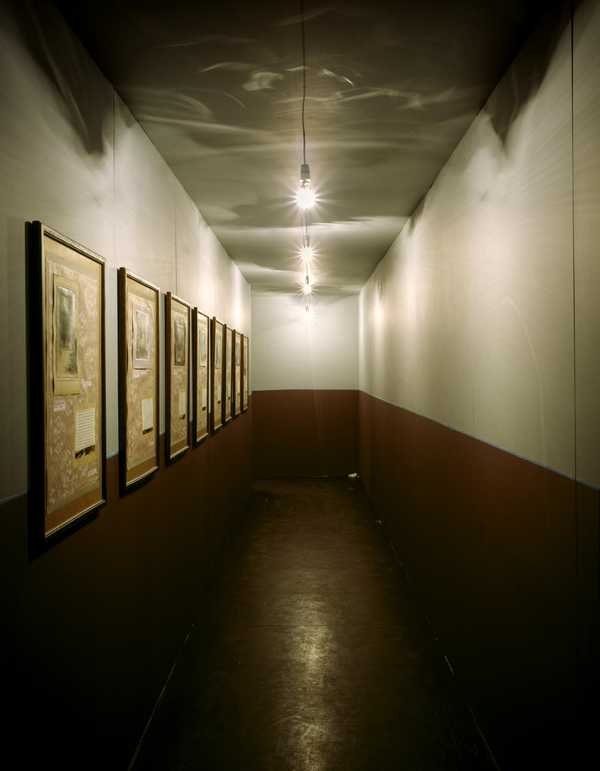
Ilya Kabakov made Labyrinth (My Mother's Album) in 1990. It is a narrow wooden corridor, some fifty metres long, bent into a spiral. The viewer steps in and keeps walking, turning, walking again. There is no shortcut.
Tate lists what makes up the work: a wooden construction, nine doors, wooden ceiling props, twenty four light bulbs, detritus, audio, and seventy six works on paper made of photographs, ink and printed papers. Read aloud, the list sounds like an inventory of an old flat.
Along the walls hang seventy six frames. Each sets three things side by side: photographs taken by the artist's uncle, fragments cut from Soviet postcards of the 1950s, and typed passages from his mother's memoirs.
It was one of three large total installations shown at Tate Modern in Not Everyone Will Be Taken Into the Future, from October 2017 to January 2018.
The uncle's photographs, the mother's words
The uncle, Juda, Yuri Grigorevich Blekher, was a provincial photographer in the coastal town of Berdiansk in south eastern Ukraine. He shot weddings and commissioned portraits and tidy, peaceful views of the town. His private passion was photographing plinths, monuments and park sculptures.
The mother, Bertha Urievna Solodukhina, wrote a memoir of a very different life. War, revolution, years of struggling to survive and protect her child. According to Emilia Kabakov, his wife and collaborator, Ilya saw his mother as standing for millions of Soviet women who struggled in the same way.
Set together, each frame becomes a crack. The picture says: the town is thriving, life is calm. The text says: poverty, homelessness, fear. Neither cancels the other. They stand together, and the viewer carries the weight of the gap between them.
Emilia Kabakov also writes that the work reflects Ilya's inability to protect his mother from poverty and homelessness. It is a son's tribute to his mother, and a tribute to all the women of her time.
Clean images and real life
In the Soviet Union, Kabakov grew up among retouched images. Photographs in newspapers and magazines were cleaned of undesirable details before printing. Pictures of happy lives and heroic workers were, as he saw them, fiction. He despised that falseness.
From the 1970s he had made illustrated albums telling stories of small people in society. Labyrinth takes that method off the page and into space. The viewer no longer turns pages. The viewer walks.
Walking is a very different way of reading. In a narrow corridor no one can step back for an overview. The eye stays close to the frame. The feet keep moving. A life is read at the pace it was lived: one stretch at a time, never knowing the next turn.
Kabakov first left the Soviet Union in 1987 to exhibit in Europe and the United States, and settled in New York in 1992. Labyrinth was made between those dates, from the outside looking back. Perhaps distance is what it takes to build so long a way home. Also about a mother, Ishiuchi Miyako photographed the things her mother left behind, another way of reading a life through its traces.
Contemporary Art