
Essays · Contemporary Art
Isaac Julien. Ten Thousand Waves.
The water comes and goes. Those who leave do not return.
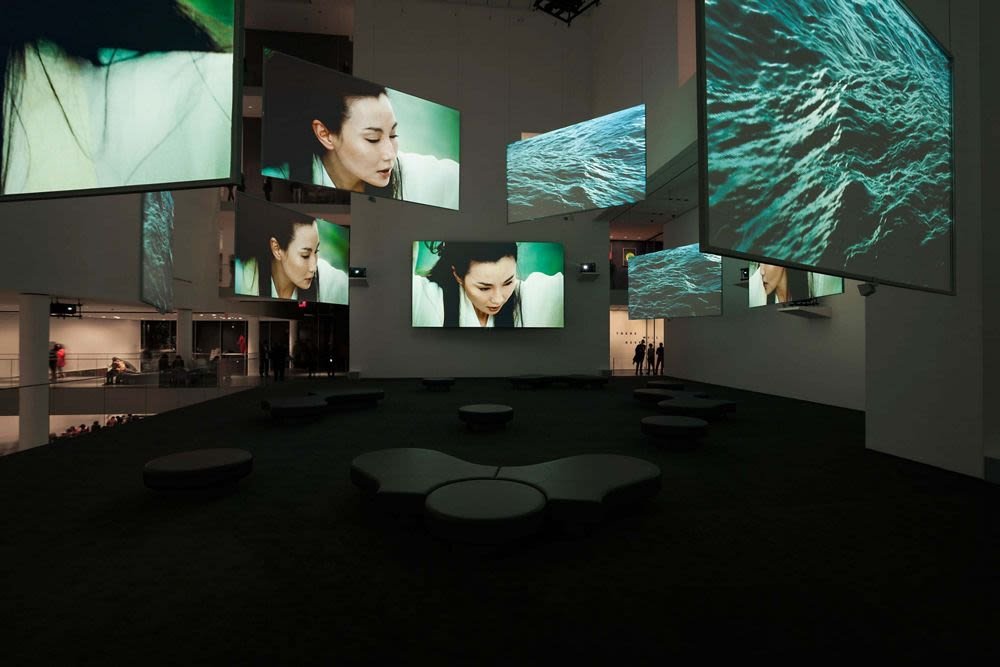
© Isaac Julien · M+ Museum
A night at Morecambe Bay
In February 2004, at Morecambe Bay in the north west of England, twenty three cockle pickers drowned as the tide came in. They were from Fujian Province in China. They worked without papers, on a stretch of sand locals knew to be dangerous, at an hour when the water rose faster than a person could run.
The news that day was brief. A number, a place name, a few lines about smuggling networks. Then other news arrived.
Isaac Julien, the British artist and filmmaker, did not let that number drift away. Six years later, in 2010, he completed Ten Thousand Waves: a nine screen film installation shot on 35mm and transferred to digital, running forty nine minutes and forty one seconds. It does not reconstruct the night as documentary. It sets that night beside other stories, older and further away.
The nine screen version is now in the M+ collection in Hong Kong. The work has travelled widely, including a showing at MoMA in New York across 2013 and 2014.
A goddess, an actress, a city
Ten Thousand Waves braids three layers of time. The first is Morecambe: the sand, the dark, the rising water. The second is the legend of Mazu, the sea goddess Fujianese fishermen trust to protect those at sea. Maggie Cheung plays Mazu, hovering above the water like someone who arrived too late.
The third is Shanghai cinema. Julien restages The Goddess, Wu Yonggang's silent film of 1934 about a mother who sells herself to raise her child. Zhao Tao plays that woman, walking through old streets, then stepping out into the modern city of glass towers.
The layers are not joined by plot. They are joined by recurring images: water, mist, lamplight, women walking alone. The nine screens hang scattered in a dark room, some facing each other, some suspended in open space. There is no single spot from which to see everything. The viewer has to choose, and every choice leaves something out.
Unfinished journeys
Julien is the child of migrants from Saint Lucia to Britain. M+ places the work beside that history, and beside the later waves of refugees arriving in Europe. But Ten Thousand Waves does not speak in the voice of commentary. It speaks through distance: between Fujian and an English shore, between a goddess and people no one protected, between a film from 1934 and a city today.
The title is a distance too. Ten thousand waves. Not one. Uncountable. Each carries a person, a journey, a reason to leave home.
What keeps the work in the viewer is its slowness. The camera rests on the water, on a face, on mountain mist. It is in no hurry to tell or explain. The dead of Morecambe are not given back their names, but they are given back time: time to be looked at, to be thought about for longer than a news item.
Leaving the room, the viewer carries no complete story. Only fragments: the sound of water, a white robe, a street at night. The way a survivor carries the memory of someone who is gone. Like Ai Weiwei's porcelain sunflower seeds, the work reminds us that behind a number there are hands, one person at a time.
Contemporary Art