
Essays · Olfactory Art
Janine Antoni. Lick and Lather.
Every act of care wears something away.
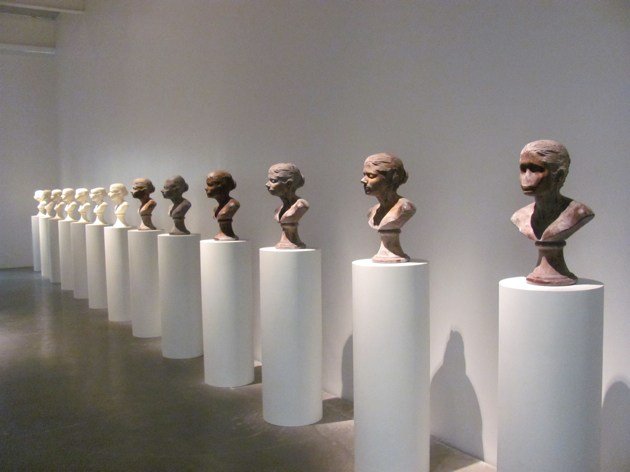
Courtesy New Museum, New York; courtesy the artist and Luhring Augustine, New York · ARTnews
Fourteen faces, two materials
In 1993 Janine Antoni, an artist born in the Bahamas and working in New York, made a set of busts of herself. She took a mould directly from her head and shoulders using alginate, the material dentists use to take impressions. It holds every fold of skin, every pore.
From that mould she cast fourteen busts. Seven in chocolate. Seven in soap. Each about 60 cm tall, set on a plinth, the way classical busts are shown in museums.
Then she began to carve them again. Not with a knife or a chisel. The chocolate ones she licked. The soap ones she took into the bath and washed with. The faces wore away: the bridge of the nose softened, the lips blurred, the hair faded. Some wore at the chin, some at the brow. One soap bust lost almost the whole crown of its head.
At a glance the fourteen faces are alike. Up close, no two are the same. Each holds the mark of a different stretch of intimate time.
The bust, a tradition of power
The bust is an old form. From ancient Rome to nineteenth century town halls, it was kept for emperors, statesmen, benefactors. Men with power. Women in classical sculpture, meanwhile, usually stood for an abstraction: Hope, Charity, Justice. Not a particular person.
Antoni knew this well. She put her own face into the very form reserved for power, but in materials that cannot last. Bronze and marble are for posterity. Chocolate and soap are for dissolving.
What results is an open question about how a woman looks at her own image. Licking is a gesture of desire. Bathing is a gesture of cleansing. Antoni has described both as gentle, loving acts, yet they slowly erase the face. Self-love and self-erasure happen in the same motion.
Two materials that speak to the nose
Lick and Lather is usually written about as a work on the body and gender. It is also a work about smell, without a single diffuser.
Chocolate and soap have clear, familiar smells. Cocoa belongs to sweets, childhood, gifts. Soap belongs to the bath, clean towels, skin just dried. No explanation needed. Before the two busts side by side, the eye sees two colours and the nose finds two everyday worlds.
Smell makes it hard to keep one's distance. A bronze can stand across the room. A chocolate bust calls up a tongue. A soap bust calls up water. Smell pulls the viewer toward the act that made the shape, toward the artist's body in the bath or bent over the chocolate.
The material remembers. Chocolate keeps the trace of the tongue. Soap keeps the trace of water. Their smell is proof that a real body left those traces.
A work of 1993
Lick and Lather was first shown in the Aperto section of the 1993 Venice Biennale, the part given to younger artists. The year before, Antoni had drawn attention with Gnaw, two large cubes of chocolate and lard that she gnawed away with her teeth.
Twenty years later, in 2013, the New Museum in New York brought it back in NYC 1993: Experimental Jet Set, Trash and No Star, a look at the art of a single year in that city. Versions of Lick and Lather are now held in collections including SFMOMA and the National Gallery of Art in Washington.
In the museum, no one licks the chocolate any more, and no one bathes with the soap. Two materials made to be used up are now carefully preserved. The work stops halfway through its wearing away. And in that state, it still smells.
For another thread of chocolate in art, see the essay on Ed Ruscha's Chocolate Room, where chocolate was silkscreened onto paper to cover a whole room.
Olfactory Art