
Essays · Olfactory Art
Larry Bamburg. TalctoTile.
A stone, and its copy in soap.
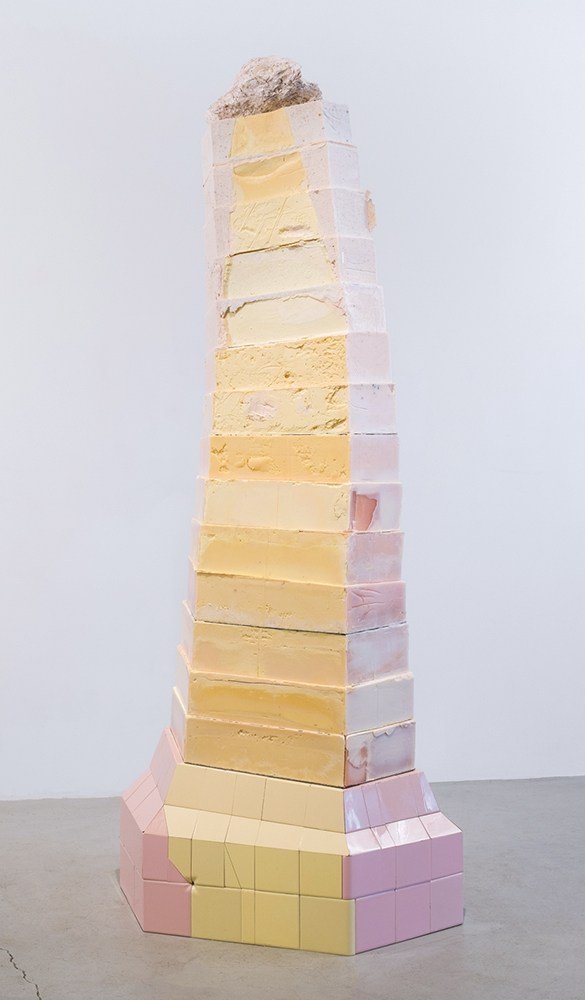
Larry Bamburg, TalctoTileTower, from a unstable foundation, 2016 · Art in America
The stone that started it
Talc is a stone found in many household things: baby powder, cosmetics, paper, paint. Yet almost no one sees it whole. We know talc only once it has been ground into a fine white powder with no shape.
Larry Bamburg, an American sculptor, began the TalctoTile series with large, unbroken pieces of talc. The surface is soft and faintly glossy, the colour pale as milky tea. A stone a fingernail can scratch.
That surface and colour sent Bamburg looking for an equivalent. Not an exact copy, but something that carries the feeling of the stone while remaining distinct from it.
After a series of decisions, he settled on soap.
Cold process tallow soap
Bamburg made his own soap by the cold process method and poured it into large slabs. The fat was beef tallow, used for soap for centuries. He added colourants to the soap.
The slabs were stacked, alternating with ceramic tiles of the kind used in bathrooms. On top sat blocks of raw talc. One work in the series, TalctoTileTower, from a unstable foundation, 2016, lists its materials as talc, ceramic tile, cold processed beef tallow soap, colourants, plywood, construction adhesive, hardware, and bees.
From a distance the towers read like rock strata, layer on layer. Up close, real stone, real tile and real soap sit together, and it is hard to say which layer is which.
Then the smell. According to the Art in America review, a sweet minty smell met visitors at the door. Talc does not smell like that. Nor does tile. It could only come from the soap.
Original and copy
The exhibition, TalctoTile, PL'd to MDO, ran at Simone Subal Gallery in New York from 14 February to 20 March 2016, Bamburg's second solo show there. The gallery described the body of work as playing with the never resolved relationship between an original and its copy.
In TalctoTile, the original is the stone and the copy is soap. But the copy is not in another room or shown as a model. It sits beside the original, on top of it, holding it up.
One is made by geology over millions of years. The other is made by one person in a few weeks. Both end up in the same place: the bathroom. Talc becomes powder. Soap becomes lather. Tile becomes wall.
Bamburg does not say which matters more. He stacks them and lets gravity do the rest. One title says it already: from a unstable foundation.
A thing with a life
Soap is not a durable material. It absorbs moisture, shrinks, shifts colour, loses scent. A soap tower left in a gallery for weeks will not match its opening day. Here the copy is more alive than the original. Talc stays still. Soap ages.
There is another reading, close to Janine Antoni's Lick and Lather, where soap is cast as a face and worn away by water. Bamburg brings no body into the work. Yet everyone who enters carries their own memory of a bathroom: soap on the hands, powder on a baby's skin, cold tiles underfoot.
TalctoTile lasts because it lets an ordinary smell do the work of sculpture. No need to describe a bathroom. Stack the right materials, and the smell builds the room.

Olfactory Art